NPS Charges and Fees in 2026
Published: 13 Oct 2026
NPS is known as a low-cost retirement investment option, but it is not completely free. Subscribers may pay account opening, contribution processing, CRA, fund management, payment gateway, and other service charges. NPS Charges and Fees can differ based on the account type, CRA, Point of Presence, and payment method. An nps calculator can also help you estimate how charges may affect your contribution and future retirement value.
1. What Are NPS Charges and Fees?
NPS Charges and Fees are the costs paid for opening, maintaining, managing, and processing an NPS account. These charges support services such as account registration, contribution processing, recordkeeping, fund management, asset custody, and online payments. Some fees are deducted directly from the contribution, while others are adjusted through account units or scheme assets.
1. Account Opening Charges
A one-time charge may apply when a subscriber opens a new NPS account. The amount can depend on the account model, Point of Presence, and current charge structure. Online and offline account opening methods may also have different costs.
2. Contribution Processing Charges
A fee may be charged whenever money is added to the NPS account. This cost may be collected by the Point of Presence, CRA, payment gateway, or another service provider. The remaining amount is then invested in the selected NPS schemes.
3. Account Maintenance Charges
The Central Recordkeeping Agency maintains the subscriber’s PRAN, personal details, transactions, and account statements. An account maintenance or recordkeeping charge may apply for these services. The method and frequency of deduction can differ by CRA and subscriber model.
4. Fund Management Charges
Pension fund managers charge a small fee for investing and managing the subscriber’s money. This fee is generally adjusted through the scheme’s assets rather than collected separately. It reduces the net return earned by the account.
5. Transaction and Service Charges
Charges may apply for certain financial and non-financial services. Examples include contributions, withdrawals, physical requests, account corrections, and changes in personal details. Some online self-service requests may cost less than assisted services.
6. Payment Gateway Charges
Online contributions made through net banking, debit cards, credit cards, or other payment methods may include gateway fees. GST may also be added to these charges. The subscriber should check the final payment amount before confirming the transaction.
7. Other Asset-Based Charges
Small charges may also apply for services provided by NPS Trust, the custodian, and other intermediaries. These costs are usually adjusted through the assets under management. Subscribers may not see them as separate deductions in every transaction.
Overall, NPS Charges and Fees include both direct account-level costs and indirect investment-related expenses. Understanding how each charge works can help subscribers choose a cost-effective contribution method and know how much money is actually invested.
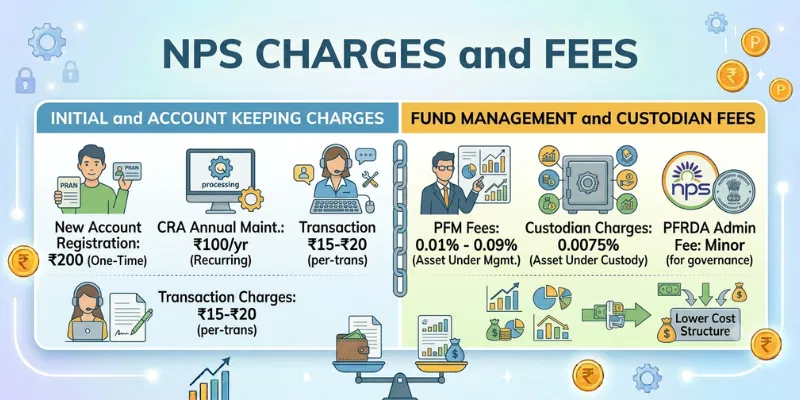
2. NPS Intermediaries That Collect Charges
Different organizations help operate and manage an NPS account. Each intermediary performs a specific task, such as account registration, recordkeeping, investment management, or fund transfer. Some NPS Charges and Fees are collected directly, while others are adjusted through the subscriber’s account or scheme assets.
1. Point of Presence
A Point of Presence, or PoP, helps subscribers open an NPS account and make contributions. It may also process service requests, KYC updates, withdrawals, and account corrections. PoP charges can depend on the service used, contribution method, and subscriber category.
2. Central Recordkeeping Agency
The Central Recordkeeping Agency, or CRA, maintains the subscriber’s PRAN, personal details, transactions, and account statements. It also supports online access, contribution records, and withdrawal processing. CRA charges may include registration, account maintenance, and transaction-related fees.
3. Pension Fund Manager
A Pension Fund Manager invests the subscriber’s money in equity, corporate bonds, government securities, and other permitted assets. It charges an investment management fee for handling the portfolio. This cost is generally adjusted through the scheme’s assets and affects the net return.
4. NPS Trust
NPS Trust monitors pension assets and works to protect subscribers’ interests. It supervises different intermediaries and checks whether they follow the applicable NPS rules. A small trust-related expense may be recovered through assets under management.
5. Custodian
The custodian safely holds the shares, bonds, and other securities purchased by pension funds. It also supports transaction settlement and maintains records of the invested assets. Custodian charges are normally adjusted through the scheme’s assets rather than collected directly from every subscriber.
Overall, several intermediaries work together to manage an NPS account. Understanding their roles makes it easier to identify where different NPS Charges and Fees come from and how they affect the amount finally invested.
3. Types of NPS Charges
Different NPS Charges and Fees apply at different stages of an account. Some are paid while opening or funding the account, while others are adjusted through the invested assets. Understanding these charge types helps subscribers know where their money goes.
1. Account Opening Charge
This is a one-time fee charged when a new NPS account is created. It covers registration, kyc verification, and PRAN generation. The amount may differ based on the account model and service provider.
2. Contribution Processing Charge
A contribution processing fee may apply whenever money is added to the NPS account. It can be collected by the Point of Presence or another authorized intermediary. The remaining contribution is invested after applicable deductions.
3. CRA Charges
The Central Recordkeeping Agency may charge for account registration, maintenance, and transaction processing. These charges support PRAN records, online account access, statements, and service requests. The fee structure may differ between CRAs and subscriber categories.
4. Pension Fund Management Charge
The Pension Fund Manager charges a small fee for managing the subscriber’s investments. It covers the selection, monitoring, and rebalancing of assets. This charge is normally adjusted through the scheme’s assets and reduces the net return.
5. NPS Trust Charge
NPS Trust may recover a small expense for supervising the pension system and protecting subscriber interests. This charge is usually deducted through assets under management. Subscribers may not see it as a separate transaction in their accounts.
6. Custodian Charge
The custodian charges for holding and servicing the shares, bonds, and other securities owned by NPS schemes. It also supports settlement and asset recordkeeping. This cost is generally adjusted through the invested assets.
7. Payment Gateway Charge
Online contributions may include payment gateway charges. The amount can depend on whether the subscriber uses net banking, a debit card, a credit card, or another payment method. Applicable GST may also be added.
8. Service Request Charge
Charges may apply to certain account services, such as correcting personal information, updating bank details, changing a nominee, or submitting physical forms. Online self-service requests may cost less or may not carry the same assisted-service fee. The exact charge depends on the request and service provider.
9. Withdrawal and Exit Processing Charge
Certain fees may apply when processing a partial withdrawal, normal exit, premature exit, or account closure. These should not be confused with withdrawal restrictions or annuity requirements. The applicable cost depends on the account type and processing method.
Overall, NPS Charges and Fees include both direct charges and small costs adjusted through scheme assets. Subscribers should check the latest CRA, PoP, and payment charge tables before opening an account or making a contribution.
4. NPS Account Opening or Onboarding Charges
NPS account opening or onboarding charges are the fees linked with registering a new subscriber through a Point of Presence. Under the charge structure effective from January 1, 2026, the applicable onboarding cost can depend on the option selected by the PoP. GST and other applicable taxes are charged separately.
1. First-Year AUM-Based Charge
During the first year, a PoP may charge 0.2% per year of the account’s assets under management, subject to a minimum of ₹30. For eligible CPSE employees, the rate is 0.1% per year with a minimum of ₹15. This charge is calculated and recovered on a quarterly basis.
2. ₹200 Onboarding Option
Instead of the AUM-based first-year charge, a PoP may choose to charge ₹200 for each new account. This amount is collected in the month after the subscriber joins NPS. When this option is used, no AUM-based PoP charge applies during the first onboarding year.
3. How the Charge Is Deducted
The onboarding charge is generally recovered through the cancellation of a small number of units from the subscriber’s NPS account. This means the subscriber may not always pay it separately in cash. The deduction reduces the account value by the applicable charge and tax amount.
4. Minimum Contribution Requirement
There is generally no compulsory minimum contribution at onboarding under the revised Common Scheme structure. However, when a PoP chooses the ₹200 onboarding option, the subscriber must contribute at least ₹250 while opening the account. This requirement applies to relevant All Citizen and Corporate Model accounts.
5. Point of Presence Charges
A Point of Presence, or PoP, helps subscribers open an NPS account, complete KYC, make contributions, and submit service requests. Under the charge structure effective from January 1, 2026, PoP charges for the All Citizen model are mainly collected through onboarding and annual account charges. The applicable amount may differ for digitally onboarded subscribers, dormant accounts, and certain employee categories.
1. One-Time Onboarding Charge
A standard one-time onboarding charge of ₹200 per new account applies when a subscriber joins through a PoP. This amount is recovered as ₹50 per quarter through the cancellation of NPS units. A reduced charge of ₹100 may apply when onboarding is completed through a fully digital and non-face-to-face process, subject to the applicable approval.
2. Annual PoP Charge
After onboarding, the PoP can receive an annual charge equal to 0.20% of the account’s assets under management. The charge is adjusted through the scheme’s NAV and paid to the PoP every quarter. It applies to existing and new active accounts linked to a PoP.
3. How the Annual Charge Is Deducted
Subscribers do not normally pay the annual charge separately in cash. The charge is adjusted through the NAV, which means it is reflected in the account value. Quarterly recovery spreads the yearly cost across the account instead of deducting the full amount at once.
4. No Charge on Dormant Accounts
A dormant NPS account is not charged the annual PoP fee. Under the current definition, an account becomes dormant when no contribution is made for four consecutive quarters after an earlier contribution. Once contributions restart, the applicable charge treatment may resume.
5. PoP Charges for eNPS Subscribers
Subscribers who open their accounts directly through eNPS and continue contributing through eNPS or D-Remit are not liable for PoP charges because their accounts are not linked to a PoP. However, a person originally onboarded through a PoP can remain liable for PoP charges even when later contributions are made through eNPS or D-Remit.
6. Minimum Contribution
For All Citizen, NPS Vatsalya, and NPS Lite subscribers, the minimum contribution is ₹250 at onboarding and ₹10 for later contributions under the current PoP structure. These contribution limits are separate from the PoP charges themselves. Subscribers should make sure their contribution is enough to cover the applicable deductions.
7. Charges for Employees of Legal Entities
Employees or members under private companies and other legal entities outside Government ownership may face an annual PoP charge of 0.20% of AUM. It is adjusted through nav and paid quarterly for active accounts. The employer may decide whether it or the employee bears certain NPS account costs.
Overall, Point of Presence fees form an important part of NPS Charges and Fees for subscribers who open and maintain their accounts through a PoP. Opening and contributing directly through eNPS may avoid these PoP charges, but subscribers should also compare digital service, support, and convenience before selecting a channel.
6. NPS Tier 1 Charges
NPS Tier 1 is the main retirement account under the National Pension System. It may include account maintenance, contribution processing, fund management, PoP, payment gateway, and other administrative charges. The exact NPS Charges and Fees depend on the subscriber model, CRA, PoP association, contribution method, and services used.
1. Account Opening Charge
A subscriber may pay an onboarding charge when opening a Tier 1 account through a Point of Presence. The applicable charge depends on the current PoP framework and the onboarding method. Subscribers who open and manage an account directly through eNPS may follow a different cost structure.
2. CRA Account Maintenance Charge
The Central Recordkeeping Agency maintains the PRAN, contribution records, transaction history, statements, and online account services. Under the CRA charge structure clarified in April 2026, the annual maintenance charge can be up to ₹1,000, depending on the applicable CRA slab and account value. It is generally recovered through the cancellation of units from the subscriber’s account.
3. Contribution Processing Charge
A transaction-related charge may apply when a subscriber contributes to the Tier 1 account. The fee can depend on whether the contribution is made through a PoP, eNPS, employer, or another authorized channel. Some charges are deducted before the remaining contribution is used to purchase NPS units.
4. Point of Presence Charge
Tier 1 subscribers linked to a PoP may pay onboarding, annual account-service, or transaction-related charges under the applicable framework. Direct eNPS subscribers who are not linked with a PoP may avoid PoP-related charges. However, an account originally opened through a PoP may continue to carry applicable PoP costs.
5. Pension Fund Management Charge
The Pension Fund Manager charges a small fee for investing Tier 1 money in equity, corporate bonds, government securities, and other permitted assets. The maximum fee follows an aum-based slab and currently ranges from 0.09% to 0.03%. This fee is adjusted through the scheme’s assets and is reflected in the net return rather than charged separately in cash.
Overall, nps tier 1 Charges include both visible transaction costs and small expenses adjusted through the invested assets. Subscribers should check their CRA charge table, PoP agreement, payment screen, and transaction statement to understand the actual cost of maintaining their account.
7. NPS Tier 2 Charges
nps tier 2 is a voluntary investment account that allows easier contributions and withdrawals than Tier 1. It does not usually have a separate annual maintenance charge of its own, but CRA, PoP, fund management, payment gateway, and transaction-related NPS Charges and Fees may still apply. The actual cost depends on the subscriber’s CRA, PoP association, payment method, and services used.
1. Tier 2 Account Activation Charge
A subscriber generally needs an active Tier 1 account before opening Tier 2. A service or transaction charge may apply when Tier 2 is activated through a PoP or assisted channel. Subscribers should check the latest CRA and PoP fee schedule before submitting the request.
2. No Separate Annual Maintenance Charge
Tier 2 generally does not carry a separate annual maintenance charge in addition to the account-level CRA costs. The CRA may still recover applicable recordkeeping charges linked with maintaining the subscriber’s overall PRAN account. Therefore, “no separate Tier 2 AMC” does not mean that every Tier 2 service is completely free.
3. Contribution Processing Charge
Charges may apply whenever money is contributed to the Tier 2 account. The cost can depend on whether the payment is made through a PoP, CRA portal, eNPS, or another authorized channel. The payment system normally displays the applicable amount before the transaction is confirmed.
4. Payment Gateway Charges
Online Tier 2 contributions can attract payment gateway charges. KFintech currently displays ₹0.60 plus GST for net banking, 0.80% plus GST for debit-card payments, and 0.90% plus GST for credit-card payments. These rates may differ across CRAs and payment platforms, so subscribers should check the payment screen before contributing.
5. Point of Presence Charges
Subscribers whose accounts are linked to a PoP may face applicable service or transaction charges. These costs may arise for contributions, assisted requests, account changes, or other PoP-supported services. Direct digital subscribers may follow a different charge structure based on their account setup and current rules.
Overall, NPS Tier 2 Charges are usually limited, but the account is not completely free. Subscribers should review CRA charges, PoP fees, payment gateway costs, and fund-level expenses before making frequent transactions.
8. How to Check NPS Charges
Subscribers should regularly check NPS Charges and Fees to understand how much they are paying for account maintenance, contributions, fund management, and other services. The exact cost can depend on the CRA, Point of Presence, account type, and payment method. Reviewing official records also helps avoid relying on old or incorrect charge tables.
1. Check the CRA Website
Visit the official website of the Central Recordkeeping Agency linked to your PRAN. Open the section for NPS charges, service fees, or subscriber information. Check the effective date because the charge structure may change over time.
2. Review Your NPS Transaction Statement
Download the latest transaction statement from your NPS account. Compare the contribution amount paid with the amount actually invested. The statement may also show unit deductions or account-related charges.
3. Check the Point of Presence Fee Schedule
Subscribers linked to a Point of Presence should review its latest charge schedule. Check onboarding fees, annual charges, contribution costs, and service-request fees. Also confirm whether GST is included or charged separately.
4. Review Charges Before Making a Contribution
The payment page usually displays transaction and gateway charges before confirmation. Check the cost for net banking, debit cards, credit cards, UPI, or other available methods. Choose a lower-cost payment option when it meets your needs.
5. Check Your Account Dashboard
Log in to your NPS account and review account details, contribution history, and service requests. Some charges may appear as direct deductions, while others may be recovered through unit cancellation. Compare recent transactions to identify any unusual deduction.
6. Read the Latest Official Circulars
PFRDA and CRAs publish circulars when NPS charges or service rules change. Check the latest circular instead of depending only on old articles or screenshots. Pay attention to the effective date and subscriber category mentioned in the document.
7. Contact Customer Support
Contact the CRA, PoP, employer, or nodal office when a charge is unclear. Share the transaction reference, PRAN details, and date of deduction when raising a query. Avoid sharing passwords, OTPs, or other sensitive login information.
8. Check Fund-Level Costs
Some expenses, such as pension fund management, NPS Trust, and custodian charges, may not appear as separate cash deductions. These costs are generally adjusted through the scheme’s assets or NAV. Review the official fund and charge disclosures to understand them.
Overall, the best way to check NPS Charges and Fees is to compare the latest official charge table with your account statement and payment records. This helps you understand direct deductions, indirect costs, and the amount finally invested for retirement.
9. Common Mistakes With NPS Charges and Fees
Many subscribers focus only on NPS returns and ignore the small costs linked with account maintenance, contributions, and services. These mistakes can reduce the amount invested and create confusion when reviewing the account statement.
1. Assuming NPS Has No Charges
NPS is considered a low-cost retirement option, but it is not completely free. Subscribers may pay CRA, PoP, payment gateway, fund management, and other service charges. Always check the complete fee structure before opening or funding the account.
2. Using an Outdated Charge Table
NPS charges can change when PFRDA or service providers revise the rules. Old blog posts and screenshots may show charges that no longer apply. Check the latest official circular and its effective date before using any figure.
3. Looking Only at Fund Management Fees
The pension fund management fee is only one part of the total cost. Subscribers may also pay account maintenance, PoP, transaction, payment gateway, NPS Trust, and custodian charges. Compare the full cost instead of focusing on one small percentage.
4. Ignoring GST
Many service charges are shown before GST is added. This means the final deduction can be slightly higher than the basic amount displayed in the fee table. Always check whether the quoted charge includes or excludes GST.
5. Choosing an Expensive Payment Method
Debit-card and credit-card contributions may cost more than net banking or other low-cost methods. Frequent card payments can increase the total yearly cost. Review the payment charges before confirming each contribution.
6. Making Too Many Small Contributions
Every contribution may involve transaction or payment charges. Making many very small payments can increase the total cost compared with fewer planned contributions. Subscribers should choose a contribution schedule that matches their income and keeps unnecessary fees low.
Avoiding these mistakes can help subscribers understand NPS Charges and Fees more clearly. It also helps them choose better payment methods and keep more money invested for retirement.
No, NPS is a low-cost retirement option, but some charges still apply. These may include CRA, PoP, fund management, payment gateway, and account-related fees. The actual cost depends on your account type and contribution method.
Some charges are deducted directly from your contribution or collected during payment. Other costs may be recovered through unit cancellation or adjusted through the scheme’s assets. This is why every charge may not appear as a separate cash deduction.
Tier 1 and Tier 2 may share some CRA, fund management, and payment-related charges. However, their account use, withdrawal frequency, and service requirements are different. Therefore, the total cost can vary between the two accounts.
Yes, you can compare payment methods and choose a lower-cost contribution channel. Avoiding frequent small card payments may also reduce unnecessary transaction costs. Always review the payment screen before confirming a contribution.
You can check the official website of your CRA, PoP, or PFRDA. You should also review your NPS transaction statement and payment records. Always check the effective date because old charge tables may no longer apply.
Conclusion
So guys, in this article, we’ve covered NPS Charges and Fees in detail. We discussed account opening costs, PoP charges, Tier 1 and Tier 2 fees, payment charges, and the correct way to check deductions. In my opinion, subscribers should always review the latest official fee table before opening an account or making a contribution. Using a low-cost payment method can also help keep more money invested for retirement. You can also calculate your nps to compare contributions, expected returns, and the possible retirement amount after charges. Check your latest NPS statement today and identify every charge deducted from your account.
The information and calculators on Finance Calculatorz are provided for educational purposes only. Calculator results are estimates and may not always be fully accurate. This content is not financial, investment, tax, or legal advice. Please consult a qualified professional before making any financial decision.


- Be Respectful
- Stay Relevant
- Stay Positive
- True Feedback
- Encourage Discussion
- Avoid Spamming
- No Fake News
- Don't Copy-Paste
- No Personal Attacks
- Be Respectful
- Stay Relevant
- Stay Positive
- True Feedback
- Encourage Discussion
- Avoid Spamming
- No Fake News
- Don't Copy-Paste
- No Personal Attacks
