Comparison between NPS vs Mutual Funds
Published: 5 Oct 2026
NPS and mutual funds are both market-linked investment options, but they serve different financial needs. NPS mainly focuses on retirement planning, while mutual funds can support retirement, education, home buying, and other goals. The NPS vs Mutual Funds comparison becomes important when investors look at returns, risk, tax benefits, liquidity, and withdrawal rules. Understanding these differences can help you choose an option that matches your long-term plan.
1. What Is NPS?
The National Pension System, or NPS, is a retirement investment scheme designed to help people build savings for their old age. It allows subscribers to invest regularly in market-linked assets such as equity, corporate bonds, and government securities. In the NPS vs Mutual Funds comparison, NPS mainly focuses on retirement, while mutual funds can support many different financial goals.
1. Retirement-Focused Investment
NPS is mainly created for long-term retirement planning. Subscribers contribute money during their working years and build a retirement corpus over time. The account follows specific withdrawal and exit rules to encourage disciplined saving.
2. Market-Linked Returns
NPS does not provide fixed or guaranteed returns. Its performance depends on market conditions, asset allocation, and the selected pension fund manager. Higher equity exposure may offer better growth potential, but it also brings more market risk.
3. Different Asset Classes
NPS invests money across different asset classes. These mainly include equity, corporate bonds, government securities, and other permitted investments. Subscribers can choose their allocation or allow the system to manage it automatically.
4. Active Choice and Auto Choice
Under Active Choice, subscribers select how much money goes into each available asset class within the allowed limits. Under Auto Choice, the asset allocation changes automatically according to the subscriber’s age. This option may suit beginners who do not want to manage their portfolio regularly.
5. Tier 1 and Tier 2 Accounts
Tier 1 is the main retirement account and comes with stricter withdrawal rules. Tier 2 is a voluntary investment account that generally offers easier access to money. However, the features and tax treatment of both accounts are different.
6. Regulated Retirement System
NPS is regulated by the Pension Fund Regulatory and Development Authority. Approved pension fund managers handle the invested money according to prescribed rules. This structure provides professional management and regular account tracking.
Overall, NPS is suitable for people who want a structured and disciplined retirement plan. However, investors should understand its withdrawal limits, market risks, and retirement-income rules before choosing it over mutual funds.
2. What Are Mutual Funds?
Mutual funds are investment schemes that collect money from many investors and invest it in different assets. These assets may include company shares, bonds, government securities, gold, and money-market instruments. In the NPS vs Mutual Funds comparison, mutual funds offer greater flexibility because investors can use them for retirement and many other financial goals.
1. Pooled Investment
A mutual fund combines money from a large number of investors. Each investor receives units based on the amount invested. The value of these units changes according to the fund’s performance.
2. Professional Fund Management
A qualified fund manager handles the investment portfolio. The manager selects and monitors assets according to the scheme’s objective. This helps beginners invest without choosing every share or bond themselves.
3. Different Types of Mutual Funds
Mutual funds are available in many categories. Common options include equity funds, debt funds, hybrid funds, index funds, liquid funds, and gold funds. Each category has a different level of risk, return potential, and investment period.
4. Market-Linked Returns
Mutual fund returns are not fixed or guaranteed. Their performance depends on market conditions, portfolio quality, expenses, and the selected fund category. equity funds may offer higher growth potential, while debt funds usually focus more on stability.
5. SIP and Lump-Sum Investment
Investors can put money into mutual funds through a systematic investment plan or a lump-sum investment. A SIP allows regular investment of a fixed amount, while a lump sum invests a larger amount at one time. Investors can select the method that matches their income and financial plan.
6. Flexible Withdrawals
Most open-ended mutual funds allow investors to redeem their units when needed. However, exit load, tax, settlement time, or scheme-specific restrictions may apply. This generally makes mutual funds more liquid than an NPS Tier 1 account.
7. Suitable for Different Goals
Mutual funds can support short-, medium-, and long-term financial goals. Investors may use them for education, a home purchase, retirement, travel, or wealth creation. The selected fund should match the goal, risk capacity, and investment period.
Overall, mutual funds provide professional management, wide investment choices, and easier access to money. However, investors should understand market risk, expenses, taxes, and fund suitability before investing.
3. NPS vs Mutual Funds Comparison
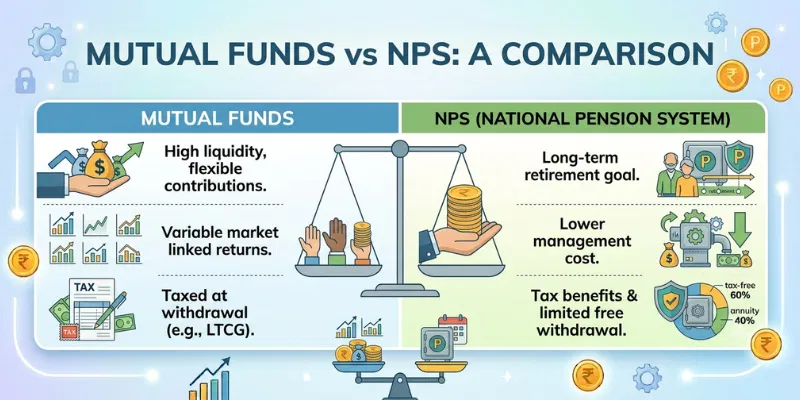
NPS and mutual funds are both market-linked investment options, but they are designed for different needs. NPS mainly helps investors build a retirement corpus, while mutual funds can support retirement and many other financial goals. The following NPS vs Mutual Funds comparison explains their main differences in simple words.
| Comparison Point | NPS | Mutual Funds |
|---|---|---|
| Main purpose | Mainly retirement planning | Retirement and other financial goals |
| Regulator | PFRDA | SEBI |
| Returns | Market-linked | Market-linked |
| Risk level | Depends on asset allocation | Depends on the selected fund category |
| Investment choices | Limited approved asset classes | Wide range of schemes and categories |
| Equity exposure | Subject to NPS rules and chosen option | Can range from very low to almost fully equity-based |
| Liquidity | Lower in the main retirement account | Generally higher in open-ended funds |
1. Investment Purpose
NPS is mainly designed to provide financial support after retirement. Its structure encourages investors to keep their money invested for the long term. Mutual funds can be used for retirement, education, buying a home, travel, wealth creation, and other goals.
2. Returns
Returns from both options depend on market performance and are not guaranteed. NPS returns depend on its mix of equity, corporate bonds, government securities, and other permitted assets. Mutual fund returns depend on the selected scheme, such as an equity, debt, hybrid, or index fund.
3. Risk
Neither NPS nor mutual funds are completely risk-free. An equity-heavy NPS portfolio may face noticeable market fluctuations, while a debt-heavy allocation may be relatively more stable. Mutual fund risk can vary widely, and SEBI’s Riskometer helps investors understand a scheme’s risk level.
4. Investment Choices
NPS offers a structured selection of approved asset classes, pension fund managers, and investment approaches. mutual funds provide a much wider range of schemes across companies, sectors, assets, and investment styles. This wider choice gives investors more flexibility but may also confuse beginners.
5. Liquidity
NPS is mainly a retirement product, so access to the corpus follows applicable withdrawal and exit rules. Mutual funds generally provide better liquidity because open-ended schemes allow investors to buy or redeem units on business days. However, exit load, tax, and settlement time may still apply.
6. Lock-In and Withdrawal Rules
The main NPS account is structured to keep retirement savings invested for longer. Current NPS rules provide specific exit, partial withdrawal, and retirement-income options, so investors should check the latest conditions before withdrawing. Mutual funds normally allow easier redemption, although some schemes may have a lock-in period.
4. Difference Between NPS and Mutual Funds
Although NPS and mutual funds both invest money in market-linked assets, they are not the same. The biggest difference in the NPS vs Mutual Funds comparison is their purpose. NPS mainly focuses on retirement planning, while mutual funds can be used for several short- and long-term financial goals.
1. Difference in Main Purpose
NPS is designed mainly to help subscribers build a retirement corpus. Its rules encourage people to keep their savings invested until retirement. Mutual funds can be used for retirement, education, home purchase, travel, emergency planning, and wealth creation.
2. Difference in Investment Options
NPS invests through selected asset classes such as equity, corporate bonds, and government securities. Subscribers can choose Active Choice or Auto Choice within the available limits. Mutual funds offer a much wider variety, including equity, debt, hybrid, index, liquid, gold, and international funds.
3. Difference in Withdrawal Flexibility
NPS Tier 1 follows strict withdrawal and exit rules because it is a retirement account. Subscribers cannot freely withdraw the entire balance whenever they want. Most open-ended mutual funds allow investors to redeem their units when needed, subject to exit load, tax, and settlement time.
4. Difference in Lock-In
NPS Tier 1 is a long-term investment that generally continues until retirement or an eligible exit. This restriction helps investors maintain retirement discipline. Most mutual funds do not have a fixed lock-in, except certain schemes such as tax-saving funds.
5. Difference in Equity Exposure
NPS allows equity investment within the prescribed limits and selected investment option. Auto Choice may also reduce equity automatically as the subscriber gets older. Mutual funds provide more freedom because investors can choose funds with low, moderate, or very high equity exposure.
6. Difference in Tax Benefits
NPS may provide special tax deductions on eligible personal and employer contributions. The available benefit depends on current tax rules and the investor’s selected tax regime. mutual fund taxation mainly depends on the fund category, capital gains, and holding period.
7. Difference in Retirement Income
NPS may require or allow part of the retirement corpus to be used for an annuity or another approved retirement-income option. This can provide regular income after retirement. Mutual funds do not require an annuity, so investors must plan their own withdrawals.
8. Difference in Costs
NPS generally follows a low-cost retirement investment structure. Its charges may include pension fund management, CRA, transaction, and Point of Presence fees. Mutual fund costs mainly include the expense ratio, while regular plans may cost more than direct plans.
Overall, the main difference between NPS and Mutual Funds is that NPS provides a structured retirement system, while mutual funds offer wider choice and greater flexibility. The right option depends on your goal, investment period, risk tolerance, tax situation, and need for access to money.
5. NPS vs Mutual Funds Returns
Returns from NPS and mutual funds are market-linked, so neither option provides fixed or guaranteed growth. In the NPS vs Mutual Funds comparison, returns mainly depend on asset allocation, market performance, investment period, costs, and the quality of fund management. A fair comparison should always involve portfolios with similar equity and debt exposure.
1. How NPS Generates Returns
NPS invests contributions in equity, corporate bonds, government securities, and other permitted assets. The final return depends on the selected pension fund manager and investment option. An equity-heavy NPS portfolio may offer higher growth potential than a conservative allocation, but it also faces greater market fluctuations.
2. How Mutual Funds Generate Returns
Mutual fund returns depend on the type of scheme selected by the investor. Equity funds mainly earn from share-price growth and dividends, while debt funds earn through interest income and changes in bond prices. hybrid funds combine equity and debt to balance growth and stability.
3. Which Can Give Higher Returns?
Equity mutual funds may offer higher return potential because some schemes can maintain very high equity exposure. NPS follows prescribed investment limits and may include a larger debt portion, depending on the chosen allocation. However, higher potential returns in mutual funds also come with greater risk and sharper short-term losses.
4. Effect of Asset Allocation
Asset allocation plays a major role in investment performance. An NPS account with 75% equity should not be compared with a debt mutual fund or liquid fund. Similarly, a pure equity mutual fund should not be compared directly with a conservative NPS life-cycle option.
5. Effect of Investment Period
Both NPS and equity-oriented mutual funds may benefit from a long investment period. A longer period gives the portfolio more time to recover from temporary market falls and t&h143
6. Effect of Costs
NPS generally follows a low-cost investment structure, which can support long-term wealth creation. Mutual fund costs depend on the expense ratio and whether the investor chooses a direct or regular plan. Higher costs reduce the investor’s final returns over time.
7. Return Flexibility
Mutual fund investors can move between different fund categories according to their goals and risk level. NPS subscribers have fewer investment choices and must follow the available asset-allocation rules. Therefore, mutual funds provide greater return flexibility, but they also require more active decision-making.
8. Return Consistency
Returns can change from year to year in both options. Equity markets may produce strong gains during some periods and negative returns during others. Investors should study long-term consistency instead of selecting an option from one year of high performance.
9. Guaranteed Returns
Neither NPS nor mutual funds guarantee a fixed return. Both are affected by market movements, interest rates, and economic conditions. Investors who need guaranteed income should not treat either option like a fixed deposit.
10. Which Is Better for Returns?
Mutual funds may suit investors who want higher equity exposure and greater control over fund selection. NPS may suit people who prefer a low-cost and disciplined retirement portfolio with limited investment choices. The better option depends on the investor’s goal, risk tolerance, investment period, and required liquidity.
Overall, the NPS vs Mutual Funds Returns comparison cannot be decided through one return figure. Investors should compare similar asset allocations, long-term performance, costs, risk, and withdrawal flexibility before making a decision.
6. NPS vs Mutual Funds Tax Benefits
Tax treatment is an important part of the NPS vs Mutual Funds comparison. NPS mainly provides deductions on eligible contributions, while mutual fund taxation usually applies when investors sell their units and earn capital gains. The actual benefit also depends on the tax regime, fund category, and current income-tax rules.
1. Tax Benefit on Personal NPS Contributions
Under the old tax regime, eligible personal contributions to NPS Tier 1 may qualify for a deduction under Section 80CCD(1). For salaried people, the deduction is subject to the prescribed percentage of salary, while self-employed subscribers follow a percentage of gross income. This deduction forms part of the overall limit available under Section 80CCE.
2. Additional NPS Deduction
Eligible subscribers under the old tax regime may claim an additional deduction for NPS contributions under Section 80CCD(1B). This benefit is separate from the general Section 80C-related limit. It is one of the main tax advantages that can make NPS attractive for retirement planning.
3. Employer Contribution Benefit
An employer’s eligible contribution to an employee’s tier 1 nps account may qualify for deduction under Section 80CCD(2). This benefit can remain available under the new tax regime, subject to the applicable conditions and limits. The Income Tax Department’s current filing guidance lists employer NPS contribution as one of the deductions enabled under the default new regime.
4. Tax Benefit on Mutual Fund Investment
Most mutual fund investments do not provide an immediate tax deduction merely because money is invested in them. However, Equity-Linked Savings Schemes may qualify for a deduction under Section 80C when the investor uses the old tax regime and meets the applicable conditions. elss also has a compulsory lock-in period, unlike most open-ended mutual funds.
5. Tax on NPS Withdrawal
The tax treatment of NPS money depends on the type of exit and the amount withdrawn through the permitted method. A qualifying lump-sum withdrawal may receive favourable tax treatment, while regular annuity income is generally considered taxable income when received. Investors should check the current withdrawal rules before estimating the after-tax retirement amount.
7. Advantages and Disadvantages of NPS
NPS is a retirement-focused investment option that offers disciplined saving and market-linked growth. However, it also comes with withdrawal limits and less flexibility than mutual funds. Understanding both sides makes the NPS vs Mutual Funds comparison easier.
1. Advantages of NPS
- Retirement-focused saving: NPS helps investors build a dedicated corpus for retirement.
- Low-cost structure: Its fund management charges are generally low, which can support long-term growth.
- Tax benefits: Eligible personal and employer contributions may provide tax deductions under applicable rules.
- Asset allocation choices: Subscribers can choose between equity, corporate bonds, government securities, and Auto Choice.
- Professional management: Approved pension fund managers handle the investments under PFRDA regulations.
2. Disadvantages of NPS
- Limited liquidity: Tier 1 money cannot be freely withdrawn whenever the subscriber wants.
- Complex exit rules: Withdrawal conditions can be difficult for beginners to understand.
- Lower flexibility: NPS offers fewer fund and asset choices than mutual funds.
- Market-linked risk: Returns are not guaranteed and may change with market conditions.
- Retirement income restrictions: Part of the corpus may need to follow approved retirement-income or annuity rules at exit.
8. Advantages and Disadvantages of Mutual Funds
Mutual funds offer professional management, wide investment choices, and better liquidity than NPS. However, they also involve market risk and require investors to select suitable schemes carefully. These points help explain their position in the NPS vs Mutual Funds comparison.
1. Advantages of Mutual Funds
- Wide investment choices: Investors can choose from equity, debt, hybrid, index, liquid, gold, and other fund categories.
- Better liquidity: Most open-ended mutual funds allow investors to redeem their units when needed.
- Suitable for different goals: Mutual funds can support retirement, education, home buying, travel, and wealth creation.
- Professional management: Experienced fund managers or passive index strategies manage the portfolio.
- Flexible investment methods: Investors can invest through a sip, lump sum, or a combination of both methods.
2. Disadvantages of Mutual Funds
- Market-linked risk: Returns are not guaranteed, and the investment value may fall during weak market conditions.
- Too many choices: A large number of schemes can make fund selection difficult for beginners.
- Investment costs: Expense ratios, exit loads, and distributor-related costs can reduce the final return.
- Less retirement discipline: Easy withdrawals may encourage investors to use long-term savings before reaching their goals.
- Wrong fund selection: Choosing a scheme that does not match the goal, risk level, or investment period can lead to poor results.
NPS may be better for people who want a disciplined and retirement-focused investment. Mutual funds may be better for investors who want more control and easier access to their money. Many people use both options for different parts of their retirement plan.
Some equity mutual funds may offer higher return potential because they can invest more heavily in shares. NPS usually follows a more controlled mix of equity and debt assets. However, higher return potential also comes with greater risk.
NPS is not completely safe because its returns are linked to the market. Its risk depends on the selected equity and debt allocation. Mutual fund risk also depends on whether you choose an equity, debt, hybrid, or other fund.
Yes, you can invest in both options at the same time. NPS can support disciplined retirement saving, while mutual funds can provide flexibility and wider investment choices. Using both may help you balance long-term growth and access to money.
NPS may provide special tax deductions on eligible personal and employer contributions. Most mutual funds do not offer an upfront tax deduction, except eligible tax-saving schemes under applicable rules. The better option depends on your tax regime and personal situation.
nps tier 1 follows specific withdrawal and exit rules, so you cannot freely redeem the full amount at any time. Most open-ended mutual funds allow easier withdrawals, although tax and exit load may apply. This makes mutual funds more liquid than NPS Tier 1.
An annuity or another approved retirement-income arrangement may apply under certain NPS exit conditions. The exact requirement depends on the subscriber’s age, corpus, and current withdrawal rules. Mutual funds do not require investors to purchase an annuity.
Conclusion
So guys, in this article, we’ve covered NPS vs Mutual Funds in detail. NPS provides a structured approach to retirement planning, while mutual funds offer greater flexibility for different financial goals. In my opinion, NPS may suit investors who want disciplined retirement savings, whereas mutual funds may suit those who need easier withdrawals and wider investment choices. You can also use both options to balance retirement discipline with financial flexibility. Review your goals, risk tolerance, and liquidity needs before making your investment decision.
The information and calculators on Finance Calculatorz are provided for educational purposes only. Calculator results are estimates and may not always be fully accurate. This content is not financial, investment, tax, or legal advice. Please consult a qualified professional before making any financial decision.



- Be Respectful
- Stay Relevant
- Stay Positive
- True Feedback
- Encourage Discussion
- Avoid Spamming
- No Fake News
- Don't Copy-Paste
- No Personal Attacks
- Be Respectful
- Stay Relevant
- Stay Positive
- True Feedback
- Encourage Discussion
- Avoid Spamming
- No Fake News
- Don't Copy-Paste
- No Personal Attacks
