IRR in Mutual Funds: Working and Formula
Published: 30 Oct 2026
IRR in Mutual Funds is used to measure the annualized return generated from multiple cash flows over time. It considers both the amount and timing of investments, withdrawals, and final value. This makes it more useful than a simple return percentage when transactions happen at regular intervals. Internal Rate of Return helps investors understand how efficiently their invested money has performed. However, it should be reviewed along with risk, costs, and investment duration.
1. What is IRR?
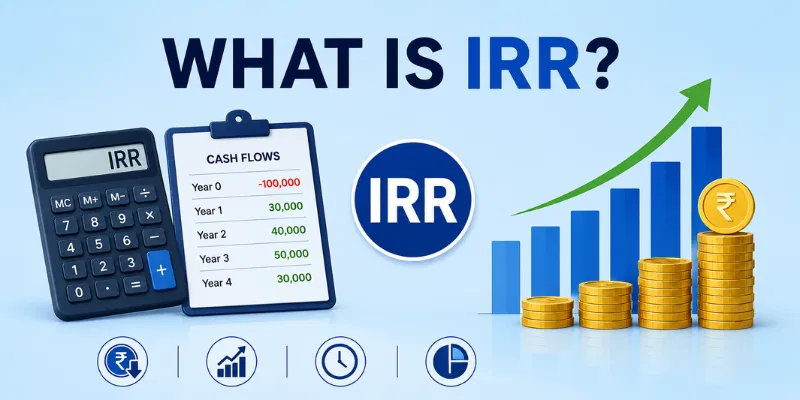
IRR stands for Internal Rate of Return and measures the annualized return of an investment. It is the rate at which the net present value of all cash flows becomes zero. In simple words, it shows the estimated yearly return generated by an investment. The calculation considers both the amount and timing of money invested and received. IRR in mutual funds can be useful when several cash flows occur at regular intervals. A higher IRR may indicate stronger performance, but it does not directly measure investment risk. Investors should also consider costs, duration, and risk before making a final decision.
2. How Does IRR Work?
IRR works by comparing the initial investment with all future cash inflows and outflows. The initial amount is recorded as a negative cash flow, while income, withdrawals, or the final investment value are entered as positive cash flows. It then finds the annual discount rate at which the present value of future cash flows becomes equal to the original investment. At this rate, the net present value of the investment becomes zero.
IRR in Mutual Funds can be used when several transactions occur at regular time intervals. The calculation considers both the size and timing of each cash flow to estimate the annualized return. A higher Internal Rate of Return may indicate better performance, but it should still be compared with investment risk, costs, duration, and available alternatives. For irregular transaction dates, XIRR is generally more suitable than standard IRR.
3. IRR Formula
The IRR formula finds the discount rate at which the net present value of all investment cash flows becomes zero.
0 = CF₀ + CF₁ ÷ (1 + IRR)¹ + CF₂ ÷ (1 + IRR)² + … + CFₙ ÷ (1 + IRR)ⁿ
Here:
- CF₀ = Initial investment, usually entered as a negative value
- CF₁, CF₂, CFₙ = Cash inflows or outflows received in future periods
- IRR = Internal Rate of Return
- n = Number of time periods
- 0 = Net present value at the calculated return rate
For example, an investor may invest ₹1,00,000 initially and receive returns over the next three years. The formula tests different discount rates until the present value of those future returns becomes equal to the initial investment. Because this calculation can be difficult manually, investors usually use an IRR Calculator, spreadsheet, or financial software to find the result accurately.
4. How to Calculate IRR?
To calculate IRR, list the initial investment and all expected future cash flows in the correct order. The initial investment should be entered as a negative value because it represents money going out, while future income should be entered as positive values. After arranging the cash flows, test different discount rates until their net present value becomes zero. The discount rate that makes NPV equal to zero is the Internal Rate of Return.
1. Step 1: Record the Initial Investment
Enter the original investment as a negative cash flow. For example, suppose you invest ₹1,00,000.
2. Step 2: List Future Cash Flows
Record all expected returns in the correct periods:
| Period | Cash Flow |
|---|---|
| Initial investment | -₹1,00,000 |
| Year 1 | ₹30,000 |
| Year 2 | ₹40,000 |
| Year 3 | ₹50,000 |
3. Step 3: Apply the IRR Formula
Use the following equation:
4. Step 4: Test Different Discount Rates
Try different return rates and calculate the net present value at each rate. Increase or decrease the rate until the NPV becomes zero or very close to zero.
5. Step 5: Find the Final IRR
For these cash flows, the IRR is approximately 8.90%. This means the investment is expected to generate an annualized return of about 8.90%.
Manual calculation can be difficult because it requires repeated trial and error. You can Calculate Your IRR more easily by entering the cash flows into a spreadsheet or financial tool. For IRR in Mutual Funds, remember that standard IRR works best when transactions occur at regular intervals; xirr is more suitable when the dates are irregular.
5. Features of IRR
IRR has several features that make it useful for evaluating investments and business projects:
- Shows annualized return: It presents investment performance as an estimated yearly percentage.
- Considers time value of money: It recognizes that money received today is more valuable than the same amount received later.
- Uses all cash flows: The calculation includes the initial investment and future cash inflows or outflows.
- Makes NPV equal to zero: IRR is the discount rate at which the investment’s net present value becomes zero.
- Supports investment comparison: Investors can compare different projects or opportunities using their expected return rates.
- Uses regular time periods: Standard IRR works best when cash flows occur at equal monthly or yearly intervals.
- Does not require a fixed discount rate: The calculation finds the return rate directly from the available cash flows.
- Helps with decision-making: An investment may be considered when its IRR is higher than the required return or cost of capital.
- Expresses results clearly: A percentage result is easier for beginners to understand than a monetary value.
- Works best with conventional cash flows: It is most reliable when one initial outflow is followed by positive cash inflows.
Although IRR in Mutual Funds can help measure returns from regular cash flows, it does not directly show risk, investment size, or total profit. Investors should therefore review the Internal Rate of Return along with NPV, costs, duration, and other performance factors.
6. Importance of IRR
IRR is important because it helps investors and businesses understand the expected annual return of an investment or project. Instead of looking only at total profit, it considers the timing and value of all cash flows. This makes financial comparison more practical and meaningful.
- Measures investment profitability: It shows the estimated annual return generated by an investment.
- Considers the time value of money: Future cash flows are adjusted because money received earlier is more valuable.
- Supports project selection: Businesses can compare several projects and identify potentially attractive options.
- Helps compare investments: Different opportunities can be reviewed using one annual percentage.
- Assists in decision-making: An investment may be acceptable when its IRR is higher than the required return.
- Uses complete cash-flow information: It includes the initial cost and all expected future inflows and outflows.
- Supports capital budgeting: Companies use it when evaluating expansion, equipment, or long-term projects.
- Provides a clear result: The percentage format is easier to understand than many complex financial figures.
- Helps evaluate regular cash flows: IRR in Mutual Funds may be useful when transactions occur at equal intervals.
- Improves return analysis: Internal Rate of Return gives a deeper view than methods that ignore the timing of cash flows.
However, IRR should not be used alone because it does not directly measure risk, project size, or total value created. Investors should also review NPV, costs, duration, and cash-flow accuracy before making a final decision.
| Advantages of IRR |
|---|
|
| Disadvantages of IRR |
|---|
|
7. IRR in Mutual Funds
IRR in Mutual Funds measures the annualized return generated from multiple investments and withdrawals over a selected period. It considers the amount of every cash flow and the time interval between transactions. The initial investment is entered as a negative value, while redemptions, dividends, and the final portfolio value are treated as positive cash flows. This provides a clearer performance estimate than methods that only compare the starting and ending values.
Standard IRR works properly when mutual fund transactions occur at equal intervals, such as every month or every year. However, actual SIP instalments, withdrawals, and redemptions may happen on different dates, so XIRR is generally more suitable for real mutual fund portfolios. Internal Rate of Return should also be reviewed with risk, expense ratio, taxes, and investment duration. A higher result may indicate stronger performance, but it does not guarantee similar future returns.
8. Factors That Affect IRR
Several factors can increase or decrease the Internal Rate of Return of an investment:
- Initial investment amount: A higher starting cost can reduce IRR if future returns do not increase accordingly.
- Size of future cash flows: Larger cash inflows generally improve the final return rate.
- Timing of returns: Cash received earlier usually increases IRR because it has a higher present value.
- Investment duration: A longer period may lower the annualized return when profits are delayed.
- Number of cash flows: Multiple deposits, withdrawals, or income payments can change the result.
- Final redemption value: A higher closing or sale value can significantly improve IRR.
- Operating and management costs: Fees and expenses reduce net cash flows and may lower the return.
- Delayed payments: Returns received later than expected can reduce the calculated rate.
- Unexpected expenses: Additional costs during the investment period may negatively affect performance.
- Accuracy of cash-flow estimates: Unrealistic projections can produce a misleading IRR.
- Market performance: Changes in asset prices can affect income and the final investment value.
- Transaction intervals: Standard IRR works best with equal intervals, while irregular dates may require XIRR.
For IRR in Mutual Funds, the investment amount, SIP timing, withdrawals, dividends, and final portfolio value can all influence the result. Therefore, investors should enter complete and accurate cash-flow details before evaluating performance.
Standard IRR may be used when SIP payments occur at equal intervals. However, actual sip dates often vary because of weekends, holidays, or delayed payments. In such cases, XIRR usually gives a more accurate result.
Yes, IRR can be negative when an investment generates less money than the amount originally invested. A negative result shows that the investment has lost value on an annualized basis. Investors should also check the reasons behind the poor performance.
A higher IRR may indicate stronger annualized returns, but it does not always mean the investment is better. It may also involve higher risk, longer duration, or uncertain cash flows. Investors should compare risk, costs, and total profit before deciding.
IRR is the discount rate that balances the present value of future cash inflows with the initial investment. At this rate, the investment creates neither positive nor negative net present value. This relationship helps measure the expected annual return.
Yes, an investment may produce multiple IRRs when cash flows change from negative to positive and back again. This can make the result confusing and less reliable. NPV or MIRR may be more useful in such cases.
No, IRR only measures the annualized return based on cash flows. It does not directly show volatility, credit risk, market risk, or the chance of loss. Investors should review risk separately before investing.
No, past IRR in Mutual Funds only explains historical performance. Future returns may change because of market conditions, fund strategy, expenses, and investor transactions. Historical returns should never be treated as guaranteed results.
Conclusion
So guys, in this article, we’ve covered IRR in Mutual Funds in detail. It helps investors understand the annualized return generated from multiple cash flows over a selected period. However, standard IRR works best when transactions occur at regular intervals, while XIRR may be more suitable for irregular dates. I personally recommend checking return, risk, expenses, and investment duration together instead of relying on one percentage alone. Review your mutual fund cash flows today and use the correct method to evaluate your investment performance.
The information and calculators on Finance Calculatorz are provided for educational purposes only. Calculator results are estimates and may not always be fully accurate. This content is not financial, investment, tax, or legal advice. Please consult a qualified professional before making any financial decision.



- Be Respectful
- Stay Relevant
- Stay Positive
- True Feedback
- Encourage Discussion
- Avoid Spamming
- No Fake News
- Don't Copy-Paste
- No Personal Attacks
- Be Respectful
- Stay Relevant
- Stay Positive
- True Feedback
- Encourage Discussion
- Avoid Spamming
- No Fake News
- Don't Copy-Paste
- No Personal Attacks
