Major SWP Mistakes to Avoid
Published: 19 Aug 2026
A Systematic Withdrawal Plan helps investors receive regular income from their mutual fund investment. However, poor planning can reduce the fund balance much faster than expected. High withdrawals, market falls, taxes, and exit loads can affect the final results. Many investors also forget to review their withdrawal amount as expenses change. These small errors can create serious problems during retirement. Understanding the common swp Mistakes to Avoid can help you protect your savings and manage regular income more wisely.
1. What Is SWP?
An SWP, or systematic withdrawal plan, allows investors to withdraw money from a mutual fund at regular intervals. You can choose monthly, quarterly, half-yearly, or yearly withdrawals based on your income needs. On each selected date, the fund house sells the required number of mutual fund units. It then transfers the withdrawal amount directly to your registered bank account. The remaining units stay invested and may continue to grow or fall with market performance. SWP can help retirees and other investors manage regular expenses without withdrawing the full investment at once.
2. How Does SWP Work?
An SWP works by redeeming mutual fund units at regular intervals. First, the investor selects the withdrawal amount, payment frequency, and start date. On each chosen date, the fund house checks the current NAV of the mutual fund. It then sells enough units to provide the selected withdrawal amount. The money is transferred directly to the investor’s registered bank account. The remaining units stay invested and may rise or fall with market performance.
For example, suppose an investor chooses to withdraw ₹10,000 every month. If the current nav is ₹50, the fund house will redeem 200 units for that payment. When the NAV rises, fewer units are sold to provide the same amount. When the NAV falls, more units are sold. This process continues until the investor stops the plan or all units are redeemed. Choosing a suitable withdrawal amount is important because high withdrawals can reduce the investment quickly.
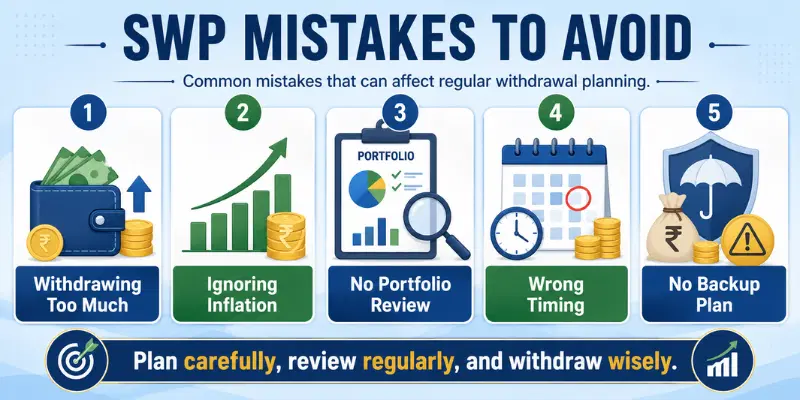
3. Major SWP Mistakes to Avoid
A Systematic Withdrawal Plan can provide regular income from mutual funds, but poor planning can reduce your investment quickly. Understanding these SWP Mistakes to Avoid can help you protect your savings and create a more stable income plan.
1. Withdrawing Too Much Money
Choosing a high withdrawal amount is one of the most common mistakes. Your fund may shrink quickly when withdrawals remain higher than investment returns.
Example: An investor withdraws ₹25,000 every month from a portfolio of only ₹10 lakh. Poor market returns may cause the investment to finish much earlier than planned.
How to Avoid It: Calculate your real monthly expenses and select a reasonable amount. Use an SWP Calculator to compare different withdrawal amounts and see how long your investment may last.
2. Starting SWP with a Small Investment
A small mutual fund balance may not support regular withdrawals for many years. Even a moderate monthly payment can reduce the original capital quickly.
Example: An investor starts withdrawing ₹12,000 monthly from an investment of ₹4 lakh. The fund may not last long, especially during weak market conditions.
How to Avoid It: Build a suitable investment amount before starting regular withdrawals. Compare your yearly income needs with the total portfolio value.
3. Ignoring Market Risk
Mutual fund returns are linked to market performance and are never guaranteed. Regular withdrawals during a market fall can place extra pressure on your portfolio.
Example: The market falls by 15%, but an investor continues taking the same high monthly amount. The fund house must sell more units at a lower NAV.
How to Avoid It: Choose a fund that matches your risk level. Reduce optional withdrawals during long market falls and review your plan carefully.
4. Choosing the Wrong Mutual Fund
Not every mutual fund is suitable for regular withdrawals. A highly risky fund may face large value changes, while a very low-growth fund may struggle to support long-term income.
Example: A retired investor uses a small-cap equity fund for essential monthly expenses. A sharp market fall may reduce the investment balance quickly.
How to Avoid It: Select a fund based on your risk level, withdrawal period, and income needs. Do not choose a scheme only because it gave high past returns.
5. Ignoring Inflation
Inflation increases the cost of food, housing, healthcare, and other daily needs. A fixed withdrawal amount may lose its value over time.
Example: A monthly withdrawal of ₹20,000 may cover expenses today, but it may not provide the same support after ten years.
How to Avoid It: Review your expenses every year and increase withdrawals only when necessary. Keep some growth-focused investments to help manage rising costs.
6. Forgetting Tax and Exit Load
Each withdrawal involves the redemption of mutual fund units. Capital gains tax and exit load may reduce the amount you finally receive.
Example: An investor expects to receive the full withdrawal amount but faces an exit load because the units were redeemed too early.
How to Avoid It: Check the fund’s tax treatment, holding period, and exit-load rules before starting. Include these possible costs in your income planning.
7. Not Keeping an Emergency Fund
Depending on SWP for every unexpected expense can disturb your long-term plan. Large emergency withdrawals may force you to sell many units during a weak market.
Example: A sudden medical bill leads an investor to withdraw ₹2 lakh from the same fund used for monthly income.
How to Avoid It: Keep separate emergency savings for medical bills and urgent expenses. Use regular withdrawals mainly for planned household needs.
8. Depending Only on SWP Income
SWP income is not guaranteed because the portfolio value can rise or fall. Depending only on it may create problems when returns remain weak.
Example: A retired person has no pension, rental income, or emergency savings. A market fall makes it difficult to continue the same monthly withdrawals.
How to Avoid It: Maintain other income sources where possible. Pension, rent, annuity income, or cash savings can reduce pressure on your mutual fund portfolio.
9. Not Reviewing the Plan Regularly
Your expenses, returns, and fund value can change over time. An old withdrawal plan may no longer match your current financial situation.
Example: An investor continues withdrawing the same high amount for several years without checking the falling fund balance.
How to Avoid It: Review the plan every six or twelve months. Check your expenses, returns, remaining units, taxes, and future income needs.
10. Ignoring How Long the Fund May Last
Many investors choose a monthly amount without checking its long-term effect. A small increase in withdrawals can shorten the life of the portfolio.
Example: An investor raises the monthly withdrawal from ₹15,000 to ₹25,000 without comparing future results. The investment may finish several years earlier.
How to Avoid It: Test different withdrawal amounts, return rates, and time periods before starting. calculate your swp carefully and review the calculation whenever your expenses or portfolio value change.
11. Increasing the Withdrawal Amount Too Often
Frequent increases can place heavy pressure on your mutual fund balance. Investors may raise withdrawals after every small rise in expenses without checking whether the portfolio can support them.
Example: An investor increases the monthly withdrawal from ₹20,000 to ₹30,000 within one year. If returns remain low, the fund may reduce much faster than expected.
How to Avoid It: Increase the amount only when your essential expenses rise. Review the portfolio value and expected withdrawal period before making any change.
12. Ignoring the Withdrawal Frequency
Choosing the wrong withdrawal frequency can create budgeting problems. Monthly, quarterly, and yearly withdrawals affect cash flow in different ways.
Example: An investor chooses a yearly withdrawal but spends most of the amount within a few months. They may then need an extra withdrawal before the next payment date.
How to Avoid It: Match the frequency with your spending needs. Monthly withdrawals may suit regular bills, while quarterly payments may suit larger planned expenses.
13. Using the Same Withdrawal Plan at Every Life Stage
Your financial needs can change as you grow older. Medical costs may rise, while some expenses, such as loan payments or education fees, may end.
Example: A retiree continues using the same withdrawal amount for many years without checking changing healthcare and household expenses.
How to Avoid It: Review your needs at different stages of retirement. Adjust the amount based on real expenses instead of following the same plan forever.
14. Ignoring Portfolio Diversification
Keeping the full investment in one fund or asset type can increase risk. An equity-only portfolio may face large market falls, while a debt-only portfolio may provide limited long-term growth.
Example: An investor keeps the entire retirement fund in a high-risk equity scheme. A major market fall can sharply reduce the value while withdrawals continue.
How to Avoid It: Spread the investment across suitable equity, debt, and cash options. Choose the mix based on your risk level, income needs, and withdrawal period.
15. Making Emotional Decisions During Market Falls
Fear can push investors to stop, increase, or change withdrawals without proper planning. Sudden decisions may disturb the long-term income strategy.
Example: An investor sees the market fall and immediately withdraws a large amount to protect the remaining money. This action may lock in losses and reduce future recovery chances.
How to Avoid It: Review the portfolio calmly before making changes. Reduce optional spending when needed, but avoid large decisions based only on short-term market movements.
4. Common Signs Your SWP Plan Needs Review
An SWP should support your income needs without reducing your investment too quickly. If you notice any of the signs below, review the plan and make suitable changes.
- The mutual fund balance is falling faster than expected.
- Your withdrawals are higher than the fund’s average returns.
- You are selling more units during market falls.
- Your monthly expenses have increased because of inflation.
- You need frequent extra withdrawals for emergencies.
- The selected mutual fund has performed poorly for a long time.
- Your current withdrawal amount no longer covers basic expenses.
- Taxes and exit load are reducing the amount you receive.
- You have no emergency fund or other source of income.
- The investment may finish before your planned withdrawal period ends.
Review your fund balance, expenses, returns, and withdrawal amount every six or twelve months. Early action can help protect your remaining investment and keep your income plan more stable.
5. Tips for Using SWP Wisely
A well-planned withdrawal strategy can provide regular income and help your investment last longer. Follow these simple tips to avoid common mistakes and manage your SWP more carefully.
- Start with a realistic withdrawal amount.
- Match withdrawals with your actual monthly expenses.
- Keep a separate emergency fund for sudden needs.
- Choose a mutual fund that matches your risk level.
- Avoid very high withdrawals during weak market periods.
- Review your plan every six or twelve months.
- Check taxes and exit load before starting.
- Keep your portfolio properly diversified.
- Increase withdrawals only when essential expenses rise.
- Use an SWP Calculator before finalizing the amount.
- Calculate Your SWP again when your portfolio or expenses change.
- Keep other income sources, such as pension or rent, where possible.
- Avoid emotional decisions during short-term market falls.
- Track how quickly your mutual fund balance is reducing.
- Seek professional advice for a large retirement portfolio.
Withdrawing too much money is one of the biggest mistakes. A high withdrawal amount can reduce the mutual fund balance faster than expected. Investors should match withdrawals with their real expenses and portfolio size.
Yes, an SWP can use the full investment over time. This may happen when withdrawals stay higher than the returns earned by the fund. Market falls can also make the portfolio reduce faster.
You should not stop it only because of short-term fear. First, review your expenses, withdrawal amount, and remaining fund balance. Reducing optional withdrawals may be better than making a sudden decision.
Review your plan every six or twelve months. Check the fund value, returns, expenses, taxes, and withdrawal amount. Regular reviews can help you correct problems before they become serious.
Yes, a separate emergency fund is very useful. It can cover sudden medical bills or urgent family expenses without disturbing your regular withdrawals. This helps protect your mutual fund investment during weak market periods.
Conclusion
So guys, in this article, we’ve covered SWP Mistakes to Avoid in detail. A Systematic Withdrawal Plan can provide regular income, but poor planning may reduce your investment faster than expected. In my opinion, you should choose a realistic withdrawal amount, keep emergency savings, and review your plan every six or twelve months. You should also consider market risk, inflation, taxes, and exit load before making changes. Avoid emotional decisions during market falls and focus on your long-term income needs. Review your current SWP today and correct any mistake before it affects your future savings.
The information and calculators on Finance Calculatorz are provided for educational purposes only. Calculator results are estimates and may not always be fully accurate. This content is not financial, investment, tax, or legal advice. Please consult a qualified professional before making any financial decision.



- Be Respectful
- Stay Relevant
- Stay Positive
- True Feedback
- Encourage Discussion
- Avoid Spamming
- No Fake News
- Don't Copy-Paste
- No Personal Attacks
- Be Respectful
- Stay Relevant
- Stay Positive
- True Feedback
- Encourage Discussion
- Avoid Spamming
- No Fake News
- Don't Copy-Paste
- No Personal Attacks
