What is Safe Withdrawal Rate (SWR)?
Published: 17 Aug 2026
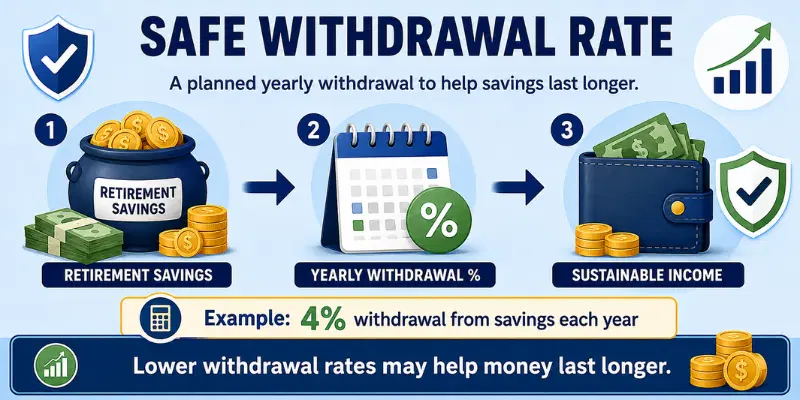
A Safe Withdrawal Rate helps retirees decide how much money they can withdraw from their investment portfolio each year. Its main goal is to provide regular income without using retirement savings too quickly. Many people use the 4% rule as a starting point, but one rate may not suit everyone. Your age, expenses, retirement period, inflation, and market returns can affect the right percentage. A lower rate may help your savings last longer, while a higher rate can provide more income. Understanding the Safe Withdrawal Rate can help you build a more stable and practical retirement plan.
1. What Is a Safe Withdrawal Rate?
A Safe Withdrawal Rate is the percentage of your retirement portfolio that you can withdraw each year without using your savings too quickly. Its main purpose is to provide regular income while helping your money last throughout retirement. For example, if you have ₹1 crore and choose a 4% withdrawal rate, you can withdraw ₹4 lakh in the first year. You may adjust this amount later based on inflation, expenses, and investment performance. However, no percentage can fully guarantee that your savings will last because market returns and future costs can change. A suitable withdrawal rate depends on your retirement age, portfolio size, income needs, and expected retirement period.
2. How Does the Safe Withdrawal Rate Work?
A Safe Withdrawal Rate works by setting a planned percentage for yearly withdrawals from a retirement portfolio. First, the investor checks the total value of all retirement investments. They then select a withdrawal rate based on their age, expenses, portfolio size, and expected retirement period. The first-year withdrawal is calculated by applying this percentage to the starting portfolio value. The remaining money stays invested and may continue to earn returns. This approach aims to provide regular income without using retirement savings too quickly.
For example, suppose a retired person has a portfolio worth ₹1 crore and chooses a 4% withdrawal rate. They can withdraw ₹4 lakh during the first year, which equals about ₹33,333 per month. In future years, they may adjust the withdrawal amount for inflation and changing expenses. They should also check market performance and the remaining portfolio balance every year. During weak market periods, reducing optional spending may help protect the savings. However, the selected rate is only a planning guide and cannot guarantee that the portfolio will last forever.
3. Safe Withdrawal Rate Formula
The Safe Withdrawal Rate formula helps you find what percentage of your retirement portfolio you withdraw each year. You need two values: your annual withdrawal amount and total portfolio value.
Safe Withdrawal Rate = (Annual Withdrawal ÷ Total Portfolio Value) × 100
For example, suppose your retirement portfolio is worth ₹1 crore and you withdraw ₹4 lakh in one year:
Safe Withdrawal Rate = (₹4,00,000 ÷ ₹1,00,00,000) × 100 = 4%
This means you are withdrawing 4% of your total retirement portfolio during the year. You can also calculate the withdrawal amount by multiplying your portfolio value by the selected rate. However, review this percentage regularly because inflation, expenses, investment returns, and retirement duration can change your needs.
4. What Is the 4% Rule?
The 4% rule is a retirement planning guideline that suggests withdrawing 4% of your total portfolio in the first year of retirement. The remaining money stays invested to support future withdrawals. In later years, you may increase the withdrawal amount to manage inflation. The main aim is to provide regular income while reducing the risk of finishing retirement savings too early. However, the rule does not guarantee that your money will last because returns, inflation, taxes, and expenses can change. You should treat it as a starting point rather than a fixed rule for every retiree.
5. How Does the 4% Rule Work?
First, calculate 4% of your portfolio value at the beginning of retirement. For example, if your retirement portfolio is ₹1 crore, you can withdraw ₹4 lakh in the first year. This equals about ₹33,333 per month. In the next year, you may increase the ₹4 lakh amount based on inflation instead of calculating 4% of the new portfolio balance. The remaining portfolio continues to stay invested in assets such as equity and debt funds. You should review the plan every year and reduce optional spending when poor market returns put pressure on your savings.
6. Different Safe Withdrawal Rates
Different withdrawal rates provide different levels of income and risk. A lower rate may help retirement savings last longer, while a higher rate may provide more income but reduce the portfolio faster. The right choice depends on age, retirement length, expenses, and market conditions.
| Withdrawal Rate | First-Year Income on ₹1 Crore | Risk Level | May Suit |
|---|---|---|---|
| 3% | ₹3 lakh | Lower | Early or cautious retirees |
| 4% | ₹4 lakh | Moderate | Balanced retirement planning |
| 5% | ₹5 lakh | Higher | People with other income sources |
| 6% | ₹6 lakh | Very high | Shorter plans or flexible spending |
1. 3% Withdrawal Rate
A 3% rate is a conservative option for people who want to protect their savings for a longer period. It may suit early retirees or people expecting a long retirement. For example, a ₹1 crore portfolio would provide ₹3 lakh in the first year. The income is lower, but the risk of using the portfolio too quickly may also be lower.
2. 4% Withdrawal Rate
A 4% rate is a common retirement planning guideline. It aims to balance regular income with the need to keep the remaining money invested. A ₹1 crore portfolio would provide ₹4 lakh in the first year. However, investors should review the plan regularly because future returns and inflation can change.
3. 5% Withdrawal Rate
A 5% rate provides higher income, but it also places more pressure on the portfolio. It may suit retirees with a shorter retirement period or other steady income sources. A ₹1 crore portfolio would provide ₹5 lakh in the first year. Poor market returns can increase the risk of finishing savings earlier.
4. 6% Withdrawal Rate
A 6% rate is more aggressive and provides a larger yearly amount. It may only suit people with lower life expectancy, strong pension income, or flexible expenses. A ₹1 crore portfolio would provide ₹6 lakh in the first year. This rate carries a higher risk of reducing the retirement fund quickly.
7. Factors That Affect the Safe Withdrawal Rate
The right withdrawal rate is not the same for every retired person. It depends on your retirement period, portfolio value, expenses, and other sources of income. You should review these factors before selecting a percentage.
1. Retirement Age
Your retirement age affects how long your savings need to last. A person who retires at 45 may need income for 40 years or more. Therefore, early retirees may need a lower withdrawal rate than people who retire at 60 or 65.
2. Retirement Duration
A longer retirement period places more pressure on your portfolio. A high withdrawal rate may finish the savings early when withdrawals continue for many years. You should select a rate that matches your expected retirement duration.
3. Portfolio Size
A larger portfolio can provide more income even at a lower percentage. For example, 3% of ₹2 crore gives more yearly income than 5% of ₹50 lakh. Always compare your required expenses with the total value of your investments.
4. Investment Returns
Strong investment returns may help your savings last longer. Low or negative returns can reduce the portfolio, especially when regular withdrawals continue. However, future returns are uncertain and should not be treated as guaranteed.
5. Inflation
Inflation increases the cost of food, healthcare, housing, and other daily needs. Your current withdrawal amount may not cover the same expenses after several years. A retirement plan should allow reasonable increases without putting too much pressure on the portfolio.
6. Asset Allocation
asset allocation means dividing your money among equity, debt, cash, and other investments. Equity may offer long-term growth but carries higher market risk. Debt and cash may offer more stability, but they may provide lower returns.
7. Market Conditions
A major market fall during the early retirement years can harm your savings. You may need to sell more investments at low prices to meet regular expenses. Keeping flexible withdrawals can reduce this risk during weak markets.
8. SWP vs SIP
SWP and SIP are two different ways to manage mutual fund investments. SIP allows investors to add a fixed amount regularly, while SWP allows them to withdraw money at regular intervals. SIP mainly supports long-term wealth creation. In contrast, swp may help retirees receive planned income from an existing investment. Both options carry market risk because mutual fund returns are not guaranteed.
A sip may help investors create a retirement portfolio during their working years. After retirement, they may use an SWP to withdraw money from that portfolio. The Safe Withdrawal Rate can help decide a reasonable yearly SWP amount. This approach may support regular income while reducing the risk of using retirement savings too quickly.
| Point | SIP | SWP |
|---|---|---|
| Full Form | Systematic Investment Plan | Systematic Withdrawal Plan |
| Main Purpose | Build wealth | Receive regular income |
| Money Flow | Bank account to mutual fund | Mutual fund to bank account |
| Effect on Units | Adds mutual fund units | Redeems mutual fund units |
| Best Suited For | Working and long-term investors | Retirees and income seekers |
| Common Use | Retirement or goal planning | Monthly expenses after retirement |
| Advantages of a Safe Withdrawal Rate |
|---|
|
| Disadvantages of a Safe Withdrawal Rate |
|---|
|
9. How to Calculate a Safe Withdrawal Rate
You can calculate a Safe Withdrawal Rate by comparing your yearly withdrawal with your total retirement portfolio. First, calculate how much money you need for one year. Then, divide that amount by your total portfolio value and multiply the result by 100.
1. Formula
Formula:
Safe Withdrawal Rate = (Annual Withdrawal ÷ Total Portfolio Value) × 100
For example, suppose your retirement portfolio is ₹80 lakh and you need ₹3.2 lakh per year:
Safe Withdrawal Rate = (₹3,20,000 ÷ ₹80,00,000) × 100 = 4%
This means you plan to withdraw 4% of your portfolio during the year. You should also subtract pension, rent, or other regular income before calculating the amount needed from investments. Review the result every year because inflation, medical costs, market returns, and your lifestyle may change.
No, the 4% rule is only a general planning guide. It may not suit people with a very long retirement or high expenses. Market returns, inflation, and taxes can also affect the result.
Yes, you can withdraw more than 4%, but it increases the risk of finishing your savings early. A higher rate also puts more pressure on your portfolio during market falls. Review your income needs carefully before choosing a higher percentage.
A 3% rate may suit cautious investors or people planning a long retirement. It provides lower income but may help the portfolio last longer. The right rate depends on your expenses and other income sources.
You should review your withdrawal rate at least once every year. Check your expenses, portfolio value, investment returns, and inflation. Reduce or increase the amount only when your situation changes.
Yes, inflation increases the cost of food, healthcare, housing, and other needs. Your current withdrawal amount may not cover the same expenses after several years. Plan reasonable increases without putting too much pressure on your savings.
A market fall can reduce your portfolio while regular withdrawals continue. You may need to sell more investments at low prices to cover expenses. Reducing optional spending during weak years may help protect your savings.
Yes, pension, rent, or annuity income can reduce the amount needed from investments. This may allow you to use a lower withdrawal percentage. A lower rate can help your retirement portfolio last longer.
Conclusion
So guys, in this article, we’ve covered Safe Withdrawal Rate in detail. It helps you plan how much money you can withdraw from your retirement portfolio each year. In my opinion, you should start with a careful rate and review it every year. You should also consider inflation, market returns, medical costs, and other income sources. Avoid following one fixed percentage without checking your personal needs. Calculate your yearly expenses today and choose a withdrawal rate that can support your retirement for longer.
The information and calculators on Finance Calculatorz are provided for educational purposes only. Calculator results are estimates and may not always be fully accurate. This content is not financial, investment, tax, or legal advice. Please consult a qualified professional before making any financial decision.


- Be Respectful
- Stay Relevant
- Stay Positive
- True Feedback
- Encourage Discussion
- Avoid Spamming
- No Fake News
- Don't Copy-Paste
- No Personal Attacks
- Be Respectful
- Stay Relevant
- Stay Positive
- True Feedback
- Encourage Discussion
- Avoid Spamming
- No Fake News
- Don't Copy-Paste
- No Personal Attacks
