Active vs Auto Choice in National Pension Scheme
Published: 16 Sep 2026
Active vs Auto Choice are two investment methods available under NPS. Active Choice allows subscribers to select their own asset allocation, while Auto Choice follows an age-based investment plan. Both options invest money in market-linked assets such as equity, corporate debt, and government securities. Their risk and return levels depend on the selected allocation. Understanding both choices can help subscribers manage retirement investments more effectively.
1. What Is Active vs Auto Choice with Example?
Active vs Auto Choice explains two different ways to manage investment allocation in NPS. Under Active Choice, the subscriber selects how much money goes into each available asset class. This option gives more control but requires basic knowledge of risk and portfolio allocation. For example, Rahul may invest 60% in equity, 25% in corporate debt, and 15% in government securities. His pension fund manager invests every contribution according to this selected percentage. Active Choice may suit investors who want to manage their allocation personally.
Under Auto Choice, the subscriber selects a life-cycle fund instead of choosing individual percentages. The system automatically divides the money according to the subscriber’s age and selected risk level. Equity exposure is generally higher at a younger age and gradually reduces over time. For example, Ayesha may choose a moderate life-cycle plan at the age of 30. Her equity and debt allocation will adjust automatically as she moves closer to retirement. Auto Choice may suit beginners who prefer easy and automatic portfolio management.
2. Working of Active vs Auto Choice with Example
Active vs Auto Choice works differently in NPS because one method gives control to the subscriber, while the other uses an automatic plan. Under Active Choice, the investor selects the percentage for equity, corporate debt, government securities, and other permitted assets. For example, Rahul may choose 70% equity, 20% corporate debt, and 10% government securities. His pension fund manager invests every contribution according to this fixed allocation. Rahul can review and change the mix later when allowed under NPS rules. This method suits people who understand investment risk and want direct control.
Under Auto Choice, the subscriber selects a life-cycle fund instead of setting each asset percentage. The system automatically divides contributions based on age and the chosen risk level. For example, Ayesha may select a moderate life-cycle fund at the age of 30. Her equity allocation will gradually reduce, while debt and government-security exposure will increase with age. She does not need to rebalance the portfolio manually as retirement comes closer. This method suits beginners who prefer simple and automatic investment management.
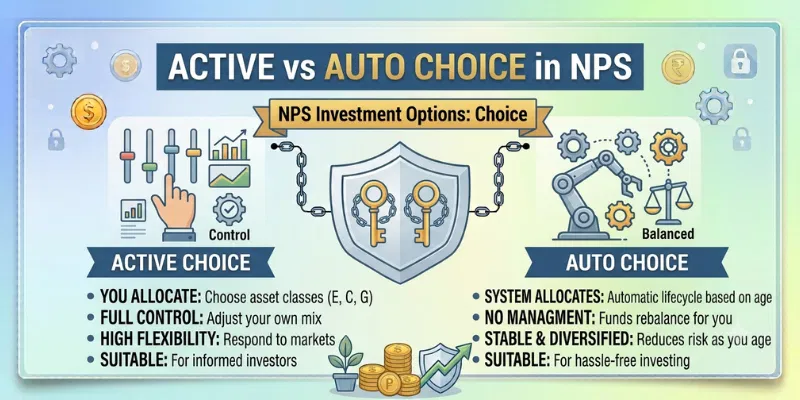
3. Active vs Auto Choice Comparison
The Active vs Auto Choice comparison helps subscribers understand which NPS investment method matches their knowledge, risk level, and retirement goals.
1. Control Over Investment
Active Choice gives subscribers greater control over their asset allocation. They can decide how much money should go into equity, corporate debt, and government securities. Auto Choice provides less control because the investment mix follows a selected life-cycle plan.
2. Knowledge Requirement
Active Choice may suit people who understand asset classes, market risk, and portfolio balancing. Auto Choice may be easier for beginners who do not want to select individual percentages. It reduces the need for detailed investment knowledge.
3. Risk Management
Under Active Choice, the subscriber is responsible for selecting a suitable risk level. A wrong allocation may create too much risk or reduce long-term growth. Auto Choice usually lowers equity exposure as the subscriber grows older.
4. Portfolio Review
Active Choice requires regular monitoring because the selected mix may become unsuitable over time. Subscribers may need to rebalance the allocation when their age, income, or goals change. Auto Choice handles these age-based adjustments automatically.
5. Personalisation
Active Choice offers more freedom to create a personalised investment mix. Auto Choice follows standard life-cycle rules that may not match every subscriber’s complete financial situation. However, it provides a simpler and more organised approach.
6. Suitable Investor
Active Choice may suit experienced investors who want direct control and can review their portfolio regularly. Auto Choice may suit beginners, busy professionals, and subscribers who prefer automatic management. The better option in Active vs Auto Choice depends on age, risk tolerance, financial knowledge, and retirement period.
| Point | Active Choice | Auto Choice |
|---|---|---|
| Asset allocation | Selected by the subscriber | Decided by the selected life-cycle fund |
| Level of control | High | Limited |
| Investment knowledge | More knowledge is helpful | Basic knowledge is enough |
| Equity allocation | Chosen within permitted limits | Based on age and risk option |
| Portfolio adjustment | Managed by the subscriber | Adjusted automatically |
| Risk management | Depends on personal decisions | Risk generally reduces with age |
| Flexibility | More personalised | Follows a predefined structure |
| Review requirement | Needs regular review | Requires less monitoring |
| Suitable for | Experienced investors | Beginners |
| Decision-making | More active involvement | Simple and automatic |
4. Advantages and Disadvantages of Active vs Auto Choice
Understanding the benefits and limitations of Active vs Auto Choice can help subscribers select a suitable NPS investment method.
1. Advantages of Active Choice
- It gives full control over asset allocation.
- Subscribers can choose investments according to their risk level.
- It allows a personalised mix of equity and debt.
- Investors can change the allocation when their goals change.
- It may suit experienced investors seeking higher growth potential.
2. Disadvantages of Active Choice
- It requires knowledge of asset classes and market risk.
- Wrong allocation can increase losses or reduce long-term growth.
- Subscribers need to review the portfolio regularly.
- Emotional decisions may lead to frequent and unnecessary changes.
- It may feel difficult for beginners.
3. Advantages of Auto Choice
- It automatically manages asset allocation according to age.
- It is simple and easy for beginners to understand.
- Equity exposure generally reduces as retirement approaches.
- Subscribers do not need to rebalance the portfolio manually.
- Different life-cycle options support different risk levels.
4. Disadvantages of Auto Choice
- Subscribers have limited control over exact asset percentages.
- The standard age-based allocation may not suit every investor.
- It does not consider all personal savings, income, or financial goals.
- Some plans may become too conservative for certain investors.
- Choosing the wrong life-cycle option can still create unsuitable risk.
The better option in Active vs Auto Choice depends on the subscriber’s age, investment knowledge, risk tolerance, and willingness to manage the portfolio.
5. Who Should Choose Active vs Auto Choice?
The right option in Active vs Auto Choice depends on the subscriber’s investment knowledge, risk level, age, and interest in managing the portfolio.
1. Who Should Choose Active Choice?
Active Choice may suit people who understand equity, debt, and asset allocation. It is useful for subscribers who want greater control over their investment mix. They should also be willing to review and adjust the portfolio when needed.
2. Experienced Investors
People with basic investment knowledge may prefer Active Choice. They can create a customised mix according to their retirement goal and risk capacity. This option may also suit investors who already manage mutual funds or other market-linked investments.
3. Young Investors With Higher Risk Capacity
Younger subscribers with many years left before retirement may choose a higher equity allocation within the permitted limit. They may have more time to recover from short-term market falls. However, they should still avoid taking more risk than they can handle.
4. Who Should Choose Auto Choice?
Auto Choice may suit beginners who do not understand asset allocation. It is also useful for people who prefer a simple and automatic investment method. The life-cycle fund adjusts the portfolio according to age.
5. Busy Subscribers
People who do not have time to review their NPS account regularly may prefer Auto Choice. It reduces the need for manual rebalancing and frequent decisions. This can make retirement investing easier to manage.
6. Conservative or Confused Investors
Subscribers who feel confused about selecting percentages may start with Auto Choice. They can choose a low, moderate, high, or aggressive life-cycle option based on risk comfort. The final decision in Active vs Auto Choice should match personal goals, age, and financial knowledge.
6. Tips for Choosing Active vs Auto Choice
These simple tips can help subscribers select the right option in Active vs Auto Choice.
- Choose Active Choice only if you understand asset allocation and market risk.
- Select Auto Choice if you prefer simple and automatic portfolio management.
- Match your investment option with your age, retirement period, and risk level.
- Avoid choosing maximum equity only because of recent high returns.
- Review your NPS option regularly and make changes only when your financial needs change.
Neither option is better for everyone. Active Choice suits people who want control, while Auto Choice suits those who prefer automatic management. The right option depends on age, risk level, and investment knowledge.
Auto Choice is usually easier for beginners. It automatically changes the asset allocation according to age and the selected life-cycle plan. Beginners should still choose a risk level they understand.
Eligible subscribers can generally change their investment preference through their NPS account. The change must follow the rules available for their subscriber category. Review the new allocation carefully before confirming it.
No, Auto Choice does not provide guaranteed returns. The money remains invested in market-linked equity and debt assets. Account value may increase or decrease with market performance.
Active Choice may offer higher growth potential when a subscriber selects more equity. However, higher equity also brings greater short-term risk. Returns depend on allocation, market conditions, fund performance, and investment time.
Yes, most life-cycle plans gradually reduce equity exposure as the subscriber gets older. More money is then moved toward corporate debt and government securities. This helps lower market risk as retirement approaches.
You should review your option once or twice a year and after major financial changes. Avoid switching only because of short-term market movements. Make changes when your age, goals, risk level, or retirement period changes.
Conclusion
So guys, in this article, we’ve covered Active vs Auto Choice in detail. We discussed how both options work, their differences, benefits, risks, and suitable users. In my opinion, beginners may start with Auto Choice because it manages asset allocation automatically. Experienced investors who understand market risk may prefer Active Choice for greater control. Compare your age, risk level, and investment knowledge today before selecting the right NPS option.
The information and calculators on Finance Calculatorz are provided for educational purposes only. Calculator results are estimates and may not always be fully accurate. This content is not financial, investment, tax, or legal advice. Please consult a qualified professional before making any financial decision.



- Be Respectful
- Stay Relevant
- Stay Positive
- True Feedback
- Encourage Discussion
- Avoid Spamming
- No Fake News
- Don't Copy-Paste
- No Personal Attacks
- Be Respectful
- Stay Relevant
- Stay Positive
- True Feedback
- Encourage Discussion
- Avoid Spamming
- No Fake News
- Don't Copy-Paste
- No Personal Attacks
