Detailed Comparison between SIP vs STP vs SWP
Published: 24 Aug 2026
SIP, STP, and SWP are three popular methods used to manage mutual fund investments. SIP allows investors to add money regularly, while STP transfers money from one mutual fund scheme to another. SWP helps investors withdraw a selected amount at regular intervals. Each method supports a different financial goal and stage of life. SIP may help build wealth, STP may manage a lump sum, and swp may provide regular income. Understanding SIP vs STP vs SWP can help you choose a method that matches your income, investment amount, and future needs.
1. What Is SIP vs STP vs SWP?
SIP, STP, and SWP are three different methods used to manage mutual fund investments. A Systematic Investment Plan (SIP) allows you to invest a fixed amount regularly from your bank account into a mutual fund. It is commonly used by investors who want to build wealth gradually for long-term goals.
A systematic transfer plan (STP) allows you to transfer money regularly from one mutual fund scheme to another within the same fund house. Investors often use STP to move a lump sum gradually from a debt fund to an equity fund. This may reduce the risk of investing the full amount at one market level.
A Systematic Withdrawal Plan (SWP) allows you to withdraw a fixed or selected amount regularly from an existing mutual fund investment. The fund house redeems some units and sends the money to your registered bank account. SWP is commonly used by retirees and investors who need regular income.
The main difference in SIP vs STP vs SWP is the direction of money. SIP moves money from your bank account into a mutual fund, STP moves money between two mutual fund schemes, and SWP moves money from a mutual fund to your bank account. In simple words, SIP helps you invest, STP helps you transfer, and SWP helps you withdraw money.
2. Working of SIP vs STP vs SWP
The working of SIP vs STP vs SWP depends on where the money comes from and where it goes. SIP invests money from your bank account, STP transfers money between mutual fund schemes, and SWP withdraws money from an existing mutual fund investment.
1. How Does SIP Work?
In a systematic investment plan, you choose a mutual fund, investment amount, payment date, and frequency. The selected amount is automatically deducted from your bank account and invested in the mutual fund. You receive units according to the NAV available on the transaction date. When the nav is low, your investment buys more units, and when it is high, it buys fewer units. You can use a SIP Calculator to estimate the possible future value of your regular investments.
Example: You start a monthly SIP of ₹5,000. This amount is automatically invested in your selected mutual fund every month, helping you build wealth gradually.
2. How Does STP Work?
In a Systematic Transfer Plan, you first invest a lump sum in one mutual fund scheme, known as the source scheme. You then choose another scheme as the target scheme. At regular intervals, a fixed or selected amount is redeemed from the source scheme and invested in the target scheme. Both schemes generally need to belong to the same mutual fund house. STP is often used to transfer money gradually from a debt fund to an equity fund.
Example: You invest ₹6 lakh in a liquid fund and transfer ₹50,000 every month into an equity fund. The full amount is transferred over 12 months instead of being invested at once.
3. How Does SWP Work?
In a systematic withdrawal plan, you choose the amount and frequency of your withdrawals. The mutual fund redeems enough units to provide the selected amount and transfers the money to your registered bank account. The remaining units continue to stay invested and may increase or decrease with market movements. The number of units redeemed depends on the NAV available on each withdrawal date. An SWP Calculator can help you estimate how long your investment may support regular withdrawals.
Example: You invest ₹15 lakh in a mutual fund and start a monthly SWP of ₹15,000. The fund house redeems the required units every month and sends ₹15,000 to your bank account.
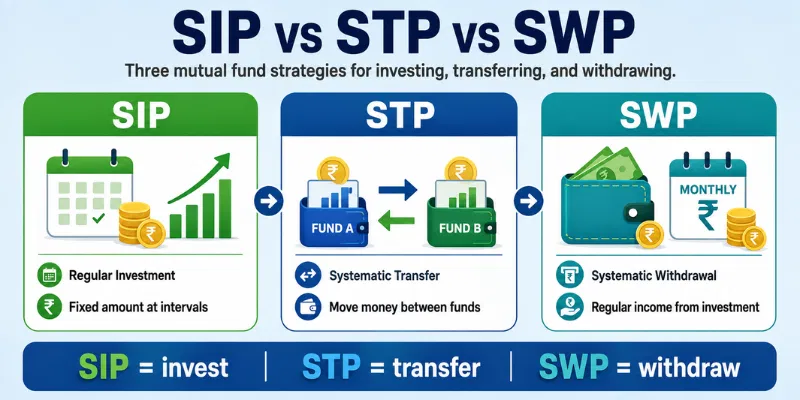
3. SIP vs STP vs SWP Comparison
The main difference between SIP vs STP vs SWP is how the money moves and what financial purpose it serves. SIP is used to invest regularly, STP is used to transfer money between mutual fund schemes, and SWP is used to withdraw money regularly.
In simple words, SIP adds money to your investment, stp moves money within your mutual fund portfolio, and SWP takes money out of the investment. The right option depends on whether your goal is to build wealth, manage a lump sum, or create regular income.
| Comparison Point | SIP | STP | SWP |
|---|---|---|---|
| Full Form | Systematic Investment Plan | Systematic Transfer Plan | Systematic Withdrawal Plan |
| Main Purpose | Regular investment | Regular fund transfer | Regular withdrawal |
| Money Movement | Bank account to mutual fund | One mutual fund scheme to another | Mutual fund to bank account |
| Existing Investment Required | No | Yes | Yes |
| Best Suited For | Long-term investors | Lump sum investors | Retirees and income seekers |
| Effect on Mutual Fund Units | New units are purchased | Units are redeemed and reinvested | Units are redeemed |
| Common Frequency | Monthly or quarterly | Weekly, monthly, or quarterly | Monthly, quarterly, or yearly |
4. Main Differences Between SIP, STP, and SWP
Although SIP, STP, and SWP involve regular mutual fund transactions, they serve completely different purposes. The main differences in SIP vs STP vs SWP are based on the direction of money, financial goal, source of funds, effect on units, taxation, and suitable users.
1. Purpose
The main purpose of sip is to help investors build wealth through regular investments. It is commonly used for long-term goals such as retirement, education, or buying a house.
STP is mainly used to transfer money gradually from one mutual fund scheme to another. It can help investors manage a lump sum and reduce the pressure of investing the full amount at one market level.
SWP is used to generate regular income from an existing mutual fund investment. It may suit retirees or investors who need monthly or quarterly cash flow.
2. Direction of Money
In SIP, money moves from the investor’s bank account into a mutual fund scheme. This increases the investment balance over time.
In STP, money moves from one mutual fund scheme to another scheme within the same fund house. The money remains invested, but its location changes.
In SWP, money moves from the mutual fund investment to the investor’s bank account. This reduces the investment balance as units are redeemed.
3. Source of Funds
SIP uses fresh money from your regular income or bank savings. You do not need a large existing mutual fund balance to start it.
STP requires an existing investment in a source mutual fund scheme. The amount is transferred regularly from this scheme to the selected target scheme.
SWP also requires an existing mutual fund investment. Regular withdrawals are made from this accumulated balance.
4. Effect on Mutual Fund Units
SIP purchases new mutual fund units during every instalment. The number of units depends on the NAV available on the investment date.
STP redeems units from the source scheme and purchases units in the target scheme. Therefore, one scheme loses units while the other scheme gains units.
SWP only redeems units from the selected mutual fund. No new units are purchased unless the investor makes a separate investment.
5. Suitable Investors
SIP may suit salaried people, beginners, and long-term investors who want to invest small amounts regularly.
STP may suit investors who already have a lump sum but do not want to invest the entire amount in an equity fund at once.
SWP may suit retirees, pensioners, or other investors who need regular income from their accumulated investments.
6. Financial Goal
SIP mainly supports wealth creation and long-term capital growth. It helps investors save regularly for future goals.
STP mainly supports gradual investment, risk management, and portfolio rebalancing. It helps move money between different fund categories in a planned way.
SWP mainly supports regular income and controlled withdrawals. It helps investors meet monthly expenses without withdrawing the full investment at once.
7. Transaction Process
In SIP, the selected amount is automatically deducted from the investor’s bank account and invested in the chosen mutual fund.
In STP, the fund house redeems a fixed amount from the source scheme and invests it in the target scheme.
In SWP, the fund house redeems the required units and transfers the selected withdrawal amount to the investor’s bank account.
8. Impact of Market Movements
SIP can benefit from rupee cost averaging. Investors buy more units when the NAV is low and fewer units when the NAV is high.
STP spreads the movement of a lump sum across different market levels. However, it does not completely remove market risk.
SWP may face greater pressure during market falls because more units may need to be sold to provide the same withdrawal amount.
9. Investment Balance
SIP usually increases the mutual fund balance because fresh money is added regularly. However, the actual value still depends on market performance.
STP does not add new money to the overall portfolio. It only shifts money from one scheme to another.
SWP gradually reduces the investment balance because money is regularly withdrawn. Strong returns may slow this reduction, but they are not guaranteed.
10. Tax Treatment
SIP instalments do not normally create tax at the time of investment. Tax may apply when the purchased units are later redeemed.
Every STP transfer involves redemption from the source scheme. This means capital gains tax may apply to each transfer.
Every SWP payment also involves unit redemption. Tax may apply to the gain portion of the withdrawn units.
5. Which Option Is Best for Wealth Creation?
SIP is generally the best option for long-term wealth creation because it allows you to invest a fixed amount regularly. It may benefit from rupee cost averaging and long-term compounding, making it suitable for beginners and salaried investors.
STP can also support wealth creation when you already have a lump sum and want to invest it gradually. SWP is less suitable because it regularly withdraws money instead of building the portfolio.
6. Which Option Is Best for Regular Income?
SWP is generally the best option for regular income because it allows you to withdraw a selected amount from your mutual fund at fixed intervals. It is commonly used by retirees and investors who need steady cash flow.
SIP invests money, while STP only transfers it between schemes. Therefore, neither is designed to provide regular income directly to your bank account.
7. Which Option Is Safer?
No option is completely risk-free because SIP, STP, and SWP all depend on the mutual funds you choose. SIP may feel safer for beginners because it spreads investments across different market levels instead of investing a large amount at once.
STP may reduce lump sum timing risk by moving money gradually between funds. SWP can be riskier during market falls because regular withdrawals may reduce the portfolio faster. Therefore, safety depends on your goal, fund type, withdrawal amount, and investment period.
8. Tax Treatment of SIP, STP, and SWP
Tax is not charged when you invest money through SIP. However, capital gains tax may apply when you later redeem the mutual fund units. Each SIP instalment is treated as a separate investment, so its holding period is calculated from its own purchase date. The final tax depends on the fund category, holding period, and applicable tax rules.
In STP, every transfer is treated as a redemption from the source fund and a new investment in the target fund. Therefore, capital gains tax may apply on each transfer, even though the money does not reach your bank account. Exit load may also apply when units are transferred before the allowed period.
In SWP, each withdrawal requires the fund house to redeem some mutual fund units. Tax is generally calculated only on the capital gain included in the redeemed units, not on the full withdrawal amount. Since mutual fund tax rules can change, investors should check the latest rules for their fund category before starting SIP, STP, or SWP.
9. Common Mistakes in SIP, STP, and SWP
Investors may make mistakes when they start SIP, STP, or SWP without understanding their purpose. These mistakes can affect returns, increase taxes, or reduce the investment balance faster than expected.
1. SIP Mistakes
- Starting SIP without a clear financial goal
- Choosing a fund only because of past returns
- Investing more than the monthly budget allows
- Stopping SIP during every market fall
- Ignoring the investment period and risk level
- Not reviewing the fund’s performance regularly
2. STP Mistakes
- Ignoring capital gains tax on every transfer
- Selecting the wrong source or target fund
- Using a very short transfer period
- Assuming STP removes all market risk
- Forgetting possible exit load charges
- Transferring money without a clear strategy
3. SWP Mistakes
- Withdrawing more than the portfolio can support
- Ignoring inflation while fixing the withdrawal amount
- Starting without an emergency fund
- Continuing the same withdrawal during weak markets
- Forgetting tax and exit load
- Not checking how long the investment may last
The best way to avoid these mistakes is to match each method with a clear goal. Review the investment regularly and make changes based on your income needs, risk level, and remaining fund value.
SIP is used to invest money regularly in a mutual fund. STP transfers money from one mutual fund scheme to another, while SWP withdraws money from a mutual fund. In simple words, SIP invests, STP transfers, and SWP withdraws.
SIP is generally suitable for beginners who want to invest small amounts regularly. It helps build an investing habit without requiring a large lump sum. However, the selected mutual fund should match the investor’s goal and risk level.
Yes, all three methods can support different stages of one financial plan. You may use SIP to build wealth, STP to move money between funds, and SWP to create regular income. Each method should be started with a clear purpose.
STP may help spread a lump sum investment across different market levels. This can reduce the pressure of investing the entire amount at one time. However, it does not guarantee better returns or remove market risk.
Yes, SWP may help retired investors receive regular income from their mutual fund investment. It can be used for monthly household, medical, and other expenses. The withdrawal amount should remain reasonable so the investment does not finish too early.
Yes, every STP transfer involves the redemption of units from the source fund. Capital gains tax may apply if those redeemed units have earned a profit. The tax treatment depends on the fund category and holding period.
Investors can generally stop or modify these plans by submitting a request to the mutual fund house or investment platform. The process and processing time may differ between providers. Check the scheme rules before making any change.
Conclusion
So guys, in this article, we’ve covered SIP vs STP vs SWP in detail. SIP helps you invest regularly, STP allows you to transfer money between mutual fund schemes, and SWP helps you withdraw money at fixed intervals. In my opinion, you should choose the option based on your financial goal, income needs, risk level, and existing investment. SIP may suit long-term wealth creation, STP may help manage a lump sum, and SWP may provide regular income. Review your financial needs today and select the method that supports your future goals.
The information and calculators on Finance Calculatorz are provided for educational purposes only. Calculator results are estimates and may not always be fully accurate. This content is not financial, investment, tax, or legal advice. Please consult a qualified professional before making any financial decision.



- Be Respectful
- Stay Relevant
- Stay Positive
- True Feedback
- Encourage Discussion
- Avoid Spamming
- No Fake News
- Don't Copy-Paste
- No Personal Attacks
- Be Respectful
- Stay Relevant
- Stay Positive
- True Feedback
- Encourage Discussion
- Avoid Spamming
- No Fake News
- Don't Copy-Paste
- No Personal Attacks
