IRR vs CAGR: Main Difference, Working and Benefits
Published: 2 Nov 2026
IRR vs CAGR is an important comparison for investors who want to measure annualized returns correctly. Both methods express performance as a yearly percentage, but they use different calculation approaches. IRR considers multiple cash inflows and outflows, while CAGR compares one starting value with one final value. This difference makes each method suitable for a different investment pattern. Understanding IRR vs CAGR can help investors avoid misleading return calculations.
1. What Is IRR vs CAGR?
IRR vs CAGR is a comparison between two methods used to measure annualized investment returns. IRR stands for Internal Rate of Return and calculates the return from multiple cash inflows and outflows over regular time periods. It considers the timing of each transaction and finds the rate at which the net present value of all cash flows becomes zero.
CAGR stands for compound annual growth rate and measures how a single lump sum investment grows from its initial value to its final value over a specific period. It assumes a steady compounded growth rate even when actual yearly returns fluctuate. In simple terms, IRR is more suitable for multiple regular cash flows, while CAGR is better for measuring the growth of one initial investment.
2. Working of IRR vs CAGR
IRR works by considering the initial investment and all future cash inflows or outflows that occur at regular intervals. It finds the annual discount rate at which the net present value of all cash flows becomes zero. The initial investment is entered as a negative value, while income, withdrawals, and final returns are treated as positive values. This makes IRR useful for investments or projects involving multiple transactions.
CAGR works by comparing one initial investment with its final value over a specific number of years. It converts the overall growth into one average compounded annual rate, even though actual returns may change each year. In the IRR vs CAGR comparison, IRR focuses on multiple cash flows and their timing, while CAGR focuses on the beginning value, ending value, and total investment duration.
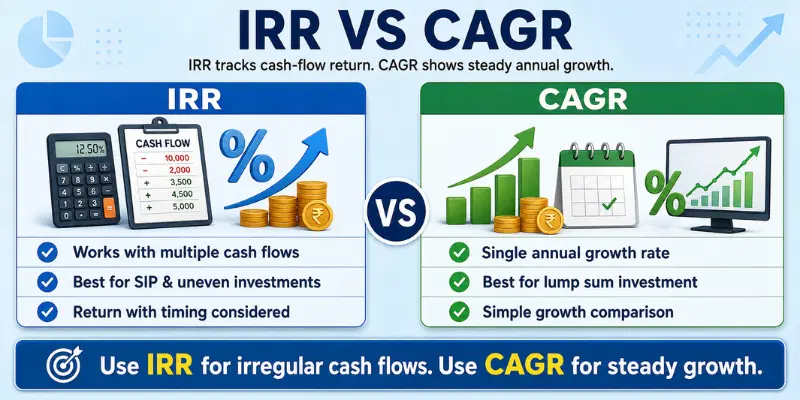
3. Differences Between IRR and CAGR
IRR vs CAGR compares two methods used to calculate annualized investment returns. Both provide results as percentages, but they differ in the type of cash flows they measure, the information they require, and the investments for which they are suitable.
1. Type of Cash Flows
irr is designed for investments that involve multiple cash inflows and outflows. These may include an initial investment, regular deposits, income payments, withdrawals, and a final redemption value. It evaluates all these transactions while calculating the annualized return.
CAGR uses only one initial value and one final value. It does not properly account for additional investments or withdrawals during the holding period. Therefore, CAGR is more suitable for a simple lump sum investment.
2. Treatment of Cash-Flow Timing
IRR considers when each cash flow occurs during the investment period. A return received earlier generally has a greater effect than the same amount received later because IRR follows the time value of money.
CAGR does not consider the timing of individual transactions because it only compares the beginning and ending values. It uses the total number of years to calculate a smooth annual growth rate. This is one of the most important differences in IRR vs CAGR.
3. Suitable Investment Type
IRR is generally suitable for business projects and investments involving multiple transactions at equal intervals. It may also be used for regular monthly or yearly investment cash flows. However, XIRR is more appropriate when transactions occur on irregular dates.
CAGR is better suited for lump sum investments where no additional deposits or withdrawals occur. Investors commonly use it to measure the long-term growth of mutual funds, stocks, business revenue, or property values.
4. Calculation Method
IRR calculates the discount rate at which the net present value of all cash flows becomes zero. It usually requires repeated calculations because different rates must be tested until the correct result is found. An IRR Calculator or spreadsheet is generally used because manual calculation can be difficult.
CAGR uses the initial value, final value, and total holding period. Its formula calculates the fixed annual compounded rate that would turn the starting amount into the ending amount. It is easier to calculate manually than IRR.
5. Data Required
IRR requires complete cash-flow information for every investment period. Investors must enter the initial amount, all future inflows and outflows, and the final investment value. Missing even one transaction can affect the final result.
CAGR requires only three details: the initial investment value, the final value, and the number of years. It does not require a complete transaction history. This limited data requirement makes CAGR simpler for beginners.
6. Treatment of Additional Investments and Withdrawals
IRR can include additional investments, regular income, partial withdrawals, and final redemption proceeds. Every cash flow is entered separately with the correct positive or negative sign. This makes the calculation more useful for investments with changing cash flows.
CAGR cannot accurately handle such transactions. If an investor adds or removes money during the investment period, the final growth rate may become misleading. In such cases, IRR or XIRR may provide a more meaningful return.
7. Complexity and Ease of Calculation
IRR is more complex because it uses several cash flows and applies the net present value concept. Calculating it manually requires trial and error, and one investment may sometimes produce more than one IRR. Investors usually depend on financial software or spreadsheets to Calculate Your IRR.
CAGR is easier because it uses a direct mathematical formula. Once the starting value, ending value, and investment duration are available, the result can be calculated quickly. This makes CAGR more convenient for simple long-term growth comparisons.
8. Interpretation and Accuracy
IRR shows the annualized return generated by multiple cash flows, but its accuracy depends on correct transaction details and equal time intervals. It can also become misleading when cash flows repeatedly change between positive and negative values.
CAGR shows the smooth compounded annual growth of one investment between two points. It is accurate for a lump sum investment but hides yearly gains, losses, and volatility. Therefore, neither method is always better; the correct choice in IRR vs CAGR depends on the structure of the investment.
4. IRR vs CAGR Comparison Table
| Basis | IRR | CAGR |
|---|---|---|
| Full form | Internal Rate of Return | Compound Annual Growth Rate |
| Cash flows | Handles multiple cash inflows and outflows | Uses one initial and one final value |
| Timing | Considers the timing of each cash flow | Considers only the total holding period |
| Best suited for | Investments with regular multiple transactions | Simple lump sum investments |
| Calculation | Finds the rate at which NPV becomes zero | Measures average compounded annual growth |
| Difficulty | More complex and usually needs a calculator | Easier and can be calculated manually |
| Advantages of IRR |
|---|
|
| Disadvantages of IRR |
|---|
|
| Advantages of CAGR |
|---|
|
| Disadvantages of CAGR |
|---|
|
5. Which Is More Accurate: IRR or CAGR?
Neither IRR nor CAGR is always more accurate because the correct choice depends on the investment structure. CAGR is more accurate for a single lump sum investment where there is one initial value and one final value. It measures the average compounded annual growth over the complete holding period.
IRR is more accurate when an investment includes multiple cash inflows and outflows at regular intervals. It considers the timing and amount of every transaction, making it more suitable for projects, regular investments, and withdrawals. However, xirr is generally better when cash flows occur on irregular dates.
Therefore, in the IRR vs CAGR comparison, use CAGR for simple lump sum growth and IRR for multiple regular cash flows. The accuracy of either method also depends on complete data, correct transaction values, and the right investment period.
6. Common Mistakes in IRR vs CAGR
Investors often choose the wrong return method or enter incomplete data while comparing investment performance. These mistakes can produce misleading annualized return figures and lead to poor decisions.
- Using CAGR for multiple cash flows: CAGR is not suitable when additional investments or withdrawals occur during the holding period.
- Using IRR for irregular transaction dates: Standard IRR assumes equal time intervals, so XIRR is usually better for transactions made on different dates.
- Entering the initial investment as positive: The original investment should be entered as a negative cash flow in an IRR calculation.
- Ignoring withdrawals and income: Dividends, redemptions, rental income, or other cash flows must be included for an accurate IRR.
- Choosing the wrong investment period: An incorrect number of years can significantly change the CAGR result.
- Forgetting the final investment value: The current portfolio value or final redemption amount must be included in the calculation.
- Comparing different investment durations: Returns should be compared over similar periods to make the IRR vs CAGR comparison fair.
- Confusing annualized return with total return: Both methods show yearly performance, not the total percentage gain earned over the complete period.
7. Tips for Choosing Between IRR and CAGR
- Use CAGR when there is one initial investment and one final value.
- Use IRR when several cash flows occur at regular monthly or yearly intervals.
- Use XIRR instead of IRR when transaction dates are irregular.
- Check the complete investment history before selecting a return method.
- Enter the initial investment as a negative cash flow in IRR calculations.
- Include all income, withdrawals, and the latest investment value.
- Use the correct holding period while calculating CAGR.
- Compare investments over similar durations for a fair result.
- Do not select a method only because it shows a higher return.
- Review total profit along with the annualized return percentage.
- Consider risk, volatility, taxes, and costs separately.
Yes, both methods may show a similar result when there is only one initial investment and one final value. This usually happens when no additional deposits or withdrawals occur. However, their calculation methods are still different.
CAGR is generally not suitable for SIPs because every instalment is invested at a different time. It only compares one starting value with one ending value. XIRR is usually more appropriate for sip returns.
Standard IRR assumes that cash flows occur at equal intervals. It may give a less accurate result when transaction dates are irregular. XIRR is generally better because it uses the exact date of every cash flow.
cagr is usually easier because it requires only the initial value, final value, and investment period. IRR involves several cash flows and often requires a spreadsheet or calculator. Therefore, beginners may find CAGR simpler to calculate and understand.
Yes, both methods can produce a negative result when the investment loses value. A negative CAGR shows an average annual decline in a lump sum investment. A negative IRR shows that the cash inflows were not enough to recover the invested amount.
No, a higher IRR does not automatically make an investment better. It may involve greater risk, uncertain cash flows, or a smaller total profit. Investors should also review costs, duration, investment size, and risk.
No, both methods mainly describe historical or estimated investment performance. Future results may change because of market movements, costs, and investment decisions. Investors should never treat past annualized returns as guaranteed.
Conclusion
So guys, in this article, we’ve covered IRR vs CAGR in detail. Both methods measure annualized returns, but they are suitable for different investment patterns. CAGR works better for a simple lump sum investment, while IRR is more useful when multiple cash flows occur at regular intervals. In my opinion, you should first review your transaction history before choosing a return method. Compare your investment structure carefully and use the method that gives you the clearest performance result.
The information and calculators on Finance Calculatorz are provided for educational purposes only. Calculator results are estimates and may not always be fully accurate. This content is not financial, investment, tax, or legal advice. Please consult a qualified professional before making any financial decision.



- Be Respectful
- Stay Relevant
- Stay Positive
- True Feedback
- Encourage Discussion
- Avoid Spamming
- No Fake News
- Don't Copy-Paste
- No Personal Attacks
- Be Respectful
- Stay Relevant
- Stay Positive
- True Feedback
- Encourage Discussion
- Avoid Spamming
- No Fake News
- Don't Copy-Paste
- No Personal Attacks
