CAGR in Mutual Funds: How to Calculate CAGR
Published: 26 Oct 2026
CAGR in mutual funds is commonly used to measure the average annual growth of a lump sum investment over a selected period. It considers the beginning value, ending value, and total number of years. This method includes the effect of compounding and presents long-term growth as one annual percentage. However, it does not show the actual gains or losses earned in each year. Understanding CAGR in Mutual Funds can help investors compare fund performance more clearly.
1. What Is CAGR in Mutual Funds?
CAGR in Mutual Funds shows the average annual rate at which a mutual fund investment has grown over a specific period. It compares the initial investment with the final value and includes the effect of compounding. For example, if ₹1,00,000 grows to ₹1,50,000 in three years, CAGR shows the average compounded growth earned each year. It does not mean the fund delivered the same return every year because actual performance may rise or fall. Compound Annual Growth Rate in Mutual Funds is mainly suitable for lump sum investments without additional deposits or withdrawals. It helps investors understand long-term performance and compare similar funds over the same period.
2. Working of CAGR in Mutual Funds
CAGR in Mutual Funds works by comparing the original lump sum investment with its final value over a selected number of years. It calculates the fixed annual growth rate that would have turned the starting amount into the ending amount through compounding. The calculation requires three values: initial investment, final fund value, and total investment period.
For example, suppose ₹1,00,000 grows to ₹1,50,000 in three years. Compound Annual Growth Rate in Mutual Funds converts this overall growth into one average yearly percentage. However, it does not mean the fund earned the same return every year because actual performance may rise or fall with market conditions.
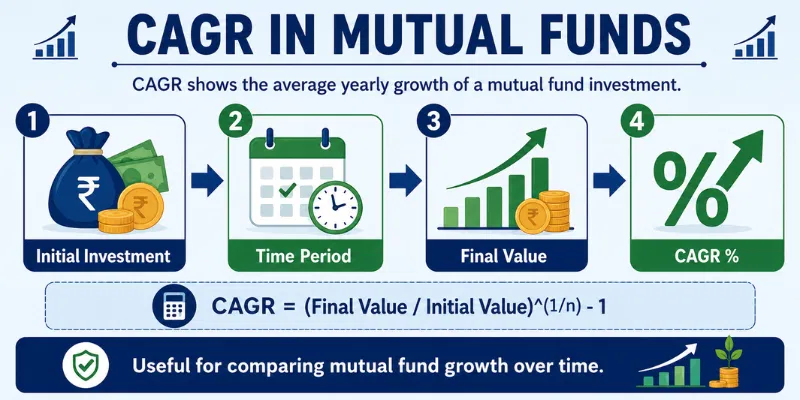
3. How to Calculate CAGR in Mutual Funds Step by Step
To calculate CAGR in Mutual Funds, you need the initial investment, final investment value, and total holding period. Use the following formula:
CAGR = [(Final Value ÷ Initial Value)^(1 ÷ Number of Years) − 1] × 100
1. Step 1: Find the Initial Investment
Check the amount you originally invested in the mutual fund. For example, suppose you invested ₹1,00,000 as a lump sum.
2. Step 2: Check the Final Value
Find the current or redemption value of your investment. Assume the investment has grown to ₹1,50,000.
3. Step 3: Calculate the Investment Period
Count the complete investment duration in years. In this example, the holding period is three years.
4. Step 4: Divide the Final Value by the Initial Value
₹1,50,000 ÷ ₹1,00,000 = 1.5
5. Step 5: Apply the Power
Raise 1.5 to the power of one divided by three:
6. Step 6: Subtract One
1.1447 − 1 = 0.1447
7. Step 7: Convert the Result into a Percentage
0.1447 × 100 = 14.47%
Therefore, the compound annual growth rate in Mutual Funds is approximately 14.47%. This means the investment grew at an average compounded annual rate of 14.47% over three years, although the actual return may have been different each year.
4. CAGR Calculation Example in Mutual Funds
Suppose you invested ₹2,00,000 as a lump sum in a mutual fund. After five years, the value of your investment increased to ₹3,50,000. To calculate CAGR in Mutual Funds, use the following formula:
CAGR = [(Final Value ÷ Initial Value)^(1 ÷ Number of Years) − 1] × 100
Now, enter the values:
CAGR = [(₹3,50,000 ÷ ₹2,00,000)^(1 ÷ 5) − 1] × 100
CAGR = [(1.75)^0.2 − 1] × 100
CAGR = (1.1184 − 1) × 100
CAGR = 11.84%
Therefore, the Compound Annual Growth Rate in Mutual Funds is approximately 11.84%. It means the investment grew at an average compounded annual rate of 11.84% over five years. However, the mutual fund may have delivered different returns in individual years due to market movements.
5. Importance of CAGR in Mutual Funds
CAGR in Mutual Funds helps investors understand how their lump sum investment has grown on an annual compounded basis. Instead of focusing only on the total profit, it converts long-term performance into one yearly percentage. This makes fund evaluation simpler and more meaningful.
- Shows long-term growth: It explains the average compounded growth achieved over a selected period.
- Makes comparison easier: Investors can compare similar mutual funds over the same three-year, five-year, or longer period.
- Reflects compounding: It considers how returns earned in earlier years contribute to future growth.
- Simplifies performance: It presents several years of market movement as one easy-to-understand annual rate.
- Supports goal tracking: Investors can compare the fund’s growth with the return required to reach their financial goals.
- Helps evaluate consistency: Reviewing Compound Annual Growth Rate in Mutual Funds across different periods can provide a broader view of performance.
- Improves decision-making: It helps investors shortlist funds, although risk, costs, benchmark returns, and fund category should also be considered.
CAGR is therefore a useful starting point for evaluating long-term mutual fund performance. However, it should not be used alone because it does not show yearly fluctuations, investment risk, or the effect of multiple cash flows.
6. Advantages of CAGR in Mutual Funds
CAGR in Mutual Funds gives investors a simple way to understand long-term investment growth. It turns performance over several years into one annual compounded rate, making fund evaluation easier.
- Easy to understand: It presents long-term growth as one clear annual percentage.
- Includes compounding: It considers the effect of returns being reinvested over time.
- Useful for lump sum investments: It works well when there is one initial investment and one final value.
- Helps compare mutual funds: Investors can compare similar funds over the same investment period.
- Shows annualized performance: It gives a clearer picture than total return alone for investments held for several years.
- Reduces the impact of yearly fluctuations: It smooths different yearly returns into one average compounded rate.
- Supports financial planning: Investors can compare fund growth with the return needed to achieve their goals.
- Easy to calculate: It only requires the initial value, final value, and investment duration.
- Useful for benchmark comparison: Compound Annual Growth Rate in Mutual Funds can be compared with the fund’s benchmark over the same period.
- Works across fund categories: It can be used to review long-term growth in equity, debt, and hybrid mutual funds.
7. Disadvantages of CAGR in Mutual Funds
Although CAGR in Mutual Funds is useful for measuring long-term growth, it has several limitations. Investors should understand these drawbacks before using it to judge fund performance.
- Hides yearly fluctuations: It shows one smooth annual rate and does not reveal gains or losses in individual years.
- Assumes steady growth: The result may appear as if the investment grew at the same rate every year, which rarely happens in real markets.
- Not suitable for SIPs: It cannot accurately measure returns when investments are made through multiple instalments.
- Ignores additional transactions: Extra deposits, partial withdrawals, and dividends can make the result less reliable.
- Does not measure risk: It cannot show volatility, market risk, drawdowns, or the possibility of losses.
- Depends on the selected period: Changing the starting or ending date may produce a very different result.
- May hide poor performance: A strong final year can improve the overall figure even if the fund performed weakly earlier.
8. CAGR vs Absolute Return in Mutual Funds
CAGR and absolute return are both used to measure mutual fund performance, but they explain returns differently. Absolute return shows the total percentage gain or loss without considering how long the investment was held. CAGR in Mutual Funds converts the total growth into an average annual compounded rate and includes the investment period.
For example, suppose ₹1,00,000 grows to ₹1,50,000 in three years. The absolute return is 50%, while the CAGR is approximately 14.47% per year. Absolute return tells you the overall gain, whereas CAGR explains the annualized growth over those three years.
Compound Annual Growth Rate in Mutual Funds is generally more useful when comparing long-term investments held for different durations. Absolute return is simpler for understanding the total gain or loss, especially when the holding period is less than one year. However, neither method is ideal for SIPs or investments with multiple cash flows, where xirr is usually more suitable.
| Basis | CAGR | Absolute Return |
|---|---|---|
| Meaning | Average annual compounded growth | Total percentage gain or loss |
| Investment period | Considers the holding period | Does not consider time |
| Best suited for | Investments held for more than one year | Short-term performance comparison |
| Compounding | Includes compounding | Does not show compounding |
| Result | Annual percentage | Total percentage |
| Formula | Uses initial value, final value, and years | Uses initial and final values only |
9. CAGR vs Average Annual Return
CAGR and average annual return both describe investment performance, but their calculation methods are different. CAGR in Mutual Funds measures the compounded annual growth between the starting and ending values. Average annual return simply adds the yearly returns and divides the total by the number of years.
For example, suppose a mutual fund earns 20% in the first year, loses 10% in the second year, and earns 15% in the third year. The average annual return is calculated by adding these returns and dividing by three:
Average Annual Return = (20% − 10% + 15%) ÷ 3 = 8.33%
However, this result does not fully reflect compounding. CAGR uses the actual beginning and ending investment values, which makes it more useful for understanding long-term growth.
Compound Annual Growth Rate in Mutual Funds is generally more reliable when investors want to measure how a lump sum has grown over several years. Average annual return may be useful for reviewing yearly performance, but it can overstate the actual growth when returns vary significantly.
| Basis | CAGR | Average Annual Return |
|---|---|---|
| Meaning | Compounded annual growth rate | Simple average of yearly returns |
| Calculation | Uses initial value, final value, and time | Adds yearly returns and divides by years |
| Compounding | Includes compounding | Does not properly include compounding |
| Required data | Starting and ending values | Individual yearly returns |
| Best suited for | Measuring long-term lump sum growth | Reviewing average yearly performance |
| Accuracy | Better reflects actual compounded growth | May give a misleading result during fluctuations |
Yes, CAGR can be negative when the final investment value is lower than the initial amount. A negative result shows the average annual decline during the selected period. This may happen when a fund performs poorly or markets fall.
No, a higher CAGR alone does not guarantee that a fund is better. The fund may also carry higher risk, greater volatility, or inconsistent performance. Investors should review risk, expenses, benchmark returns, and fund category as well.
Investors should review three-year, five-year, and longer-term returns when possible. A longer period may provide a broader view of fund performance across different market conditions. Always compare funds using the same time period.
Published mutual fund returns based on nav generally reflect the scheme’s operating expenses. However, other investor-level costs and taxes may not be fully shown in the result. Read the fund documents carefully before making a decision.
Yes, two funds can show similar annualized growth while having very different levels of volatility. One fund may deliver smoother returns, while the other may experience large gains and losses. Risk measures should therefore be checked along with CAGR.
No, CAGR only explains historical investment growth. Future performance can change because of market conditions, fund strategy, expenses, and economic factors. Investors should not treat past returns as guaranteed results.
Conclusion
So guys, in this article, we’ve covered CAGR in Mutual Funds in detail. It helps investors understand the average annual compounded growth of a lump sum investment over a selected period. However, it does not show yearly fluctuations, risk, or multiple cash flows. I personally recommend using CAGR along with benchmark performance, expense ratio, and risk level before selecting a fund. Use a CAGR Calculator today to review your mutual fund growth and make a more informed investment decision.
The information and calculators on Finance Calculatorz are provided for educational purposes only. Calculator results are estimates and may not always be fully accurate. This content is not financial, investment, tax, or legal advice. Please consult a qualified professional before making any financial decision.



- Be Respectful
- Stay Relevant
- Stay Positive
- True Feedback
- Encourage Discussion
- Avoid Spamming
- No Fake News
- Don't Copy-Paste
- No Personal Attacks
- Be Respectful
- Stay Relevant
- Stay Positive
- True Feedback
- Encourage Discussion
- Avoid Spamming
- No Fake News
- Don't Copy-Paste
- No Personal Attacks
