Comparison between SWP vs SIP: Working, Features, Benefits
Published: 14 Aug 2026
SWP vs SIP explains two different ways of using mutual funds for financial planning. SIP helps investors add a fixed amount regularly, while SWP allows them to withdraw money at chosen intervals. One method focuses on building wealth, and the other focuses on creating regular income. Both options can be useful at different stages of life. Young investors may prefer SIP, while retired people may find SWP more suitable. Understanding SWP vs SIP can help you choose the right option based on your income, goals, and future needs.
1. What Is SIP vs SWP?
A systematic investment plan allows you to invest a fixed amount in a mutual fund at regular intervals. You can invest monthly, quarterly, or at another chosen frequency. The fund house uses each payment to buy mutual fund units based on the current NAV. SIP mainly helps investors build wealth slowly through regular investing. It is often suitable for salaried people, young investors, and those planning long-term goals.
A systematic withdrawal plan works in the opposite way. It allows you to withdraw a fixed amount from an existing mutual fund investment at regular intervals. The fund house sells some units and transfers the money to your bank account. SWP mainly helps investors create regular income for retirement or monthly expenses. Understanding SWP vs SIP helps you decide whether you need to grow your money or withdraw it in a planned way.
2. Working of SIP vs SWP
A Systematic Investment Plan works by investing a fixed amount in a mutual fund at regular intervals. The investor chooses the amount, payment date, and investment frequency. On each selected date, money is deducted from the bank account and used to buy mutual fund units. When the nav is low, the investor receives more units. When the NAV is high, the investor receives fewer units. This method helps investors build wealth slowly over time.
A Systematic Withdrawal Plan works by redeeming mutual fund units at regular intervals. The investor chooses the withdrawal amount and payment frequency. On each selected date, the fund house sells enough units to provide the chosen amount. The money is then transferred to the investor’s bank account. When the NAV is low, more units are sold for the same withdrawal. This is the main working difference in SWP vs SIP.
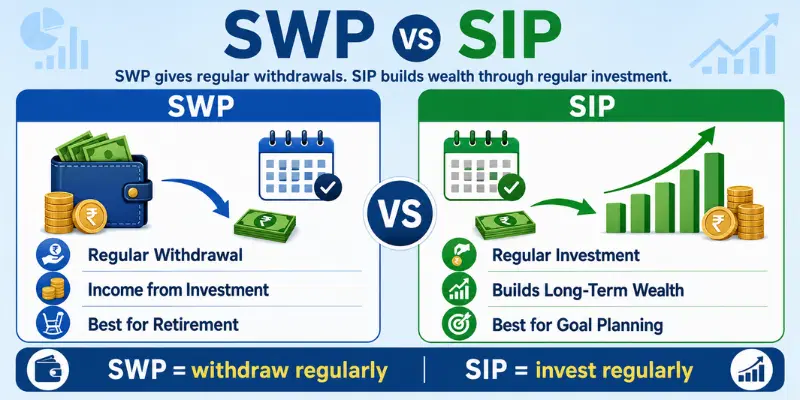
3. Main Difference Between SIP and SWP
The main difference between SIP and SWP is the direction of money. In SIP, you regularly invest money from your bank account into a mutual fund. In SWP, you regularly withdraw money from an existing mutual fund investment into your bank account. SIP mainly helps build wealth, while SWP helps create regular income. SIP increases your mutual fund units over time, but SWP reduces them through regular redemptions. This basic difference makes SWP vs SIP useful for different financial goals and life stages.
- Purpose: SIP builds wealth, while SWP provides regular income.
- Money flow: SIP moves money into a mutual fund, while SWP moves money out.
- Mutual fund units: SIP adds units, while SWP redeems units.
- Best suited for: SIP suits earners, while SWP often suits retirees.
- Financial stage: SIP supports the saving stage, while SWP supports the income stage.
4. Key Features of SIP and SWP
SIP and SWP serve different financial needs, but both offer a simple and planned way to manage mutual fund investments. SIP helps investors add money regularly, while SWP helps them withdraw money in a controlled way. Their key features make SWP vs SIP useful at different stages of an investor’s financial journey.
1. Key Features of SIP
- Allows regular mutual fund investments
- Supports small monthly contributions
- Uses automatic bank deductions
- Helps build long-term wealth
- Offers rupee cost averaging
- Benefits from compounding over time
- Can usually be increased, paused, or stopped
2. Key Features of SWP
- Provides regular withdrawals
- Offers flexible withdrawal frequency
- Transfers money directly to the bank
- Allows a custom withdrawal amount
- Keeps the remaining balance invested
- Helps manage retirement or monthly expenses
- Can usually be changed or stopped later
5. Advantages and Disadvantages of SIP
A Systematic Investment Plan helps investors add money to mutual funds at regular intervals. It can support long-term goals and build a steady investment habit. However, SIP returns depend on market performance, so investors should also understand its limits.
| Advantages of SIP |
|---|
|
| Disadvantages of SIP |
|---|
|
6. Advantages and Disadvantages of SWP
A Systematic Withdrawal Plan allows investors to receive money from a mutual fund at regular intervals. It can support monthly expenses and retirement needs while keeping the remaining amount invested. However, withdrawals and market changes can reduce the fund balance over time.
| Advantages of SWP |
|---|
|
| Disadvantages of SWP |
|---|
|
7. SWP vs SIP with Two Examples
SWP vs SIP becomes easier to understand through simple examples. SIP helps you invest money regularly, while SWP helps you withdraw money from an existing mutual fund investment. The examples below show how both methods work in real life.
1. Example 1: SIP for Building Wealth
Suppose Rahul invests ₹5,000 every month in a mutual fund through SIP. The amount is automatically deducted from his bank account on a fixed date. When the NAV is low, he receives more mutual fund units, and when it is high, he receives fewer units. He continues investing for ten years to build money for his child’s education. Rahul can use a SIP Calculator to estimate the possible future value of his investment. He can also Calculate Your SIP with different amounts and expected return rates before starting.
2. Example 2: SWP for Regular Income
Suppose Meena has ₹12 lakh invested in a mutual fund after retirement. She starts an SWP of ₹10,000 per month to manage household and medical expenses. The fund house redeems the required units each month and transfers ₹10,000 to her bank account. Her remaining mutual fund units stay invested and may continue to earn returns. Meena can use an SWP Calculator to check how long her investment may support these withdrawals. She should calculate your swp carefully before selecting the monthly amount.
8. Can SIP and SWP Be Used Together?
Yes, SIP and SWP can be used together as part of one long-term financial plan. An investor may use SIP during the earning years to build a large mutual fund balance. Later, the same investor may start SWP to receive regular income from the accumulated investment. This approach can support goals such as retirement, education, or planned monthly expenses. It also shows how SWP and SIP can serve different needs at different stages of life.
For example, a person may invest ₹10,000 every month through SIP for 20 years. After retirement, they may stop investing and begin withdrawing ₹25,000 per month through SWP. The remaining amount stays invested and may continue to earn returns. However, the withdrawal amount should remain reasonable so the fund can last longer. Regular reviews can help the investor adjust both plans based on income, expenses, and market performance.
- SIP helps build the investment fund.
- SWP helps create regular cash flow.
- Both can support long-term retirement planning.
- The investor should keep separate emergency savings.
- The plan should be reviewed every six or twelve months.
9. Factors to Consider Before Choosing SIP or SWP
Choosing between SIP and SWP depends on your financial needs, income, age, and future goals. Both methods work differently, so you should understand your situation before making a decision.
1. Financial Goal
First, decide what you want to achieve. SIP may suit you if your goal is to build wealth for retirement, education, or a home. SWP may suit you if you need regular income from an existing mutual fund investment.
2. Current Income and Investment Amount
SIP is useful for people who earn regularly and can invest a fixed amount every month. SWP usually needs a large existing investment before regular withdrawals can begin. Your available income and fund balance play an important role in the SWP vs SIP decision.
3. Investment Period
SIP generally works better for long-term goals because regular investments need time to grow. SWP may be used for short-term or long-term income needs. You should choose a withdrawal amount that can support the planned period.
4. Risk and Market Conditions
Both SIP and SWP depend on mutual fund performance. SIP can benefit from investing at different market levels, while SWP may face more pressure during a market fall. Poor returns can reduce the fund balance faster when regular withdrawals continue.
5. Age and Life Stage
Young and working investors may prefer SIP to build wealth over time. Retired people may prefer SWP to manage household, medical, and other regular expenses. Many investors use SWP and SIP at different stages of their financial journey.
10. Which Is Safer: SIP or SWP?
sip is generally safer for long-term wealth building because you invest small amounts over time. It reduces the pressure of investing a large amount at one market level. When prices fall, your regular payment buys more units. However, SIP still carries market risk, and returns are never guaranteed.
SWP can be useful for regular income, but it may carry more risk during market falls. The fund house must keep selling units to provide withdrawals, even when the NAV is low. This can reduce the investment balance faster. Therefore, in the SWP vs SIP comparison, SIP is often safer for building money, while SWP needs more careful planning to protect capital.
- SIP suits long-term investors with regular income.
- SWP suits investors who already have a large fund balance.
- SIP spreads investments across different market levels.
- SWP may sell more units when the market falls.
- The safer choice depends on your goal, fund type, and time period.
SIP allows you to invest money in a mutual fund at regular intervals. SWP allows you to withdraw money from an existing mutual fund investment. In simple words, SIP builds wealth, while SWP provides regular income.
Neither option is better for every investor. SIP may suit people who want to build wealth, while SWP may suit those who need regular cash flow. Your choice should depend on your financial goal and current life stage.
Yes, you can use SWP and SIP as part of one financial plan. You may invest through SIP during your working years and start withdrawals after building a large fund. This approach is often useful for retirement planning.
SWP may be more suitable for retired people who need regular income. It allows them to withdraw a selected amount every month or quarter. However, they should keep withdrawals reasonable to protect their remaining investment.
No, SIP does not guarantee returns because mutual funds depend on market performance. The investment value may rise or fall over time. A longer investment period may help manage short-term market changes.
Yes, regular withdrawals can finish the investment when they remain higher than the fund’s returns. Market falls may also cause more units to be sold for each payment. Investors should review the remaining balance regularly.
Most mutual fund platforms allow investors to stop SIP or SWP by submitting a request. Some platforms may take a few working days to process the change. Always check the rules of your fund house before stopping the plan.
SIP may be safer for long-term wealth building because it spreads investments across different market levels. SWP may face more pressure during market falls because units must still be sold for withdrawals. However, both methods carry mutual fund risk.
Conclusion
So guys, in this article, we’ve covered swp vs SIP in detail. SIP helps you invest money regularly and build wealth over time, while SWP helps you withdraw money in a planned way. In my opinion, working people should use SIP for long-term goals, while retirees can consider SWP for regular income. However, you should always check your income, risk level, fund value, and future needs before making a choice. Review your plan every year and avoid investing or withdrawing more than you can manage. Compare both options today and choose the one that fits your financial journey.
The information and calculators on Finance Calculatorz are provided for educational purposes only. Calculator results are estimates and may not always be fully accurate. This content is not financial, investment, tax, or legal advice. Please consult a qualified professional before making any financial decision.



- Be Respectful
- Stay Relevant
- Stay Positive
- True Feedback
- Encourage Discussion
- Avoid Spamming
- No Fake News
- Don't Copy-Paste
- No Personal Attacks
- Be Respectful
- Stay Relevant
- Stay Positive
- True Feedback
- Encourage Discussion
- Avoid Spamming
- No Fake News
- Don't Copy-Paste
- No Personal Attacks
