Major 6 Types of SWP (Systematic Withdrawal Plan)
Published: 12 Aug 2026
Types of SWP give investors different ways to withdraw money from their mutual fund investments. Some options provide a fixed amount, while others depend on investment growth or changing financial needs. Investors can choose monthly, quarterly, half-yearly, or yearly withdrawals. Each withdrawal method affects the remaining fund balance in a different way. Retired people may prefer steady payments, while other investors may need more flexible income. Understanding the Types of SWP can help you select a plan that matches your expenses, investment value, and future goals.
1. What Is an SWP?
An SWP is a facility that allows investors to withdraw money from a mutual fund at regular intervals. The full form of SWP is systematic withdrawal plan. Investors can choose monthly, quarterly, half-yearly, or yearly payments based on their needs. On each withdrawal date, the fund house sells a certain number of mutual fund units and transfers the amount to the investor’s bank account. The remaining units stay invested and may continue to grow based on market performance. Understanding how it works is important before comparing the different Types of SWP.
2. Working of SWP
An SWP works by allowing investors to withdraw a selected amount from a mutual fund at regular intervals. First, the investor chooses the withdrawal amount and payment frequency. The frequency may be monthly, quarterly, half-yearly, or yearly. On each chosen date, the fund house checks the current NAV of the mutual fund. It then redeems enough units to provide the selected amount. The money is transferred directly to the investor’s registered bank account.
For example, suppose an investor chooses to withdraw ₹10,000 every month. If the current NAV is ₹50, the fund house will redeem 200 units for that payment. When the NAV rises, fewer units are sold to provide the same amount. When the NAV falls, more units are sold for the withdrawal. The remaining units stay invested and may continue to grow or fall with the market. This process continues until the investor stops the plan or all units are redeemed.
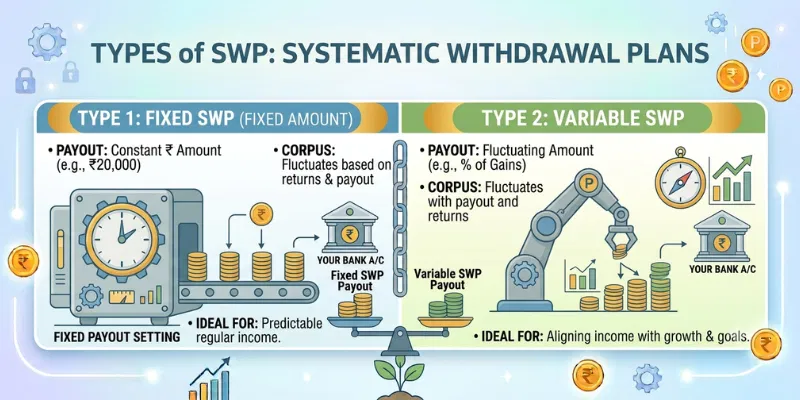
3. Top 6 Types of SWP
Different Types of SWP allow investors to withdraw money from mutual funds in a way that matches their income needs. Some plans offer fixed payments, while others depend on growth, time, or changing expenses. Each option affects the remaining investment differently. Therefore, investors should understand how every type works before choosing one.
1. Fixed Amount SWP
A Fixed Amount SWP allows an investor to withdraw the same amount at regular intervals. The investor may select monthly, quarterly, half-yearly, or yearly payments. This is one of the simplest Types of SWP because the withdrawal amount remains unchanged. It may suit retirees and people who need steady money for regular household expenses.
1. How Does It Work?
The investor first chooses a fixed withdrawal amount and payment frequency. On each selected date, the fund house redeems enough mutual fund units to provide that amount. For example, an investor may choose to withdraw ₹15,000 every month. If the NAV falls, the fund house sells more units to provide ₹15,000. If the NAV rises, it sells fewer units. The process continues until the investor stops the plan or the available units finish.
| Advantages |
|---|
|
| Disadvantages |
|---|
|
2. Appreciation-Based SWP
An Appreciation-Based SWP allows an investor to withdraw only the growth earned by the mutual fund. The aim is to keep the original investment amount safe for as long as possible. The withdrawal value can change because mutual fund returns are linked to market performance. This option may suit investors who do not need a fixed monthly income.
1. How Does It Work?
The investor withdraws the increase in the value of the investment. For example, suppose an investment grows from ₹10 lakh to ₹10.60 lakh. The investor may withdraw the ₹60,000 appreciation and leave the original ₹10 lakh invested. However, the investor may receive little or no money when the fund does not earn a profit. The amount available for withdrawal may also change in every period. This makes income less predictable than a fixed withdrawal plan.
| Advantages |
|---|
|
| Disadvantages |
|---|
|
3. Fixed Period SWP
A Fixed Period SWP provides regular withdrawals for a selected number of months or years. The investor chooses the duration before starting the plan. It may be useful for goals with a clear time period, such as education fees, a career break, or temporary income support. The withdrawal amount should match the fund value and planned duration.
1. How Does It Work?
The investor chooses the withdrawal amount, frequency, and total period. For example, a parent may withdraw ₹20,000 every month for five years to pay education costs. The fund house redeems the required number of units on every withdrawal date. The remaining balance continues to stay invested during the selected period. The plan ends when the chosen duration finishes. It may also stop earlier when all mutual fund units are redeemed.
| Advantages |
|---|
|
| Disadvantages |
|---|
|
4. Capital Withdrawal SWP
A Capital Withdrawal SWP allows investors to withdraw both investment gains and part of their original capital. It may provide a higher regular amount than an appreciation-based plan. This type is often used by people who want to spend their accumulated savings over time. However, the fund balance may gradually decrease with every withdrawal.
1. How Does It Work?
The investor selects a regular withdrawal amount based on financial needs. The payment may come from investment gains and the original invested amount. For example, a retired investor may withdraw ₹25,000 every month for household and medical expenses. The fund house sells enough units to provide the chosen amount. When returns are lower than withdrawals, the original capital starts reducing. The investment may eventually finish if large withdrawals continue for a long time.
| Advantages |
|---|
|
| Disadvantages |
|---|
|
5. Variable Amount SWP
A Variable Amount SWP allows investors to increase or decrease the withdrawal amount based on their needs. They may take a smaller amount during normal months and a larger amount during expensive months. This option provides more flexibility than a fixed plan. It may suit families, business owners, and people with changing monthly expenses.
1. How Does It Work?
The investor changes the withdrawal amount when financial needs change. For example, a person may normally withdraw ₹10,000 but increase it to ₹25,000 for a medical bill. The fund house redeems units based on the new withdrawal amount and current NAV. Some mutual fund platforms may require the investor to stop the existing plan and submit a new request. Frequent changes may make it difficult to predict how long the investment will last. Investors should use an SWP Calculator before making large changes.
| Advantages |
|---|
|
| Disadvantages |
|---|
|
6. Inflation-Adjusted SWP
An Inflation-Adjusted SWP increases the withdrawal amount over time. It helps investors manage the rising prices of food, healthcare, housing, and other daily needs. The investor may increase the payment by a fixed percentage every year. This option can be useful for retired people who need income for a long period.
1. How Does It Work?
The investor starts with a selected monthly or yearly withdrawal amount. The amount then rises by a fixed rate, such as 5% each year. For example, an investor may start with ₹20,000 per month and increase it to ₹21,000 the following year. The fund house sells more units as the withdrawal amount increases. The mutual fund must earn enough returns to support the growing payments. Investors should Calculate Your SWP before selecting the yearly increase rate.
| Advantages |
|---|
|
| Disadvantages |
|---|
|
| Type of SWP | Withdrawal Method | Income Pattern | Best For |
|---|---|---|---|
| Fixed Amount SWP | Same amount at regular intervals | Fixed and regular | Retirees and people with monthly expenses |
| Appreciation-Based SWP | Withdraws only the fund’s growth | Changes with returns | Investors who want to protect capital |
| Fixed Period SWP | Continues for a selected period | Regular for a fixed duration | Education, career breaks, and short-term goals |
| Capital Withdrawal SWP | Uses both returns and original capital | Planned and regular | Retirees using accumulated savings |
| Variable Amount SWP | Amount changes based on needs | Flexible | Families and people with irregular expenses |
| Inflation-Adjusted SWP | Withdrawal increases every year | Rising income | Long-term retirees |
This comparison shows that each option serves a different purpose. Fixed plans offer steady income, while flexible plans adjust to changing needs. Appreciation-based plans focus on protecting capital, while capital withdrawal plans use savings more quickly. The right choice depends on your income needs, investment value, risk level, and withdrawal period.
4. Factors to Consider Before Choosing an SWP Type
Choosing the right option depends on your income needs, investment value, and future goals. Different Types of swp work in different ways, so investors should compare a few important factors before starting.
1. Withdrawal Amount
The withdrawal amount decides how quickly your investment may reduce. A high amount can provide more income, but it may also finish the fund earlier. Choose an amount that matches your monthly needs.
2. Initial Investment
A larger investment can usually support regular withdrawals for a longer period. A small fund balance may not handle high or increasing payments. Always compare the investment value with the planned withdrawal.
3. Withdrawal Frequency
You can choose monthly, quarterly, half-yearly, or yearly payments. Monthly withdrawals suit regular expenses, while less frequent payments may suit larger planned costs. Select a schedule that matches your budget.
4. Investment Duration
Think about how long you need the income. A short-term goal may suit a Fixed Period plan, while retirement may need a longer and more careful approach. Longer periods usually require lower withdrawals.
5. Market Performance
Mutual fund returns can rise or fall with the market. Poor returns may reduce the fund value, especially when regular withdrawals continue. This risk becomes more serious during the early years of the plan.
6. NAV Changes
NAV is the price of one mutual fund unit. When the nav is low, the fund house must sell more units to provide the same withdrawal amount. When the NAV is high, fewer units are redeemed.
7. Inflation
Inflation increases the cost of daily goods and services. A fixed withdrawal may not remain enough after several years. An Inflation-Adjusted plan may help, but it can also reduce the fund faster.
8. Risk Level
Every investor has a different level of comfort with market changes. equity funds may offer higher growth but also carry more risk. Debt or hybrid funds may provide lower market swings, but returns can still change.
9. Tax and Exit Load
Tax may apply to the capital gain part of each withdrawal. Some funds may also charge an exit load for early redemption. These costs can reduce the final amount received.
10. Financial Goal
Your goal should guide your choice among different Types of SWP. Retirees may need regular income, while parents may need payments for education costs. A clear goal makes it easier to select the right plan.
5. How to Choose the Right Type of SWP
Choosing the right option depends on your income needs, investment amount, and financial goals. Different Types of SWP offer different withdrawal methods, so you should compare them carefully before starting.
1. Check Your Income Needs
First, decide how much money you need every month or year. Retired people may need regular income for household and medical expenses. Investors with irregular costs may prefer a flexible withdrawal option.
2. Review Your Investment Amount
Your total investment should be large enough to support regular withdrawals. A small fund balance may reduce quickly if you choose a high withdrawal amount. Compare your starting investment with your expected income needs.
3. Choose the Right Withdrawal Frequency
Select monthly, quarterly, half-yearly, or yearly payments. Monthly withdrawals may suit regular bills, while yearly withdrawals may suit insurance or education costs. Choose a schedule that matches your spending pattern.
4. Decide How Long You Need Income
Think about the total withdrawal period. A Fixed Period SWP may suit short-term goals, while retirement may need a longer plan. Longer periods usually require a lower and safer withdrawal amount.
5. Consider Market Risk
Mutual fund returns can rise or fall with market conditions. Equity funds may offer higher growth, but they also carry more risk. Choose a fund and withdrawal method that match your comfort level.
6. Keep Inflation in Mind
Daily expenses may increase every year due to inflation. A fixed payment may become less useful after several years. An Inflation-Adjusted SWP may help, but higher future withdrawals can reduce the fund faster.
7. Check Tax and Exit Load
Each withdrawal may create a capital gain tax liability. Some mutual funds may also charge an exit load during the early period. Review these costs before selecting an option.
8. Compare the SWP Types
Compare fixed, variable, appreciation-based, and other Types of SWP. A Fixed Amount plan may suit regular income needs, while a Variable Amount plan may suit changing expenses. Choose the type that best matches your financial goal.
9. Use an SWP Calculator
An SWP Calculator can help you compare different investment amounts, withdrawal values, expected returns, and time periods. It shows how long your investment may last under different conditions. This makes planning easier and more practical.
10. Review the Plan Regularly
Check your fund balance, returns, expenses, and withdrawal amount every six or twelve months. Reduce or increase the payment only when needed. You should calculate your swp again whenever your financial needs or market conditions change.
A Fixed Amount SWP provides the same withdrawal amount at regular intervals. You can choose monthly, quarterly, half-yearly, or yearly payments. However, the fund balance may reduce if returns stay lower than withdrawals.
An Appreciation-Based SWP mainly uses the growth earned by the mutual fund. It may help keep the original investment untouched for longer. Still, market losses can reduce the capital value.
Yes, most fund houses allow investors to stop an existing plan and start a new one. You may need to submit a fresh request with the new amount or frequency. Check your fund house rules before making changes.
A Fixed Amount or Inflation-Adjusted SWP may suit retired investors. The right choice depends on monthly expenses, fund value, and retirement period. Keep the withdrawal amount reasonable so the investment can last longer.
Yes, the investment can finish when withdrawals remain higher than returns. Market falls may also force the fund house to sell more units. Review the plan regularly to avoid using the balance too quickly.
No, all Types of SWP carry some level of market risk. Mutual fund value can rise or fall based on market performance. Choose a suitable fund and avoid very high withdrawals.
Review your plan every six or twelve months. Check the remaining balance, fund returns, expenses, and withdrawal amount. Make changes when your financial needs or market conditions change.
Conclusion
So guys, in this article, we’ve covered Types of SWP in detail. We discussed how each option works, its benefits, its risks, and the factors you should check before choosing one. In my opinion, you should select an SWP type based on your income needs, investment value, and withdrawal period. Avoid choosing a high withdrawal amount because it may reduce your fund faster. Review your plan regularly and keep emergency savings separate. Compare the available options today and choose the one that supports your financial goals.
The information and calculators on Finance Calculatorz are provided for educational purposes only. Calculator results are estimates and may not always be fully accurate. This content is not financial, investment, tax, or legal advice. Please consult a qualified professional before making any financial decision.



- Be Respectful
- Stay Relevant
- Stay Positive
- True Feedback
- Encourage Discussion
- Avoid Spamming
- No Fake News
- Don't Copy-Paste
- No Personal Attacks
- Be Respectful
- Stay Relevant
- Stay Positive
- True Feedback
- Encourage Discussion
- Avoid Spamming
- No Fake News
- Don't Copy-Paste
- No Personal Attacks
