Major Types of NPS (National Pension scheme)
Published: 2 Sep 2026
The National Pension System offers different account options for retirement planning. The main Types of NPS include Tier I and Tier II accounts, along with models for individuals, corporate employees, government workers, and minors. Each type has different features, withdrawal rules, contribution methods, and tax benefits. Some options focus on long-term retirement savings, while others provide more flexibility. Understanding these differences can help investors choose the right NPS account.
1. What Is NPS?
NPS stands for National Pension System, a market-linked retirement investment scheme in India. It allows people to contribute money regularly during their working years. The amount is invested in assets such as equity, corporate debt, and government securities. For example, Ali may invest ₹5,000 every month in an NPS Tier I account. His retirement corpus may grow according to contributions, market performance, and investment period. Understanding NPS also makes the different Types of NPS easier to compare.
2. Main Types of NPS Accounts
The National Pension System mainly offers two account types: Tier I and Tier II. Both accounts serve different purposes, so investors should compare their withdrawal rules, tax benefits, flexibility, and retirement focus before choosing between these Types of NPS.
1. Tier I NPS Account
Tier I is the main retirement account under NPS. It is designed for long-term retirement planning and follows specific withdrawal rules. Subscribers can contribute regularly and select a pension fund manager, investment choice, and suitable asset allocation.
Main Features of Tier I
- It is the primary NPS retirement account.
- It focuses on long-term pension planning.
- Withdrawals are restricted under applicable rules.
- Personal and employer contributions may be added.
- The money is invested in approved market-linked assets.
- Eligible contributions may provide tax benefits.
- Exit and annuity conditions may apply at retirement.
Advantages of Tier I
- It encourages disciplined retirement saving.
- It may offer tax benefits under current laws.
- It provides access to equity, debt, and government securities.
- Employer contributions may increase retirement savings.
- The account remains portable across jobs and locations.
- Professional pension fund managers manage the investments.
Disadvantages of Tier I
- Money cannot be withdrawn freely at any time.
- Returns are market-linked and not guaranteed.
- Exit and annuity rules may reduce flexibility.
- The account may not suit short-term financial needs.
- Pension income from an annuity may be taxable.
- Beginners may find its rules difficult to understand.
Who May Choose Tier I?
Tier I may suit salaried employees, self-employed people, government workers, and other investors who want to build a long-term retirement fund. It is more suitable for money that will not be needed for regular or short-term expenses.
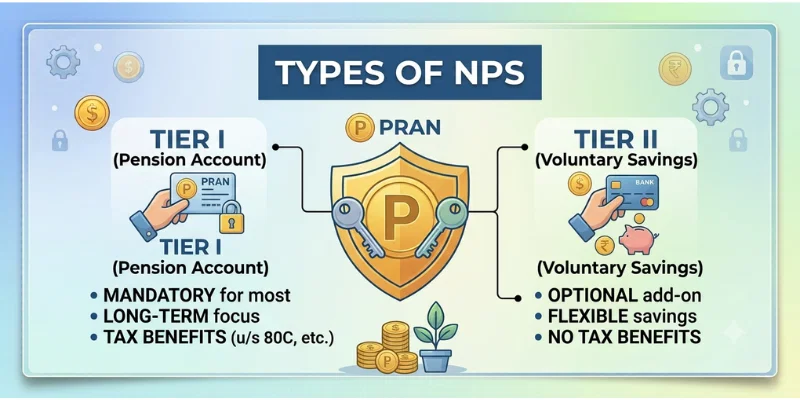
2. Tier II NPS Account
Tier II is an optional investment account available to subscribers who already have an active Tier I account. It provides more withdrawal flexibility and can be used for general market-linked investing. However, it does not usually provide the same retirement and tax benefits as Tier I.
Main Features of Tier II
- It is an optional NPS account.
- An active Tier I account is generally required.
- Deposits and withdrawals are more flexible.
- It does not mainly focus on retirement.
- Subscribers can choose investment options and pension funds.
- Returns depend on market performance.
- General tax benefits are usually limited.
Advantages of Tier II
- Money can usually be withdrawn more easily.
- It offers professional fund management.
- Investors can access different asset classes.
- It may suit medium- or long-term investment needs.
- Contributions can be made according to personal capacity.
- Account management is available through NPS platforms.
Disadvantages of Tier II
- It usually offers limited tax benefits.
- Returns are not fixed or guaranteed.
- Market changes can reduce the account value.
- It cannot normally be opened without Tier I.
- It should not replace an emergency fund.
- It does not provide the same retirement discipline as Tier I.
Who May Choose Tier II?
Tier II may suit existing Tier I subscribers who want a more flexible investment option. Investors should still keep emergency money in safer and more liquid accounts because Tier II remains market-linked.
3. Tier I vs Tier II
| Point | Tier I | Tier II |
| Main purpose | Retirement planning | Flexible investing |
| Account status | Primary NPS account | Optional account |
| Withdrawal | Restricted | More flexible |
| Tax benefits | May be available | Usually limited |
| Employer contribution | May be available | Generally not used |
| Retirement focus | High | Low |
| Market risk | Yes | Yes |
| Best suited for | Long-term retirement | General investment needs |
Among different NPS types, Tier I is mainly designed to build retirement savings, while Tier II offers greater access to money. The right choice depends on whether your main goal is retirement security or flexible market-linked investing.
3. Types of NPS Based on Subscriber Sector
The National Pension System classifies subscribers according to their employment type and the method through which they join the scheme. The four main NPS sectors are Central Government, State Government, Corporate, and All Citizen. NPS Vatsalya is a separate NPS-based scheme created for eligible minors.
1. Central Government NPS
This sector covers eligible Central Government employees and employees of participating Central Autonomous Bodies. Contributions are generally deducted through salary, and the government also contributes according to applicable service rules. The money is deposited into the employee’s Tier I retirement account. Investment choices and pension funds may depend on current government rules. The PRAN remains connected to the subscriber even after a job or location change.
2. State Government NPS
State Government NPS applies to eligible employees of participating state governments and State Autonomous Bodies. The employee and state government contribute according to the rules adopted by that state. Contributions are generally processed through the payroll system and invested in Tier I. Pension fund choices, contribution rates, and service conditions may differ between states. Employees should therefore check the latest rules issued by their department.
3. Corporate NPS
Corporate NPS is designed for employees of companies and other eligible organisations that have adopted NPS. The employee, employer, or both may contribute to the subscriber’s retirement account. Contributions may be deducted automatically from salary, which supports regular retirement saving. The account belongs to the employee and can generally continue after changing jobs. This sector may also offer eligible tax benefits on employer contributions under current laws.
4. All Citizen Model
The All Citizen Model is a voluntary option for eligible people who join NPS independently. It may suit private employees without Corporate NPS, freelancers, professionals, business owners, and other individual retirement planners. Subscribers can choose their contribution amount, pension fund, and investment option within applicable rules. They can open a Tier I account and may also activate Tier II. Among different NPS types, this model offers greater personal control over retirement planning.
5. NPS Vatsalya
NPS Vatsalya is designed for eligible minor children and is operated by a parent or guardian. Contributions are invested to build long-term savings for the child. The account follows separate KYC, contribution, withdrawal, and transition rules. When the child becomes an adult, the account is handled according to the applicable scheme conditions. Parents should not use it as a replacement for emergency savings or education planning.
4. NPS Account Types vs NPS Subscriber Models
NPS account types and subscriber models are related, but they do not mean the same thing. Account types explain how the account works, while subscriber models explain how a person joins the National Pension System.
1. Meaning of NPS Account Types
NPS account types refer to Tier I and Tier II accounts. Tier I mainly focuses on long-term retirement planning and follows withdrawal restrictions. Tier II is optional and offers greater flexibility for general investing.
2. Meaning of NPS Subscriber Models
Subscriber models classify investors according to their employment or joining category. Common models include Central Government, State Government, Corporate, All Citizen, and NPS Vatsalya. Each model may follow different contribution and service rules.
3. Main Purpose
Account types decide the purpose and withdrawal structure of the account. Subscriber models decide how contributions are made and which employment rules apply. Both together define the subscriber’s complete NPS arrangement.
4. Simple Example
A private employee may join through the Corporate NPS model and hold a Tier I account. A freelancer may join through the All Citizen Model and open Tier I with an optional Tier II account. This shows that one subscriber model can include different account types.
5. Key Difference
| Point | NPS Account Types | NPS Subscriber Models |
| Meaning | Structure of the account | Category of the subscriber |
| Main options | Tier I and Tier II | Government, Corporate, All Citizen and others |
| Main focus | Retirement and withdrawal rules | Employment and joining method |
| Example | Tier I retirement account | Corporate NPS subscriber |
| Flexibility | Depends on account tier | Depends on sector rules |
Understanding this difference makes the Types of NPS easier to compare. The account type explains where your money is held, while the subscriber model explains how you participate in NPS.
5. NPS Account Types vs NPS Subscriber Models
NPS account types and subscriber models are two different parts of the National Pension System. Account types explain the purpose and withdrawal rules of an account, while subscriber models show how a person joins NPS based on employment or age category.
1. NPS Account Types
The main NPS account types are Tier I and Tier II. Tier I is the primary retirement account and follows specific withdrawal conditions. Tier II is an optional account that provides greater flexibility for deposits and withdrawals.
2. NPS Subscriber Models
Subscriber models classify people according to their employment or registration category. These models include Central Government NPS, State Government NPS, Corporate NPS, All Citizen Model, and NPS Vatsalya. Contribution rules and employer involvement may differ across these models.
3. Main Purpose
Account types determine how the invested money can be used and withdrawn. Subscriber models determine how the account is opened, who contributes, and which sector rules apply. Both are important for understanding different Types of NPS.
4. Employer Contribution
Tier I accounts under Corporate or Government NPS may receive employer contributions. A Tier I account under the All Citizen Model usually depends on personal contributions. Tier II is generally used for voluntary individual investing.
5. Withdrawal Rules
Withdrawal conditions mainly depend on whether the account is Tier I or Tier II. Tier I has retirement-focused restrictions, while Tier II generally allows easier access. Subscriber-sector rules may add further conditions in some cases.
6. Types of NPS Asset Classes
NPS contributions are invested across different asset classes based on the subscriber’s chosen investment option. Each class has a different level of risk, return potential, and stability, so understanding them is important when comparing Types of NPS.
1. Equity – Asset Class E
Equity invests mainly in shares and related market instruments. It offers higher long-term growth potential but can face strong price changes in the short term. This asset class may suit younger investors or people with a long retirement period and higher risk tolerance.
2. Corporate Debt – Asset Class C
Corporate debt invests in bonds and other debt instruments issued by companies and financial institutions. It usually offers more stability than equity, but it still carries credit and interest-rate risk. This option may suit investors who want a balance between income and moderate risk.
3. Government Securities – Asset Class G
Government securities invest mainly in central and state government bonds. They generally carry lower credit risk than corporate bonds, although their market value can change when interest rates move. This asset class can add stability to an NPS portfolio.
4. Alternative Investments – Asset Class A
Alternative assets may include permitted instruments such as REITs, InvITs, mortgage-backed securities, and other approved investments. They can improve diversification but may carry specialised and higher risks. Allocation limits apply, so only a small part of the portfolio is usually invested in this class.
7. Which Type of NPS Is Best for Beginners?
For many beginners, a Tier I account may be suitable because it focuses on long-term retirement planning. People joining independently can use the All Citizen Model, while eligible employees may benefit from Corporate NPS. Auto Choice can make investing easier because it adjusts the asset mix automatically with age. Tier II offers more flexible withdrawals but should not replace emergency savings. Among different Types of NPS, the best option depends on employment, risk comfort, and retirement goals. Beginners should start with a simple plan and an affordable regular contribution.
8. Which Type of NPS Is Best for Salaried Persons?
For salaried people, Corporate NPS may be a suitable option when the employer offers contributions and payroll deductions. It can make retirement saving more regular and may provide additional tax benefits under applicable rules. If the employer does not offer Corporate NPS, the All Citizen Model can be used independently. Tier I is usually more suitable for long-term retirement planning, while Tier II offers greater withdrawal flexibility. Among different Types of NPS, the right choice depends on employer benefits, tax position, and retirement goals. Salaried investors should compare both options before deciding.
9. How to Choose the Right Type of NPS
Choosing the right option depends on your employment, retirement goal, risk level, and need for withdrawals. Follow these simple steps to compare different Types of NPS.
1. Check Your Employment Type
First, identify whether you are a salaried employee, government worker, freelancer, business owner, or parent opening NPS Vatsalya. This helps you select the correct subscriber model.
2. Decide Your Main Goal
Choose Tier I if your main purpose is long-term retirement planning. Consider Tier II only when you already have Tier I and need more flexible investing.
3. Check Employer Benefits
Find out whether your employer offers Corporate NPS and contributes to your account. Employer support may help increase your retirement savings.
4. Understand Withdrawal Needs
Do not put short-term or emergency money into a restricted retirement account. Keep separate savings for urgent expenses.
5. Choose Active or Auto Choice
Select Active Choice if you understand asset allocation and want more control. Choose Auto Choice if you prefer a simple age-based investment plan.
6. Check Your Risk Level
A higher equity allocation may suit younger investors with a long retirement period. People who prefer more stability may choose a balanced mix of equity, corporate debt, and government securities.
7. Review Tax Benefits
Compare tax benefits under your current tax regime and employment category. Do not select an account only for saving tax.
8. Start with an Affordable Contribution
Choose an amount you can invest regularly without disturbing your monthly expenses. Increase the contribution gradually when your income grows.
9. Compare Pension Fund Managers
Review long-term performance, consistency, risk, and service quality. Avoid choosing a fund only because it recently gave high returns.
10. Review the Account Regularly
Check your NPS account once or twice a year. Update the contribution, nominee, pension fund, or investment choice when your financial situation changes.
10. Tips for Choosing the Right NPS Type
These simple tips can help beginners compare different NPS types and choose a suitable option.
- Select Tier I mainly for long-term retirement planning.
- Check whether your employer offers Corporate NPS benefits.
- Choose Auto Choice if asset allocation feels difficult.
- Keep emergency savings separate from NPS investments.
- Review contributions, nominee details, and investment choices regularly.
Yes, an eligible subscriber can have both accounts. Tier I is the main retirement account, while Tier II offers more flexible withdrawals. An active Tier I account is generally required before opening Tier II.
You may change certain investment choices, pension fund managers, or asset allocation under current rules. However, changing the subscriber model may depend on your employment and account category. Check the latest NPS process before requesting a change.
Corporate NPS may be useful when the employer contributes or offers salary-based deductions. The All Citizen Model may suit people who want to join independently. The better option depends on employer benefits and personal retirement needs.
Tier II generally does not provide the same tax benefits as Tier I. Some special conditions may apply to certain government employees. Always check the latest tax rules before claiming any deduction.
Yes, eligible self-employed subscribers under the All Citizen Model can generally choose Auto Choice. It may suit beginners who do not want to manage asset percentages themselves. The selected life-cycle option will adjust the investment mix with age.
Conclusion
So guys, in this article, we’ve covered Types of NPS in detail. We discussed Tier I, Tier II, subscriber models, asset classes, and suitable options for beginners and salaried people. In my opinion, Tier I with Auto Choice can be a simple starting point for many new investors. However, you should also check employer benefits, withdrawal rules, and your retirement goals before choosing. Compare the available NPS options today and select the one that best supports your future needs.
The information and calculators on Finance Calculatorz are provided for educational purposes only. Calculator results are estimates and may not always be fully accurate. This content is not financial, investment, tax, or legal advice. Please consult a qualified professional before making any financial decision.



- Be Respectful
- Stay Relevant
- Stay Positive
- True Feedback
- Encourage Discussion
- Avoid Spamming
- No Fake News
- Don't Copy-Paste
- No Personal Attacks
- Be Respectful
- Stay Relevant
- Stay Positive
- True Feedback
- Encourage Discussion
- Avoid Spamming
- No Fake News
- Don't Copy-Paste
- No Personal Attacks
