LTCG tax on Mutual Funds: A Complete Guide
Published: 20 Jul 2026
LTCG tax on mutual funds applies when you sell your mutual fund units after holding them for the required long-term period. The tax amount depends on the type of fund, the holding period, and the profit you earn. Equity mutual funds and debt mutual funds may follow different tax rules. The exemption limit can also affect your final tax amount. Many investors ignore these points and face confusion at the time of redemption. So, it is important to understand LTCG tax on mutual funds before selling your units.
1. What is LTCG Tax on Mutual Funds?
LTCG tax on mutual funds is the tax you may pay when you sell mutual fund units after holding them for the required long-term period. LTCG stands for Long-Term Capital Gain. It applies only when you earn a profit from the sale. The holding period depends on the type of mutual fund you own. Equity and debt mutual funds may follow different tax rules.
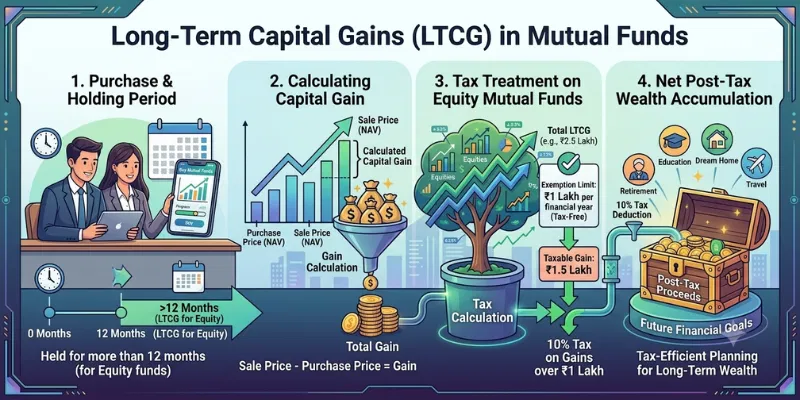
To calculate LTCG tax on mutual funds, you first find the difference between the sale value and the purchase cost. You then check the fund type, holding period, and available tax exemption. Only the taxable part of the profit is used to calculate the final tax. Charges like cess may also increase the total amount. Understanding these rules helps investors plan redemptions and avoid tax mistakes.
1. Capital Gain with Example
Capital gain is the profit you earn when you sell an investment for more than its purchase price. It can come from mutual funds, shares, property, gold, or other assets. The gain becomes taxable only when you sell the asset and book the profit. For example, suppose you invest ₹50,000 in a mutual fund and later sell it for ₹65,000. Your capital gain will be ₹15,000 because ₹65,000 minus ₹50,000 equals ₹15,000. This gain may be short-term or long-term based on how long you held the investment. Knowing the type of capital gain helps you calculate the correct tax.
2. Which Mutual Funds Qualify as Equity-Oriented Funds?
An equity-oriented mutual fund mainly invests investors’ money in shares of Indian companies. For tax purposes, a fund generally needs to invest at least 65% of its assets in domestic company shares. These funds aim to grow money over a long period. Their value can rise or fall with the stock market. They also follow equity mutual fund tax rules.
Large-cap, mid-cap, small-cap, flexi-cap, and many index funds usually qualify as equity-oriented funds. elss funds and aggressive hybrid funds may also qualify when they meet the required equity level. However, every hybrid fund or fund of funds may not receive the same tax treatment. Investors should check the fund document before making a decision. This simple check can help them calculate capital gains tax correctly.
3. LTCG Tax on Equity Mutual Funds
LTCG tax on equity mutual funds applies when you sell units after holding them for more than 12 months and earn a profit. Under the current rules, total eligible long-term gains up to ₹1.25 lakh in a financial year are tax-free. Any gain above this limit is taxed at 12.5%, without indexation benefit. Investors should check their total yearly gains before redeeming units to calculate the correct tax.
4. LTCG Tax on Debt Mutual Funds
LTCG tax on debt mutual funds depends on the purchase date and the fund’s investment structure. Many debt fund units bought on or after 1 April 2023 do not receive long-term tax benefits, even when investors hold them for several years. Their gains are usually added to the investor’s total income and taxed according to the applicable income tax slab. Investors should check the purchase date and fund category before calculating tax, as older investments may follow different rules.
5. LTCG Tax on Hybrid Mutual Funds
LTCG tax on hybrid mutual funds depends on how much the fund invests in equity and debt assets. If the scheme qualifies as an equity-oriented fund, gains after more than 12 months follow equity fund tax rules. Other hybrid funds may need a longer holding period, and their tax rate can depend on the fund structure and purchase date. Investors should check the scheme category before selling because not every hybrid fund receives the same LTCG tax treatment.
6. LTCG Tax on Gold and International Mutual Funds
LTCG tax on gold and international mutual funds depends on the purchase date, holding period, and fund structure. These funds do not usually qualify for the special tax rules available to Indian equity mutual funds. Some investments held for the required long-term period may face 12.5% tax without indexation, while specified funds may be taxed at the investor’s income tax slab rate. Investors should check the scheme type and purchase date before selling because the tax treatment can differ.
7. How to Calculate LTCG Tax on Mutual Funds
Step 1: Find Your Capital Gain
Subtract the purchase cost from the sale value of your mutual fund units.
Step 2: Check the Fund Type
Equity, debt, hybrid, gold, and international funds can follow different tax rules.
Step 3: Check the Holding Period
This tells you whether your profit qualifies as a long-term capital gain.
Step 4: Apply the Tax-Free Limit
For eligible equity mutual funds, total LTCG up to ₹1.25 lakh in a financial year is tax-free.
Step 5: Calculate the Taxable Gain
Suppose your equity LTCG is ₹2 lakh. After removing the ₹1.25 lakh exemption, your taxable gain becomes ₹75,000.
Step 6: Apply the Tax Rate
A 12.5% tax on ₹75,000 comes to ₹9,375. Cess and surcharge may increase the final tax amount.
8. How SIP Investments Affect LTCG Tax
Each SIP instalment counts as a separate mutual fund investment for LTCG tax. This means every payment has its own purchase date, cost, and holding period. When you redeem units, the oldest units are usually treated as sold first under the FIFO method. Some units may qualify as long-term, while newer units may remain short-term. For example, units bought 14 months ago may face LTCG rules, but units bought 8 months ago may face STCG rules. So, always check the age of each SIP instalment before calculating tax.
9. How Lumpsum Investments Affect LTCG Tax
A lump-sum investment usually has one main purchase date, so LTCG tax is easier to track. The holding period starts from the day you invest the full amount. When you sell the units, the gain becomes long-term only after the required holding period is complete. For example, if you invest ₹2 lakh at once and sell later for ₹2.60 lakh, your capital gain is ₹60,000. The tax treatment then depends on the fund type and how long you held the units. Extra lump-sum purchases will have separate purchase dates and separate holding periods.
10. Common Mistakes Investors Make
- Treating every mutual fund as an equity fund and using the wrong tax rules.
- Ignoring the purchase date while checking the long-term holding period.
- Forgetting that every sip instalment has a separate holding period.
- Applying the ₹1.25 lakh exemption to debt, gold, or international funds.
- Using old tax rates without checking the latest rules.
No, the ₹1.25 lakh limit does not apply to each scheme separately. It applies to your total eligible long-term gains from equity investments during one financial year. Any eligible gain above this limit may become taxable.
Yes, one SIP redemption can include both types of gains. Older SIP units may qualify as long-term, while newer units may still remain short-term. This happens because every SIP instalment has its own purchase date.
Yes, a mutual fund switch is usually treated as a redemption from the old scheme and a fresh purchase in the new scheme. If the old units have earned a profit, capital gains tax may apply. This rule can also apply when you switch between plans of the same fund house.
Yes, eligible capital losses can help reduce taxable capital gains. A long-term capital loss can generally be adjusted against long-term capital gains. You must report the loss correctly and file your tax return on time to carry it forward.
Tax depends on the units sold, not only on the amount you withdraw. Even a small redemption may include both your invested money and some profit. The fund statement can show the actual capital gain linked to the redeemed units.
No, the three-year lock-in period does not make all ELSS gains tax-free. elss usually follows equity mutual fund tax rules after redemption. Eligible long-term gains above the yearly exemption may still be taxable.
Conclusion
So guys, in this article, we’ve covered LTCG tax on mutual funds in detail. We discussed its meaning, tax rates, fund types, holding periods, and simple calculation steps. I personally recommend checking your fund category and purchase date before redeeming any units. This small step can help you avoid tax mistakes and plan your returns wisely. Review your mutual fund statement today and calculate your possible tax before making a withdrawal.
The information and calculators on Finance Calculatorz are provided for educational purposes only. Calculator results are estimates and may not always be fully accurate. This content is not financial, investment, tax, or legal advice. Please consult a qualified professional before making any financial decision.



- Be Respectful
- Stay Relevant
- Stay Positive
- True Feedback
- Encourage Discussion
- Avoid Spamming
- No Fake News
- Don't Copy-Paste
- No Personal Attacks
- Be Respectful
- Stay Relevant
- Stay Positive
- True Feedback
- Encourage Discussion
- Avoid Spamming
- No Fake News
- Don't Copy-Paste
- No Personal Attacks
