What is MIRR? How it Works and How to Calculate
Published: 6 Nov 2026
MIRR is a financial return method used to evaluate investments with multiple cash flows. It improves some limitations of traditional IRR by using separate finance and reinvestment rates. This gives investors a more realistic annualized return estimate. Modified Internal Rate of Return also reduces the problem of multiple IRR results. Understanding this method can help businesses compare long-term projects more clearly.
1. What Is MIRR?
MIRR stands for Modified Internal Rate of Return and measures the annualized return of an investment with multiple cash flows. It improves the traditional IRR method by using separate rates for financing negative cash flows and reinvesting positive cash flows. The finance rate represents the cost of funding the investment, while the reinvestment rate shows the expected return on reinvested income. Modified Internal Rate of Return generally produces one clear result and reduces the problem of multiple return rates. It gives investors and businesses a more realistic view of project profitability. However, the final result still depends on accurate cash flows and suitable finance and reinvestment rates.
2. Working of MIRR
MIRR works by separating an investment’s negative and positive cash flows. Negative cash flows, such as the initial investment and later expenses, are discounted to their present value using the finance rate. Positive cash flows, such as income and sale proceeds, are compounded to the end of the investment period using the reinvestment rate. The Modified Internal Rate of Return then calculates the annual rate that connects the present value of costs with the future value of returns. This method gives a more realistic result than standard IRR because it does not assume that all income can be reinvested at the same IRR. It also usually produces one clear return rate, making project comparison easier.
3. Why Was MIRR Introduced?
MIRR was introduced to solve some important limitations of the traditional IRR method. Standard IRR assumes that all positive cash flows are reinvested at the same IRR, which may be unrealistic when the calculated rate is very high. It can also produce multiple return rates when cash flows change between negative and positive more than once. Modified Internal Rate of Return addresses these problems by using a realistic finance rate for negative cash flows and a separate reinvestment rate for positive cash flows. It generally provides one clear annualized return, making project evaluation and comparison easier. However, the result still depends on selecting suitable rates and using accurate cash-flow estimates.
4. MIRR Formula
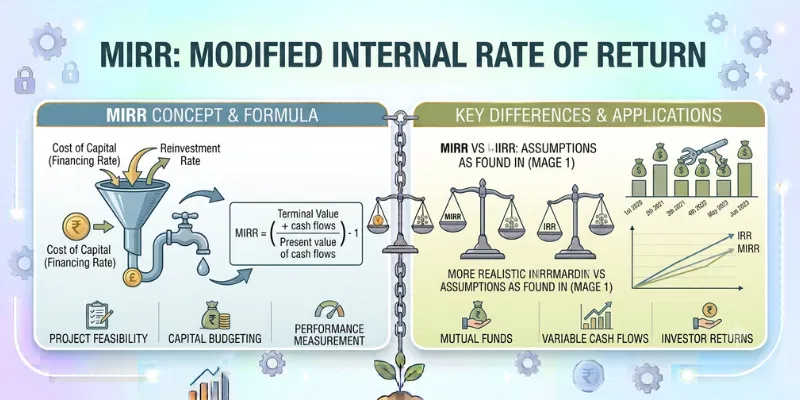
The Modified Internal Rate of Return formula compares the future value of positive cash flows with the present value of negative cash flows over the complete investment period.
MIRR = [(Future Value of Positive Cash Flows ÷ Present Value of Negative Cash Flows)^(1 ÷ n)] − 1
Here:
- Future Value of Positive Cash Flows means all income or returns compounded to the end of the investment period using the reinvestment rate.
- Present Value of Negative Cash Flows means the initial investment and other expenses discounted to the beginning using the finance rate.
- n represents the total number of investment periods.
- MIRR is the Modified Internal Rate of Return expressed as an annual percentage.
This formula provides a more realistic result because it uses separate rates for financing costs and reinvested returns. It also usually gives one clear answer, unlike traditional IRR, which may sometimes produce multiple results.
5. Main Components of MIRR
Modified Internal Rate of Return depends on several components that work together to calculate a realistic annualized return. These components explain how investment costs are financed, how positive returns are reinvested, and how the complete project period affects the final result.
1. Positive Cash Flows
Positive cash flows include income, returns, dividends, rental income, or final sale proceeds received from an investment. These amounts are compounded to the end of the investment period using the reinvestment rate.
2. Negative Cash Flows
Negative cash flows include the initial investment and any additional costs paid during the project. These amounts are discounted back to the beginning of the investment period using the finance rate.
3. Finance Rate
The finance rate represents the cost of borrowing or arranging funds for the investment. It is used to calculate the present value of all negative cash flows.
4. Reinvestment Rate
The reinvestment rate is the expected return earned by reinvesting positive cash flows. It provides a more realistic assumption than reinvesting every return at the original IRR.
5. Investment Period
The investment period is the total duration of the project or investment. It helps convert the final result into an annualized percentage.
6. Future Value of Positive Cash Flows
All positive cash flows are moved forward to the end of the project using the reinvestment rate. This shows how much the received income may grow over time.
7. Present Value of Negative Cash Flows
All negative cash flows are brought back to the starting point using the finance rate. Modified Internal Rate of Return then connects this present cost with the future value of returns.
6. How to Calculate MIRR
To calculate MIRR, you need the complete cash-flow details, finance rate, reinvestment rate, and total investment period. The calculation first brings all negative cash flows to their present value and moves all positive cash flows to the end of the project.
1. Step 1: Record All Cash Flows
List the initial investment, future income, additional expenses, and final sale value in the correct order. Enter investments and costs as negative values, while income and returns should be positive.
2. Step 2: Select the Finance Rate
Choose the rate that represents the cost of borrowing or arranging money for the investment. This rate is used to discount negative cash flows back to the beginning.
3. Step 3: Select the Reinvestment Rate
Choose a realistic rate at which positive cash flows can be reinvested. This rate is used to compound all income to the end of the investment period.
4. Step 4: Calculate the Present Value of Negative Cash Flows
Discount the initial investment and any later expenses using the finance rate. Add these discounted amounts to find the total present value of all outflows.
5. Step 5: Calculate the Future Value of Positive Cash Flows
Compound every positive cash flow to the end of the project using the reinvestment rate. Add these amounts to calculate the total future value of all inflows.
6. Step 6: Apply the MIRR Formula
Use the following formula:
MIRR = [(Future Value of Positive Cash Flows ÷ Present Value of Negative Cash Flows)^(1 ÷ n)] − 1
Here, n represents the total number of investment periods.
7. Step 7: Convert the Result into a Percentage
Multiply the calculated value by 100 to express the Modified Internal Rate of Return as an annual percentage. This percentage shows the estimated yearly return after considering realistic financing and reinvestment assumptions.
7. Features of MIRR
Modified Internal Rate of Return includes several features that make it useful for evaluating investments and long-term business projects. It improves some weaknesses of traditional IRR and provides a more practical annualized return estimate.
- Uses multiple cash flows: It includes the initial investment, additional expenses, regular income, and final sale proceeds.
- Considers the time value of money: It adjusts cash flows according to when they occur during the investment period.
- Uses a separate finance rate: Negative cash flows are discounted using the cost of funding the investment.
- Uses a separate reinvestment rate: Positive cash flows are compounded using a realistic expected return.
- Usually gives one clear result: It reduces the problem of multiple return rates that may occur with traditional IRR.
- Shows annualized performance: The final result is expressed as a yearly percentage.
- Supports project comparison: Businesses can compare different projects using a consistent return measure.
8. Importance of MIRR
Modified Internal Rate of Return is important because it gives investors and businesses a more realistic estimate of an investment’s annualized return. It improves traditional IRR by using separate finance and reinvestment rates, which makes project evaluation clearer and more practical.
- Provides a realistic return estimate: It avoids the assumption that all positive cash flows can be reinvested at the same IRR.
- Considers financing costs: Negative cash flows are adjusted using the finance rate, which reflects the cost of arranging funds.
- Uses a practical reinvestment rate: Positive cash flows are compounded at a rate that may better match actual market opportunities.
- Reduces the multiple IRR problem: It usually produces one clear return rate, even when cash flows change signs more than once.
- Improves project comparison: Businesses can compare several long-term projects using a more consistent annual percentage.
- Supports capital budgeting: It helps evaluate investments such as machinery, expansion, property, and product development.
- Includes the time value of money: Cash flows are adjusted according to when they occur during the investment period.
| Advantages of MIRR |
|---|
|
| Disadvantages of MIRR |
|---|
|
9. MIRR Decision Rule
The MIRR decision rule helps investors and businesses decide whether a project is financially acceptable. The calculated return is compared with the required rate of return, cost of capital, or minimum return expected from the investment.
1. Accept the Investment
Consider accepting the project when its MIRR is higher than the required rate of return. This suggests that the investment may generate enough return to cover its financing cost and meet the expected target.
2. Reject the Investment
Consider rejecting the project when its Modified Internal Rate of Return is lower than the required return. This indicates that the expected annualized return may not be sufficient for the project’s cost and risk.
3. Review the Investment Carefully
Review the project in more detail when Modified Internal Rate of Return is equal to or very close to the required return. Small changes in costs, income, finance rate, or reinvestment rate could affect the final decision.
4. Comparing Multiple Projects
When comparing several projects, a higher MIRR may indicate a stronger return. However, businesses should also review NPV, total profit, project size, duration, and risk before choosing the final option.
For example, if a project has an MIRR of 13% and the required return is 10%, it may be considered acceptable. However, this decision should still be supported by realistic cash-flow estimates and a complete financial analysis.
10. What Is a Good MIRR?
A good MIRR is generally one that is higher than the investor’s required rate of return or the company’s cost of capital. For example, if a business expects at least a 10% return and a project produces a Modified Internal Rate of Return of 13%, the project may be considered financially attractive. However, there is no single good rate for every investment because the suitable return depends on risk, project duration, industry, financing cost, and available alternatives.
Some important points to consider include:
- Required return: MIRR should ideally be higher than the minimum return expected from the project.
- Cost of capital: A return above the company’s financing cost may indicate better financial potential.
- Project risk: Higher-risk projects may require a higher Modified Internal Rate of Return.
- Investment duration: Projects with different time periods should not be compared only through one percentage.
- Cash-flow reliability: The result is more useful when future income and expenses are estimated realistically.
11. MIRR in Real Estate
Modified Internal Rate of Return can help evaluate a real estate investment that includes purchase costs, rental income, maintenance expenses, and final sale proceeds. It uses a finance rate for negative cash flows, such as the property price, renovation, and repair costs. Positive cash flows, including rent and sale value, are compounded using a realistic reinvestment rate. This gives investors a clearer annualized return than traditional IRR in some cases. However, the result still depends on accurate estimates of income, expenses, financing costs, and property value.
- Include the property purchase price and renovation costs as negative cash flows.
- Add rental income and final sale proceeds as positive cash flows.
- Use a realistic borrowing rate and reinvestment rate.
- Compare MIRR with NPV, risk, holding period, and total profit.
12. MIRR in Capital Budgeting
Modified Internal Rate of Return is useful in capital budgeting because it helps businesses evaluate long-term investment projects more realistically. It considers the cost of financing negative cash flows and the return earned on reinvested positive cash flows. Companies can use it to compare projects such as machinery purchases, business expansion, or new product launches. Modified Internal Rate of Return usually provides one clear annualized result, which makes project ranking easier. However, it should still be reviewed with NPV, project risk, duration, and total value created.
- Compare the project’s MIRR with the required rate of return.
- Use realistic finance and reinvestment rates.
- Include all expected costs, income, and final value.
- Review NPV, risk, project size, and duration before making a decision.
13. Multiple IRR Problem
The multiple IRR problem occurs when an investment’s cash flows change signs more than once during the project period. For example, a project may begin with an initial cost, generate positive income, and later require another major expense. In such cases, the traditional IRR method may produce two or more return rates, making the result confusing. Modified Internal Rate of Return helps reduce this problem by using separate finance and reinvestment rates. It generally provides one clear annualized return for easier project evaluation.
- It usually appears in projects with non-conventional cash-flow patterns.
- Multiple return rates can make investment comparison difficult.
- MIRR generally provides one clearer result than traditional IRR.
- NPV should also be reviewed before making the final decision.
Modified Internal Rate of Return solves some important limitations of traditional IRR. It uses separate finance and reinvestment rates and usually produces one clear result. However, the better method depends on the investment and the available cash-flow data.
Yes, MIRR can be negative when the investment generates less value than its total cost. A negative result suggests that the project may not recover the invested amount effectively. Investors should also review NPV and cash-flow estimates before deciding.
MIRR uses a finance rate for negative cash flows and a reinvestment rate for positive cash flows. This reflects the cost of funding and the realistic return available on reinvested income. Using separate rates makes the calculation more practical than standard IRR.
MIRR generally produces one clear annualized return. This is one of its main advantages over traditional irr, which may show multiple rates when cash-flow signs change several times. A single result makes project comparison easier.
No, a higher Modified Internal Rate of Return alone does not guarantee that an investment is better. The project may also involve greater risk, higher costs, or uncertain future cash flows. Investors should compare NPV, duration, project size, and total profit as well.
No, Modified Internal Rate of Return is based on expected or historical cash-flow information. Actual results may change because of market conditions, costs, delays, and inaccurate forecasts. Investors should treat it as an evaluation tool rather than a guarantee.
Conclusion
So guys, in this article, we’ve covered MIRR in detail. It provides a more realistic annualized return by using separate finance and reinvestment rates for negative and positive cash flows. In my opinion, investors and businesses should use it with NPV, project risk, duration, and total profit instead of relying on one percentage alone. You can also compare the result through an IRR Calculator to understand how different assumptions affect the return. Review your project cash flows today and choose the investment that best matches your required return.
The content on Finance Calculatorz is intended for educational and informational purposes. It provides general guidance on financial topics and tools. Readers are encouraged to use the information to make informed decisions about their finances.



- Be Respectful
- Stay Relevant
- Stay Positive
- True Feedback
- Encourage Discussion
- Avoid Spamming
- No Fake News
- Don't Copy-Paste
- No Personal Attacks
- Be Respectful
- Stay Relevant
- Stay Positive
- True Feedback
- Encourage Discussion
- Avoid Spamming
- No Fake News
- Don't Copy-Paste
- No Personal Attacks
