IRR vs XIRR: Key Differences and Benefits
Published: 4 Nov 2026
IRR vs XIRR is an important comparison for investors who want to measure annualized returns accurately. Both methods consider multiple cash flows, but they handle transaction timing differently. IRR assumes that cash flows occur at equal intervals, while XIRR uses the exact date of every investment and withdrawal. This makes IRR suitable for structured cash flows and XIRR more useful for real investment portfolios. Understanding IRR vs XIRR helps investors choose the correct return calculation method.
1. What Is IRR vs XIRR?
IRR vs XIRR compares two methods used to calculate the annualized return of investments with multiple cash flows. IRR stands for Internal Rate of Return and assumes that deposits, withdrawals, or returns occur at equal time intervals. It calculates the rate at which the net present value of all cash flows becomes zero. This method is commonly used for projects or investments with regular monthly, quarterly, or yearly transactions.
xirr stands for Extended Internal Rate of Return and uses the exact date of every cash flow. It is more suitable when investments, withdrawals, dividends, or redemptions happen on irregular dates. In simple words, IRR works with fixed intervals, while XIRR reflects the actual timing of transactions. Therefore, XIRR usually provides a more realistic return for SIPs, mutual funds, stocks, and personal investment portfolios.
2. Working of IRR vs XIRR
IRR works by arranging the initial investment and all future cash flows at equal time intervals, such as monthly, quarterly, or yearly. The initial investment is entered as a negative value, while income, withdrawals, or the final value are entered as positive values. It then finds the discount rate at which the net present value of all cash flows becomes zero. IRR does not use exact transaction dates, so it is most suitable when the time gap between cash flows remains regular.
XIRR works in a similar way, but it also includes the actual date of every transaction. It measures how long each amount remained invested and adjusts the annualized return accordingly. In the IRR vs XIRR comparison, IRR uses fixed periods, while XIRR uses the exact number of days between cash flows. This makes XIRR more practical for SIPs, mutual funds, and portfolios where investments and withdrawals happen on different dates.
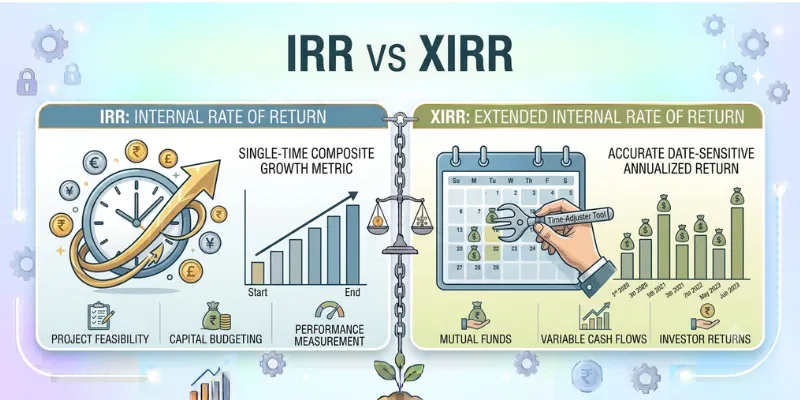
3. Differences Between IRR and XIRR
IRR vs XIRR compares two methods used to calculate annualized returns from multiple cash flows. Both consider the time value of money, but they differ mainly in how they handle transaction intervals and dates.
1. Transaction Intervals
IRR assumes that every cash flow occurs at an equal interval, such as monthly, quarterly, or yearly. For example, if income is received at the end of every year, IRR can calculate the return effectively.
XIRR does not require equal intervals. It can calculate returns when investments, withdrawals, or income occur on different dates. This makes it more suitable for real-world investment activity.
2. Use of Exact Dates
IRR only uses the order of cash flows and treats the time gap between them as equal. It does not require investors to enter the actual date of each transaction.
XIRR uses the exact date of every cash flow. It calculates how many days passed between transactions and adjusts the annualized return accordingly. This is one of the most important differences in IRR vs XIRR.
3. Suitable Investment Type
IRR is suitable for business projects or investments where cash flows follow a fixed schedule. Examples include yearly project income, regular loan payments, or structured financial plans.
XIRR is more suitable for mutual funds, SIPs, stocks, real estate, and personal portfolios. These investments usually involve purchases, dividends, withdrawals, and redemptions on irregular dates.
4. Calculation Method
IRR finds the discount rate at which the net present value of all cash flows becomes zero. It uses period numbers such as Year 1, Year 2, and Year 3 rather than actual calendar dates.
XIRR also finds the rate that makes net present value equal to zero. However, it uses the exact number of days between each transaction and the first cash flow. This allows it to reflect the real investment period more accurately.
5. Data Required
IRR requires the initial investment and all future cash flows in the correct order. Investors do not need to provide transaction dates, but every cash flow must represent an equal time period.
XIRR requires both the cash-flow amounts and their matching dates. Each value must be connected to the correct transaction date. Missing or incorrect dates can significantly change the final result.
6. Accuracy of Results
IRR gives an accurate result when all cash flows occur at equal intervals. However, it may become less reliable when actual transaction dates vary significantly.
XIRR usually gives a more realistic return for irregular cash flows because it considers the exact timing of every transaction. Therefore, its accuracy is often better for SIPs and personal investment portfolios.
7. Ease of Calculation
irr is slightly easier to arrange because only the cash-flow values are required. However, solving it manually can still be difficult because the calculation involves trial and error.
XIRR requires additional date information, so data preparation may take more time. Investors usually use a spreadsheet, financial software, or calculator to find the result accurately.
8. Common Uses
IRR is commonly used in capital budgeting, business expansion, machinery purchases, and project evaluation. It helps companies compare the expected return of projects with their required rate of return.
XIRR is commonly used to measure returns from SIPs, mutual funds, stocks, property investments, and portfolios with irregular transactions. Therefore, in the IRR vs XIRR comparison, IRR suits fixed-period cash flows, while XIRR is more practical for transactions made on actual dates.
4. IRR vs XIRR Comparison Table
| Basis | IRR | XIRR |
|---|---|---|
| Full form | Internal Rate of Return | Extended Internal Rate of Return |
| Time intervals | Assumes equal intervals between cash flows | Handles irregular intervals between cash flows |
| Exact dates | Does not require actual transaction dates | Requires the exact date of each transaction |
| Best suited for | Business projects and regular cash flows | SIPs, mutual funds, stocks, and personal portfolios |
| Calculation basis | Uses fixed period numbers | Uses the actual number of days between transactions |
| Accuracy | More accurate for regular cash flows | More accurate for irregular cash flows |
| Advantages of IRR |
|---|
|
| Disadvantages of IRR |
|---|
|
| Advantages of XIRR |
|---|
|
| Disadvantages of XIRR |
|---|
|
5. Common Mistakes in IRR vs XIRR
- Using IRR for irregular dates: IRR assumes equal time intervals, so it may give a less accurate result when transactions occur on different dates.
- Entering wrong cash-flow signs: Investments should be entered as negative values, while withdrawals, income, and final value should be positive.
- Missing important transactions: Excluding deposits, dividends, withdrawals, or redemptions can make the final return misleading.
- Forgetting the final portfolio value: The current or closing investment value must be included as a positive cash flow.
- Using incorrect transaction dates: Even a small date error can affect XIRR because it uses the exact number of days between cash flows.
- Mixing regular and irregular periods: Investors should not use IRR when some cash flows are monthly and others occur on random dates.
- Comparing different investment durations: Returns should be compared over similar periods for a fair IRR vs XIRR analysis.
- Confusing annualized return with total return: Both methods show yearly performance, not the complete percentage gain earned over the full period.
- Ignoring fees, taxes, and costs: These charges can reduce actual returns and should be included where relevant.
6. Tips for Choosing Between IRR and XIRR
- Use IRR when cash flows occur at equal monthly, quarterly, or yearly intervals.
- Use XIRR when investments, withdrawals, or returns happen on different dates.
- Enter investments as negative values and returns as positive values.
- Include every deposit, dividend, withdrawal, and final portfolio value.
- Check all transaction dates carefully before calculating XIRR.
- Compare investments over similar periods for a fair result.
- Review risk, costs, taxes, and total profit along with the annualized return.
Yes, they may show similar results when all cash flows occur at equal intervals. In that situation, the effect of exact dates is limited. However, the results can differ when transaction dates are irregular.
Yes, XIRR is generally more suitable for SIPs because each instalment has an actual transaction date. It considers how long every payment remained invested. This makes the result more realistic for mutual fund portfolios.
IRR can include multiple cash flows, but it assumes equal gaps between them. It may give a less accurate result when transactions happen on different dates. XIRR is usually the better choice in such cases.
The difference usually comes from transaction timing. IRR treats cash flows as regularly spaced, while XIRR uses their exact dates. Earlier or later payments can therefore change the annualized result.
Yes, both methods can produce a negative return. This may happen when the total value received is lower than the amount invested. A negative result indicates an annualized investment loss.
No, a higher XIRR does not automatically make an investment better. It may also involve greater risk, higher costs, or unstable performance. Investors should review risk, consistency, duration, and total profit as well.
No, these methods mainly measure historical or estimated performance. Future returns can change because of market movements, expenses, and investment decisions. Investors should not treat past annualized returns as guaranteed results.
Conclusion
So guys, in this article, we’ve covered IRR vs XIRR in detail. Both methods calculate annualized returns, but they are suitable for different cash-flow patterns. IRR works better when transactions occur at equal intervals, while XIRR uses exact dates and is more practical for irregular investments. In my opinion, investors should review their transaction history before selecting either method. Check your cash flows carefully and use the calculation that gives you a more accurate performance result.
The information and calculators on Finance Calculatorz are provided for educational purposes only. Calculator results are estimates and may not always be fully accurate. This content is not financial, investment, tax, or legal advice. Please consult a qualified professional before making any financial decision.



- Be Respectful
- Stay Relevant
- Stay Positive
- True Feedback
- Encourage Discussion
- Avoid Spamming
- No Fake News
- Don't Copy-Paste
- No Personal Attacks
- Be Respectful
- Stay Relevant
- Stay Positive
- True Feedback
- Encourage Discussion
- Avoid Spamming
- No Fake News
- Don't Copy-Paste
- No Personal Attacks
