What is NPS Tier 2? Benefits and Eligibility
Published: 11 Sep 2026
Are you confused about how NPS Tier 2 works and whether it is different from Tier 1? Many beginners do not understand its eligibility rules, investment choices, withdrawal flexibility, and tax treatment. They may also assume that it offers the same tax benefits as the main pension account. This confusion can lead to wrong expectations and poor investment decisions. A clear understanding can help you decide whether this account suits your financial goals.
1. What Is NPS Tier 2?
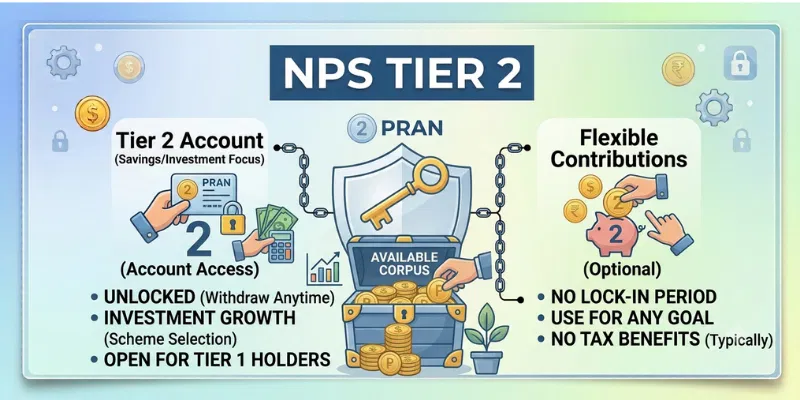
NPS Tier 2 is an optional investment account available to eligible subscribers who already have an active Tier 1 account. It allows investors to contribute money and withdraw it with more flexibility than the main retirement account. The invested amount can be divided among equity, corporate debt, and government securities. For example, Ravi may invest ₹3,000 every month in his Tier 2 account for a medium-term goal. His final value will depend on contributions, market returns, asset allocation, and charges. Since Tier 2 NPS offers flexible withdrawals, it may suit investors who want easier access to their money.
2. Working of NPS Tier 2
NPS Tier 2 works as an optional investment account linked to an active Tier 1 account. The subscriber can add money according to personal income and financial goals. They can choose a pension fund manager to handle the invested amount. The money is then divided among equity, corporate debt, and government securities. Subscribers may select their preferred asset allocation based on risk level. The account value changes according to market performance, charges, and investment time.
Tier 2 NPS also allows subscribers to withdraw money with greater flexibility. They can request a partial or full withdrawal when funds are required. There is generally no compulsory retirement lock-in for the regular Tier 2 account. The withdrawn amount is transferred to the registered bank account after processing. Subscribers may also transfer money from Tier 2 to Tier 1 under applicable rules. Once transferred to Tier 1, that money follows the stricter retirement withdrawal conditions.
3. Who Can Open an NPS Tier 2 Account?
The following conditions can help you understand who is eligible to open an NPS Tier 2 account.
1. Existing Tier 1 Subscriber
A person must generally have an active nps tier 1 account before opening Tier 2. The Tier 2 account works as an optional account linked to the same PRAN.
2. Eligible NPS Subscriber
Salaried employees, self-employed people, professionals, business owners, and other eligible NPS subscribers may activate the account. Their main Tier 1 account must remain active.
3. Government and Corporate Employees
Eligible Central Government, State Government, and corporate subscribers may also open the account. It can usually be activated with Tier 1 registration or at a later stage.
4. Complete KYC Details
The subscriber must have valid KYC information, including identity proof, address proof, PAN, and contact details. The information should match the details registered with the Tier 1 account.
5. Valid Bank Account
A valid bank account is required for contributions and withdrawals. The bank details should be correctly linked to the subscriber’s NPS account.
6. Active PRAN
The subscriber must have a valid Permanent Retirement Account Number. The same PRAN is used to manage both Tier 1 and Tier 2 NPS accounts.
7. Activate the Account
Eligible subscribers can activate Tier 2 through their CRA portal, eNPS platform, or an authorised Point of Presence. They may choose a separate pension fund and investment option for this account.
4. Main Features of NPS Tier 2
NPS Tier 2 is an optional investment account linked to an active Tier 1 account. It offers market-linked investment choices with greater withdrawal flexibility, making it different from the main retirement-focused NPS account.
1. Optional Investment Account
Opening this account is not compulsory for every NPS subscriber. It is an additional investment facility for eligible people who already maintain an active Tier 1 account.
2. Linked to Tier 1
A regular Tier 2 account works under the subscriber’s existing PRAN. Therefore, a separate Permanent Retirement Account Number is not normally issued for it.
3. Flexible Withdrawals
Subscribers can generally withdraw part or all of their money whenever required. This makes the account more liquid than Tier 1, which follows stricter retirement withdrawal rules.
4. No Compulsory Annuity
Money withdrawn from a regular Tier 2 account does not normally need to be used for purchasing an annuity. The subscriber can receive the approved withdrawal amount directly in the registered bank account.
5. Market-Linked Returns
The account does not provide a fixed or guaranteed interest rate. Its returns depend on asset allocation, pension fund performance, market conditions, investment duration, and applicable charges.
6. Different Asset Classes
Subscribers can invest in permitted asset classes such as equity, corporate debt, and government securities. Alternative Asset Class A is generally available only in Tier 1 and not in the regular Tier 2 account.
7. High Equity Allocation
Under applicable investment choices, subscribers may invest a large portion of the account in equity. This may provide higher long-term growth potential, but it also increases short-term market risk.
8. Pension Fund Selection
Eligible subscribers can select a registered pension fund to manage their money. They should compare long-term performance, risk, consistency, and service quality before making a choice.
9. Separate Investment Choice
The investment pattern selected for Tier 2 NPS can generally be different from the allocation used in Tier 1. This allows subscribers to use the two accounts for different financial goals.
10. Professional Fund Management
Registered pension fund managers invest and manage the contributions. This helps subscribers gain exposure to equity and debt assets without directly selecting individual shares or bonds.
5. NPS Tier 2 Contribution Rules
NPS Tier 2 offers flexible contribution rules because it is an optional investment account. Subscribers can add money according to their income and goals, but certain minimum amounts apply when opening the account and making individual contributions.
1. Minimum Contribution to Open the Account
A subscriber generally needs to contribute at least ₹250 to open a Tier 2 account. An active Tier 1 account is also required before activating it.
2. Minimum Amount for Each Contribution
The minimum amount for a later contribution is generally ₹250. Subscribers can invest more than this amount according to their financial capacity.
3. No Minimum Annual Contribution
There is generally no compulsory minimum contribution required every financial year. This means subscribers do not need to deposit a fixed yearly amount to keep the account active.
4. No Fixed Maximum Limit
There is generally no fixed upper limit on the amount that can be contributed. Subscribers may invest according to their income, financial goals, and risk level.
5. Flexible Contribution Frequency
Subscribers may contribute monthly, quarterly, yearly, or at irregular intervals. They can also make multiple contributions during the same financial year.
6. Voluntary Contributions
All contributions to a regular Tier 2 account are voluntary. The subscriber can decide when and how much to invest without following a compulsory monthly schedule.
7. Personal Contributions Only
Regular Tier 2 NPS contributions are generally made by the subscriber. Employer contributions are mainly connected with the Tier 1 retirement account.
6. NPS Tier 2 Returns
NPS Tier 2 offers market-linked returns, which means it does not provide a fixed or guaranteed interest rate. The actual return depends on the chosen asset classes, pension fund performance, market conditions, investment period, and applicable charges.
1. Returns Depend on Asset Allocation
The selected investment mix has a major effect on account performance. A portfolio with more equity may offer higher growth potential, while debt-heavy allocation may provide relatively greater stability.
2. Equity Returns
Equity investments mainly include shares and equity-related instruments. They may generate stronger returns over the long term but can also face sharp short-term losses during weak market conditions.
3. Corporate Debt Returns
Corporate debt invests mainly in bonds issued by companies. Returns depend on interest rates, bond prices, and the credit quality of the issuing companies.
4. Government Securities Returns
Government securities mainly invest in government bonds. They usually carry lower credit risk, but their market value may still change when interest rates rise or fall.
5. Pension Fund Performance
Different pension fund managers may produce different returns even within the same asset class. Subscribers can compare updated Tier 2 scheme returns through the official NPS Trust return pages.
6. Investment Period Matters
A longer investment period may help reduce the effect of short-term market changes. It can also give the invested money more time to GJsi4$V9O$MA)compounding.
7. Charges Affect Actual Returns
Fund management, recordkeeping, transaction, and service charges may reduce the final value. Subscribers should consider returns after charges instead of looking only at the reported scheme performance.
8. Returns Are Not Guaranteed
Tier 2 NPS is not similar to a fixed deposit or guaranteed savings plan. Its account value may increase or decrease according to market movements.
Now about “NPS Tier 2 Withdrawal Rules”
7. NPS Tier 2 Withdrawal Rules
NPS Tier 2 offers flexible withdrawals because it is an optional investment account rather than the main retirement account. Subscribers can generally withdraw their money at any time without waiting until retirement.
1. Withdrawal at Any Time
Subscribers can request a withdrawal whenever they need money. Regular Tier 2 accounts do not follow the strict retirement withdrawal conditions that apply to Tier 1.
2. Partial Withdrawal
A subscriber may withdraw only a part of the available account balance. The remaining amount can stay invested and continue earning market-linked returns.
3. Full Withdrawal
The entire balance may also be withdrawn when required. After processing, the approved amount is transferred to the subscriber’s registered bank account.
4. No Standard Lock-In Period
A regular Tier 2 NPS account generally has no compulsory lock-in period. Subscribers do not need to wait for a fixed number of years before accessing their funds.
5. No Purpose Restriction
Subscribers do not generally need to provide a special reason for withdrawing money. The amount may be used for education, travel, emergencies, purchases, or other personal needs.
6. No Compulsory Annuity
The withdrawn balance does not normally need to be used to purchase an annuity. This is different from Tier 1, where annuity conditions may apply during certain exits.
7. One-Way Transfer to Tier 1
Subscribers may transfer money from Tier 2 to their Tier 1 account. This is a one-way switch, and the transferred amount then follows the stricter withdrawal and exit rules of Tier 1.
8. Closure of the Tier 1 Account
When the main Tier 1 account is closed, any remaining balance in the regular Tier 2 account is generally withdrawn at the same time. The amount is then transferred to the subscriber’s registered bank account.
8. Charges in NPS Tier 2
NPS Tier 2 is considered a low-cost investment account, but certain charges still apply for account services, transactions, recordkeeping, and fund management. Tier 2 transaction charges are generally the same as Tier 1 charges, while no separate annual maintenance charge applies to the Tier 2 account.
1. Account Activation Charge
A processing charge may apply when activating the Tier 2 account through a Point of Presence or another service channel. The exact amount can depend on the platform or service provider selected by the subscriber.
2. Contribution Processing Charge
A transaction charge may apply whenever money is contributed through certain channels. Online and offline contribution costs can differ, so subscribers should check the fee before making a payment.
3. Central Recordkeeping Agency Charge
The Central Recordkeeping Agency maintains subscriber records, account statements, and transaction details. Recordkeeping and service charges may be recovered according to the approved charge structure.
4. Pension Fund Management Fee
The pension fund manager charges a small fee for investing and managing the subscriber’s money. The maximum investment management fee currently follows asset-based slabs ranging from 0.09% to 0.03%, while a different first-slab rate applies to UTI Pension Fund.
5. Custodian and NPS Trust Charges
Small charges may also apply for holding securities, protecting assets, and supervising the NPS structure. These costs are generally adjusted from the scheme assets instead of being collected separately from the subscriber.
9. How to Open an NPS Tier 2 Account
You can activate NPS Tier 2 online through your Central Recordkeeping Agency portal or offline through an authorised Point of Presence. An active Tier 1 account is generally required before you can open it.
1. Check Your Tier 1 Account
Make sure your Tier 1 account is active and your PRAN is valid. Regular Tier 2 cannot generally be opened without an active Tier 1 account.
2. Log In to Your CRA Account
Visit the CRA platform linked to your NPS account and log in using your PRAN and password. Look for the option called Activate Tier II Account.
3. Confirm Your Personal Details
Review your name, address, mobile number, email address, PAN, and bank details. Update any incorrect information before continuing.
4. Add Nominee Details
Enter or confirm your nominee information. This helps protect the account benefits for your family.
5. Choose a Pension Fund
Select an available pension fund manager to manage your investments. You may choose a fund different from the one used for Tier 1.
6. Select an Investment Option
Choose how your money should be divided among equity, corporate debt, and government securities. Select an allocation that matches your goal and risk tolerance.
7. Make the Initial Contribution
Pay the required opening contribution through an available online payment method. Processing or transaction charges may apply.
8. Complete Authentication
Confirm the request through OTP, e-sign, or another verification method supported by your CRA.
9. Save the Confirmation
After activation, save the receipt and confirmation details. Your Tier 2 NPS account will operate under the same PRAN as your Tier 1 account.
10. Tips for Managing NPS Tier 2
These simple tips can help beginners use NPS Tier 2 more effectively.
- Keep emergency savings separate from this account.
- Choose asset allocation according to your risk level.
- Avoid investing fully in equity without understanding market risk.
- Review your pension fund and portfolio performance regularly.
- Do not expect guaranteed returns from market-linked investments.
- Understand tax rules before making large contributions or withdrawals.
- Keep bank, nominee, mobile, and email details updated.
No, you generally need an active Tier 1 account before opening Tier 2. Both accounts operate under the same PRAN. Tier 2 works as an optional investment account linked to Tier 1.
Yes, regular Tier 2 generally allows partial or full withdrawals whenever required. You do not usually need to wait until retirement. The special Tier II Tax Saver Scheme follows different withdrawal rules.
A regular NPS Tier 2 account generally has no compulsory lock-in period. Subscribers can access their money according to their needs. The Tax Saver Scheme for eligible Central Government employees has a three-year lock-in.
No, returns are market-linked and not guaranteed. The account value depends on asset allocation, pension fund performance, market conditions, and charges. It may rise or fall during the investment period.
Regular Tier 2 contributions generally do not provide the same tax deductions as Tier 1. A special Tax Saver Scheme is available only to eligible Central Government subscribers. Always check the latest income-tax rules before investing.
Conclusion
So guys, in this article, we’ve covered NPS Tier 2 in detail. We discussed its meaning, working, eligibility, main features, contribution rules, returns, withdrawals, charges, and account-opening process. In my opinion, this account can be useful for existing NPS subscribers who want flexible withdrawals and market-linked investment choices. However, you should understand the tax rules and market risks before investing. Review your financial goals today and decide whether this account fits your needs.
The information and calculators on Finance Calculatorz are provided for educational purposes only. Calculator results are estimates and may not always be fully accurate. This content is not financial, investment, tax, or legal advice. Please consult a qualified professional before making any financial decision.



- Be Respectful
- Stay Relevant
- Stay Positive
- True Feedback
- Encourage Discussion
- Avoid Spamming
- No Fake News
- Don't Copy-Paste
- No Personal Attacks
- Be Respectful
- Stay Relevant
- Stay Positive
- True Feedback
- Encourage Discussion
- Avoid Spamming
- No Fake News
- Don't Copy-Paste
- No Personal Attacks
