What is NPS Tier 1? Working and Benefits
Published: 4 Sep 2026
Are you confused about how NPS Tier 1 works and whether it is suitable for your retirement goals? Many beginners find its contribution rules, investment choices, tax benefits, and withdrawal conditions difficult to understand. They may also feel unsure about Active Choice, Auto Choice, and annuity rules. This confusion can make retirement planning stressful. A clear understanding of the account can help you make better investment decisions.
1. What Is NPS Tier 1?
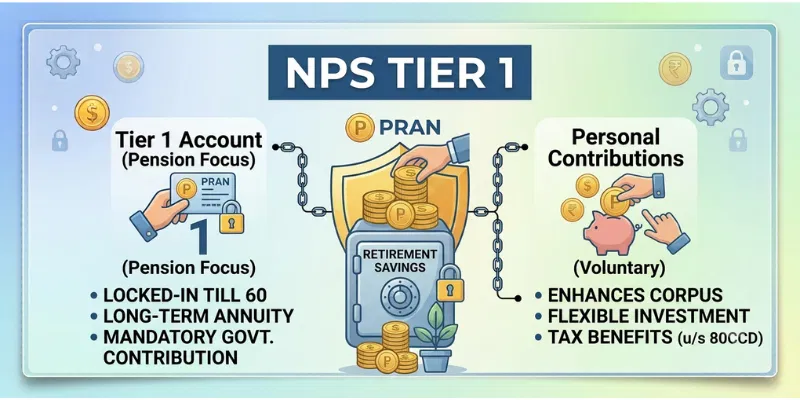
NPS Tier 1 is the main retirement account offered under the National Pension System. It allows subscribers to invest regularly and build a retirement fund for the future. The contributions are invested in equity, corporate bonds, government securities, and other permitted assets. For example, Ravi can invest ₹5,000 every month in his Tier 1 NPS account for 25 years. His final retirement corpus will depend on contributions, market returns, investment period, and applicable charges. Since this account focuses on retirement, it follows specific rules for partial withdrawals and final exit.
2. How Does NPS Tier 1 Work?
NPS Tier 1 works by collecting regular contributions from the subscriber for retirement planning. The subscriber first opens an account and receives a unique Permanent Retirement Account Number. Money can be invested monthly, quarterly, yearly, or at other suitable intervals. In some cases, an eligible employer may also contribute to the employee’s account. The subscriber chooses a pension fund manager to manage and invest the money. They can select Active Choice or Auto Choice based on their investment knowledge. The contributions are then divided among permitted asset classes according to the selected option.
The value of the account grows through regular contributions and market-linked returns. Its performance depends on asset allocation, market conditions, fund results, charges, and time. Equity may offer higher growth, while debt investments may provide greater stability. The subscriber can review the account and change certain investment choices when permitted. Money in Tier 1 NPS cannot be withdrawn as freely as money in a savings account. At retirement, the accumulated corpus is used according to applicable withdrawal and annuity rules. This process helps subscribers build an organised retirement fund throughout their working years.
3. Who Can Open an NPS Tier 1 Account?
The following steps can help you check whether you are eligible to open an NPS Tier 1 account.
1. Check Your Age
A voluntary NPS account can generally be opened by an eligible person between 18 and 85 years of age. Your age is checked on the date you submit the application.
2. Check Your Citizenship Status
Resident Indian citizens can open the account. Eligible Non-Resident Indians and Overseas Citizens of India can also apply under the current rules.
3. Identify Your Employment Type
Salaried employees, self-employed people, freelancers, professionals, and business owners may open the account. Government and corporate employees may also join through the NPS model offered by their employer.
4. Complete the KYC Process
The applicant must complete Know Your Customer verification. This usually requires PAN, identity proof, address proof, photograph, mobile number, and email address.
5. Provide Bank Details
A valid bank account is normally required for contributions and withdrawals. NRIs and OCI applicants may need to provide eligible NRE or NRO bank account details under current rules.
6. Add Nominee Details
The applicant should add a nominee while opening the account. This helps the family claim the account benefits if the subscriber dies.
7. Submit the Application
The account can be opened online through eNPS or through an authorised Point of Presence. After successful registration, the subscriber receives a unique PRAN for managing the Tier 1 NPS account.
4. Main Features of NPS Tier 1
NPS Tier 1 is a long-term retirement account designed to help people build a retirement corpus through regular contributions. It offers flexible investment choices, professional fund management, tax benefits, and controlled withdrawal rules.
1. Retirement-Focused Account
The main purpose of this account is to create savings for retirement. Subscribers invest during their working years and use the accumulated corpus after retirement. Since it is a pension account, it is not suitable for short-term financial needs.
2. Permanent PRAN Number
Every subscriber receives a unique Permanent Retirement Account Number, known as PRAN. This number remains connected to the subscriber throughout their life. It does not change when the person changes a job, employer, city, or state.
3. Flexible Contribution Options
Subscribers can contribute according to their income and financial capacity. They may invest monthly, quarterly, yearly, or at flexible intervals. Regular contributions can make retirement planning more disciplined and manageable.
4. Personal and Employer Contributions
The subscriber can contribute directly to the account. In eligible corporate or government arrangements, the employer may also contribute. Employer contributions can help increase the total retirement savings over time.
5. Market-Linked Returns
The account does not offer a fixed or guaranteed interest rate. Returns depend on market performance and the selected investment mix. The final corpus may change due to contribution amount, investment period, asset allocation, charges, and fund performance.
6. Different Asset Classes
The invested money can be divided among permitted asset classes. These may include equity, corporate debt, government securities, and other approved investments. Each asset class carries a different level of risk and return potential.
7. Active Choice
Active Choice allows subscribers to select the percentage invested in different asset classes. It offers greater control over the portfolio. This option may suit investors who understand risk and asset allocation.
8. Auto Choice
Auto Choice follows a life-cycle investment plan based on the subscriber’s age. The asset allocation changes automatically as the subscriber gets older. It may suit beginners who do not want to manage investment percentages themselves.
9. Professional Fund Management
Registered pension fund managers handle the investments. They invest the contributions according to the selected scheme and asset allocation. This helps subscribers who do not have enough time or knowledge to manage investments directly.
10. Pension Fund Selection
Subscribers may choose a pension fund manager from the available options where permitted. They can compare long-term performance, service quality, and investment approach. Certain changes may also be allowed under current rules.
5. NPS Tier 1 Contribution Rules
NPS Tier 1 offers a flexible contribution system that allows subscribers to invest according to their income and retirement goals. However, minimum contribution requirements, payment methods, and employer rules may differ across subscriber categories.
1. Minimum Contribution at Account Opening
A subscriber generally needs to contribute at least ₹500 while opening a Tier 1 account. This amount becomes the first investment in the retirement account.
2. Minimum Annual Contribution
Under the All Citizen Model, the subscriber generally needs to contribute at least ₹1,000 in one financial year. This amount can be deposited through one payment or several smaller payments during the year.
3. No Maximum Contribution Limit
There is no fixed maximum limit on contributions to the account. Subscribers can invest more according to their income, retirement target, and financial capacity. However, income-tax deductions remain subject to separate legal limits.
4. Flexible Contribution Frequency
Subscribers can contribute monthly, quarterly, yearly, or whenever they have available funds. There is generally no restriction on the number of contributions that can be made during a financial year. Regular monthly investing may make retirement planning more disciplined.
5. Personal Contributions
The account holder can contribute directly through an authorised NPS platform, Central Recordkeeping Agency, Point of Presence, or supported online payment facility. Every successful contribution is added to the subscriber’s retirement corpus and invested according to the selected scheme.
6. Employer Contributions
Eligible employers may contribute to an employee’s account under Corporate or Government NPS arrangements. The contribution amount depends on company policy, salary structure, service rules, and the subscriber’s employment category.
7. Government Employee Contributions
For eligible State Government employees, the employee generally contributes a fixed percentage of salary and Dearness Allowance, while the government also contributes according to applicable service rules. These contributions are deposited into the employee’s Tier 1 account. The exact percentage may differ by government category or current rules.
8. Contribution Through D-Remit
Subscribers can use D-Remit to transfer contributions directly from their bank account. The current minimum contribution through this facility is ₹500, and subscribers can also set up periodic auto-debit instructions through their bank.
9. Contribution Charges
Certain account-opening, contribution-processing, recordkeeping, and service charges may apply. The amount may depend on the contribution method, account channel, and service provider. Subscribers should check the latest official charge table before making payments.
10. Tax Limits Are Different from Contribution Limits
Although Tier 1 NPS does not have a fixed maximum investment limit, the full contribution may not qualify for a tax deduction. Tax benefits depend on the contribution source, employment category, selected tax regime, and current income-tax rules. Subscribers should separate their retirement investment decision from their tax-saving calculation.
6. NPS Tier 1 Investment Options
NPS Tier 1 allows subscribers to choose how their contributions are invested. The main investment options are Active Choice and Auto Choice. The right option depends on the subscriber’s age, risk level, investment knowledge, and retirement period.
1. Active Choice
Active Choice allows subscribers to decide how much money should be invested in each asset class. It offers greater control over the investment portfolio. This option may suit people who understand asset allocation and can review their investments regularly.
Under Active Choice, the available asset classes generally include:
- Equity (E): Up to 75%
- Corporate Debt (C): Up to 100%
- Government Securities (G): Up to 100%
- Alternative Assets (A): Up to 5%
The total allocation across the selected asset classes must equal 100%. Alternative Assets are available only in the Tier 1 account under the applicable rules.
Equity – Asset Class E
Equity investments mainly include shares and equity-related instruments. They may offer higher long-term growth potential but also carry greater market risk. This option may suit younger subscribers who have many years left before retirement and can handle short-term market changes.
Corporate Debt – Asset Class C
Corporate Debt invests mainly in bonds and other debt instruments issued by companies. It may provide greater stability than equity, but it still carries credit and interest-rate risks. Subscribers may use it to balance growth and stability in their retirement portfolio.
Government Securities – Asset Class G
Government Securities invest mainly in bonds issued by the Central and State Governments. They generally carry lower credit risk than corporate bonds. However, their market value can still rise or fall when interest rates change.
Alternative Assets – Asset Class A
Alternative Assets may include certain permitted investment products outside traditional equity and bonds. They may carry specialised risks and are usually suitable only for informed investors. The maximum allocation is generally limited to 5% under Active Choice.
2. Auto Choice
Auto Choice is an age-based investment option for subscribers who do not want to select asset percentages themselves. The money is invested through a predefined life-cycle plan. As the subscriber grows older, exposure to equity and corporate debt generally decreases while allocation to safer assets increases.
Life Cycle 75 – High
This option can begin with equity exposure of up to 75% for younger subscribers. The equity percentage gradually falls as the subscriber becomes older. It may suit people who want higher growth potential and can accept greater market risk.
Life Cycle 50 – Moderate
This option can begin with equity exposure of up to 50%. It creates a more balanced mix of equity, corporate debt, and government securities. It may suit beginners and subscribers with a moderate risk level.
Life Cycle 25 – Low
This option can begin with equity exposure of up to 25%. A larger portion is invested in debt and government securities. It may suit conservative subscribers who prefer lower market exposure and greater stability.
Life Cycle Aggressive
This life-cycle option follows a different age-based allocation pattern and may retain relatively higher equity exposure at later ages than some other Auto Choice plans. It may suit subscribers who want growth potential but prefer automatic portfolio management. The exact availability can depend on the subscriber category and platform.
3. Which Option Is Better?
Active Choice may suit experienced investors who want direct control over asset allocation. Auto Choice may suit beginners who prefer an automatic age-based investment plan. Subscribers should select an option according to their retirement period, risk tolerance, financial knowledge, and ability to review investments regularly.
7. NPS Tier 1 Returns
NPS Tier 1 provides market-linked returns instead of a fixed interest rate. The actual return depends on the selected asset classes, pension fund performance, market conditions, investment period, and applicable charges. Therefore, subscribers should not expect guaranteed returns from this retirement account.
1. Returns Depend on Asset Allocation
The subscriber’s investment mix plays an important role in overall performance. A portfolio with higher equity exposure may offer stronger long-term growth potential, but it can also experience greater short-term changes. Debt and government securities may provide more stability, although their returns can also rise or fall.
2. Equity Returns
Equity investments mainly include shares and equity-related instruments. They may generate higher returns over a long period, especially when markets perform well. However, they also carry greater risk and may show negative returns during weak market periods.
3. Corporate Debt Returns
Corporate debt invests mainly in bonds issued by companies. Its returns are usually more stable than equity returns, but they depend on interest rates, credit quality, and bond-market conditions. It may help balance risk in a retirement portfolio.
4. Government Securities Returns
Government securities invest mainly in Central and State Government bonds. They usually carry lower credit risk, but their market value may change when interest rates move. Therefore, they should not be treated as completely risk-free investments.
5. Alternative Asset Returns
Alternative assets may offer additional diversification. However, they can involve specialised risks and may not perform consistently in every market condition. Their allocation is limited under the applicable Tier 1 investment rules.
6. Pension Fund Performance
Different pension fund managers may produce different returns even within the same asset class. Subscribers can compare scheme-wise returns through the official NPS Trust return dashboard. Past performance can help with comparison, but it does not guarantee future results.
7. Effect of Investment Period
A longer investment period gives contributions more time to grow. It can also help reduce the effect of short-term market changes. Subscribers who start early may benefit more from regular contributions and compounding.
8. What Is the Annuity in NPS Tier 1?
An annuity in nps Tier 1 is a pension plan purchased using a portion of the retirement corpus. The annuity provider then pays regular pension income to the subscriber after retirement. The payment may be monthly, quarterly, half-yearly, or yearly, depending on the selected option. The pension amount depends on the invested corpus, annuity rate, age, and plan type. Regular annuity income is generally taxable according to applicable income-tax rules.
9. How to Open an NPS Tier 1 Account
You can open an NPS Tier 1 account online through an authorised eNPS platform or offline through a registered Point of Presence. The following steps explain the basic account-opening process.
1. Check Your Eligibility
Confirm that you meet the current age, citizenship, and KYC requirements. Eligible resident Indians, NRIs, and OCI applicants may join under applicable rules.
2. Choose an Account-Opening Method
You can open the account online through the eNPS portal of a Central Recordkeeping Agency. You can also visit an authorised Point of Presence for offline registration.
3. Keep the Required Documents Ready
You may need:
- PAN
- Identity proof
- Address proof
- Bank account details
- Photograph
- Mobile number
- Email address
4. Complete the Registration Form
Enter your personal, contact, employment, bank, and nominee details carefully. Make sure all information matches your KYC documents.
5. Complete KYC Verification
The applicant must complete identity verification through the available method. Online registration may support PAN-based, bank-based, Aadhaar-based, or DigiLocker-assisted verification, depending on the selected platform.
6. Choose Tier 1 Account
Select NPS Tier 1 as your main retirement account. Tier II is optional and can generally be opened only after having an active Tier 1 account.
7. Select Investment Details
Choose your pension fund manager and investment option. You may select Active Choice to manage asset percentages yourself or Auto Choice for automatic age-based allocation.
8. Add Nominee Details
Enter the name and required details of your nominee. Review this information carefully because it helps protect your family’s claim to the account benefits.
9. Make the First Contribution
Pay the required initial contribution through an available payment method. The amount will be invested according to your selected fund and asset allocation.
10. Receive Your PRAN
After successful registration, you will receive a Permanent Retirement Account Number. Keep your PRAN, login details, payment receipt, and registration confirmation safe for future account management.
10. Tips for Managing NPS Tier 1
These simple tips can help beginners manage their NPS Tier 1 account more effectively.
- Start contributing early to benefit from long-term compounding.
- Choose an investment option that matches your age and risk level.
- Increase your contribution whenever your income grows.
- Review your pension fund and asset allocation regularly.
- Keep nominee, bank, and contact details updated.
NPS operates under a regulated pension system, but its returns are market-linked. The risk depends on the selected equity, debt, and government-security allocation. It is not a guaranteed-return investment.
Yes, partial withdrawal may be allowed for approved purposes under specific conditions. Normal and premature exits follow separate rules. Subscribers should check the latest withdrawal guidelines before applying.
You may pause contributions, but minimum annual contribution rules can apply to certain accounts. Missing the required amount may affect the account’s active status. Regular contributions also help build a larger retirement corpus.
Eligible subscribers may change their pension fund manager under applicable rules. You should compare long-term performance and consistency before switching. Avoid changing only because another fund recently gave higher returns.
No, the final corpus and pension amount are not guaranteed. They depend on contributions, investment returns, annuity rates, and the selected pension option. An annuity is purchased to provide regular income after exit.
Yes, eligible salaried and self-employed people can join under the applicable NPS model. Corporate and government employees may also receive employer contributions. Eligibility and contribution arrangements can differ by subscriber category.
There is generally no fixed upper contribution limit in the account. However, minimum contribution requirements and tax-deduction limits are separate. Subscribers should invest according to their income and retirement goals.
Conclusion
So guys, in this article, we’ve covered NPS Tier 1 in detail. We discussed how it works, who can open it, its main features, contribution rules, investment options, returns, annuity, and account-opening process. In my opinion, it is a useful option for people who want to build retirement savings through regular and long-term investing. However, you should choose an asset allocation that matches your age, income, and risk level. Review your retirement goals today and start planning your NPS investment carefully.
The information and calculators on Finance Calculatorz are provided for educational purposes only. Calculator results are estimates and may not always be fully accurate. This content is not financial, investment, tax, or legal advice. Please consult a qualified professional before making any financial decision.


- Be Respectful
- Stay Relevant
- Stay Positive
- True Feedback
- Encourage Discussion
- Avoid Spamming
- No Fake News
- Don't Copy-Paste
- No Personal Attacks
- Be Respectful
- Stay Relevant
- Stay Positive
- True Feedback
- Encourage Discussion
- Avoid Spamming
- No Fake News
- Don't Copy-Paste
- No Personal Attacks
