What is Sharpe Ratio in Mutual Fund?
Published: 14 Jun 2026
Have you ever seen two funds with similar returns but felt confused about which one is better? Many investors face this problem. Looking at returns alone does not give the right answer. The Sharpe ratio in mutual funds helps you compare them based on both return and risk. It gives you a clearer and smarter way to choose.
1. Why Sharpe Ratio is Important in Mutual Funds
The Sharpe ratio is important because it helps you see the real value of your investment. Many people only look at returns and ignore risk. This can lead to wrong decisions. A fund may give high returns but also carry high risk. This ratio helps you understand if the return is worth the risk. It gives a better picture of performance instead of just numbers. This is why smart investors do not depend on returns alone. They also check how stable those returns are.
The Sharpe ratio in mutual funds is very useful when you compare different options. It helps you choose a fund that gives better returns with lower risk. A higher value usually means the fund is performing well for the risk taken. Many investors look for the best Sharpe ratio when selecting funds. This helps them avoid risky investments and make better choices. So before you invest, ask yourself, are you checking only returns or also the risk behind them?
2. Sharpe Ratio Formula
The Sharpe ratio uses a simple formula to measure return compared to risk. The formula is:
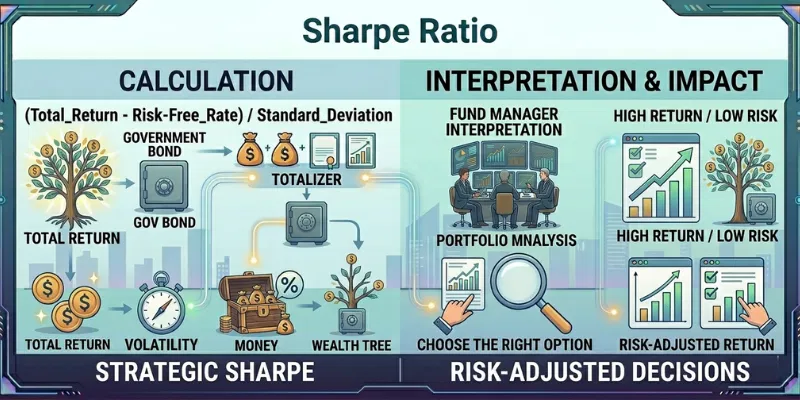
Sharpe Ratio = (Return – Risk-free rate) ÷ Risk
Here, “Return” means the profit you earn from an investment. “Risk-free rate” is the return you can get from a safe option like a bank deposit or government bond. “Risk” shows how much the investment value moves up and down. The formula checks how much extra return you earn after removing the safe return.
Let’s keep it simple. If an investment gives high returns but also has high ups and downs, the Sharpe ratio may not be strong. But if a fund gives stable returns with lower risk, the value will be better. The Sharperatio in mutualfunds helps you understand this balance easily. So you do not need to solve the formula yourself. Just focus on the idea that better returns with lower risk give a higher value.
3. How to Interpret Sharpe Ratio?
The Sharpe ratio helps you understand if an investment is giving good returns for the risk you take. A higher value usually means better performance. It shows that the investment is giving more return without taking too much risk. A lower value means the returns are not strong compared to the risk. This makes it easier to compare different funds in a simple way. Instead of looking only at returns, you also see how stable those returns are. This helps you make smarter choices.
To keep it simple, you can follow a basic guide. If the value is below 1, it is not very good. Around 1 means average performance. Above 1 is considered good, and above 2 is very strong. The Sharpe ratio in mutual funds helps you quickly judge which fund is better. Many investors look for the best Sharpe ratio when comparing options. But remember, it is just one tool and should not be used alone. So ask yourself, are you choosing high returns or better risk-adjusted returns?
4. Real-Life Example
Let’s understand this with a simple example. Imagine two mutual funds give the same return of 12% per year. At first, both look equally good. But when you check their risk, you see a difference. Fund A has high ups and downs, while Fund B is more stable. Now this is where the Sharpe ratio helps. It shows which fund gives better returns for the risk taken.
If Fund A has a lower value and Fund B has a higher one, it means Fund B is the better choice. Even though both give the same return, Fund B is less risky. The Sharpe ratio in mutual funds helps you see this clearly. Many investors look for the best Sharpe ratio to choose a stable option. So instead of picking a fund based only on returns, you can choose the one that gives better balance and peace of mind.
5. How to Use Sharpe Ratio Before Investing?
Using the Sharpe ratio before investing is simple and very helpful. First, check the returns of the mutual fund you are planning to invest in. Then look at its Sharpe value to understand the level of risk involved. Do not look at this number alone. Always compare it with similar funds in the same category. This helps you see which fund is giving better returns for the risk taken. A higher value usually means a better balance between return and risk. This makes your decision more clear and practical.
The Sharpe ratio in mutual funds becomes more useful when you compare multiple options side by side. Many investors try to find the best Sharpe ratio within a category before choosing a fund. This helps them avoid risky options that only look good because of high returns. You can also combine this with other factors like past performance and your investment goal. So before you invest, ask yourself, are you checking both return and risk or only chasing high returns?
6. Benefits of Using Sharpe Ratio
The Sharpe ratio helps you make better investment decisions by showing the balance between return and risk. Many people only look at returns and ignore how risky the investment is. This ratio gives a clearer picture and helps you avoid that mistake. It makes comparing different mutual funds simple and practical. You can quickly see which option is more stable and reliable. This is very useful for beginners who feel confused by numbers. Instead of guessing, you get a logical way to choose.
Another benefit is that it improves confidence in your decisions. The Sharpe ratio in mutual funds helps you focus on quality returns, not just high returns. Many investors look for the best Sharpe ratio to find funds that perform well with less risk. It also helps you avoid unstable options that may look attractive at first. So instead of chasing high profits blindly, you can choose investments that offer better balance and long-term growth.
7. Limitations of Sharpe Ratio
The Sharpe ratio is useful, but it is not perfect. It is based on past data, so it cannot predict future performance. Markets change, and a fund that performed well before may not do the same in the future. It also assumes that risk is always measured by price changes, which may not show the full picture. Some investments may have hidden risks that this ratio cannot capture. This is why you should not depend on it alone. It is a helpful tool, but not a complete solution.
Another limitation is that it can sometimes give misleading results. A fund may show a high value due to short-term performance. The Sharpe ratio in mutual funds also depends on the time period you choose for analysis. Different time frames can give different results. Many investors look for the best Sharpe ratio, but they forget to check other factors. So it is better to use this measure along with other tools and your own research before making a decision.
8 Sharpe Ratio vs Other Ratios
The Sharpe ratio is one of the most popular ways to measure return compared to risk. But it is not the only tool. Other ratios like Sortino Ratio and Alpha are also used by investors. The Sharpe index considers total risk, which includes all types of ups and downs in price. This makes it simple and useful for beginners. It gives a general idea of how stable an investment is.
Other ratios focus on specific types of risk. For example, Sortino Ratio only looks at downside risk, which means losses. Alpha measures how much extra return a fund gives compared to the market. The Sharpe ratio in mutual funds is easier to understand and widely used. Many investors first check this value and then look at other measures if needed. So instead of relying on one number, it is better to use multiple tools for a clear decision.
9. Who Should Use Sharpe Ratio?
The Sharpe ratio is useful for anyone who wants to invest in a smart and balanced way. Beginners can use it to understand the difference between high returns and high risk. It helps them avoid confusing choices and pick better options. Mutual fund investors also use it to compare different funds easily. It gives a clear idea of which fund is more stable for the level of return.
The Sharpe ratio in mutual funds is also helpful for long-term investors who want steady growth. People who care about risk and want to avoid sudden losses can benefit from it. Many investors look for the best Sharpe ratio when selecting funds for their portfolio. It is a simple tool that works for both beginners and experienced investors. So if you want to make better decisions and reduce risk, this measure can help you a lot.
10. Common Mistakes to Avoid
Many investors make simple mistakes when using the Sharpe ratio. One common mistake is focusing only on this number and ignoring other factors. A fund may have a good value but still not match your goals. Another mistake is comparing funds from different categories. This gives a wrong idea because each category has different risk levels. Some people also look at short-term data, which can be misleading. It is always better to check long-term performance.
Another mistake is thinking that a high value always means the best choice. The Sharpe ratio in mutual funds should be used along with other details like past returns and consistency. Many investors chase the best Sharpe ratio without understanding the full picture. This can lead to poor decisions. So ask yourself, are you using this as a guide or relying on it completely? A balanced approach always works better.
You should not look at the number alone. Always compare it with similar funds in the same category. This gives you a clear idea of whether it is truly strong or just average.
Yes, it can be a better option if it takes less risk. A fund with stable performance may give more peace of mind. The Sharpe ratio helps you see this balance clearly.
They change because market conditions keep changing. Returns and risk both move up and down. That is why you should check updated data before making a decision.
No, that is not a good approach. You should also check your goals, time period, and risk level. The Sharpe ratio in mutual funds is helpful, but it is not the only factor.
You do not need to check it daily. Reviewing it every few months is enough for long-term investors. This helps you stay updated without making unnecessary changes.
Conclusion
So guys, in this article, we’ve covered Sharpe ratio in detail. You now understand how it helps you compare return and risk in a simple way. My personal recommendation is to always check this value along with returns before choosing any fund. It gives you a clearer and more balanced view. Even a small check can help you avoid risky decisions. So take a moment, review your options, and start making smarter investment choices today.
The information and calculators on Finance Calculatorz are provided for educational purposes only. Calculator results are estimates and may not always be fully accurate. This content is not financial, investment, tax, or legal advice. Please consult a qualified professional before making any financial decision.



- Be Respectful
- Stay Relevant
- Stay Positive
- True Feedback
- Encourage Discussion
- Avoid Spamming
- No Fake News
- Don't Copy-Paste
- No Personal Attacks
- Be Respectful
- Stay Relevant
- Stay Positive
- True Feedback
- Encourage Discussion
- Avoid Spamming
- No Fake News
- Don't Copy-Paste
- No Personal Attacks
