Dividend Distribution Tax (DDT) in Mutual Funds
Published: 24 Jul 2026
Dividend distribution tax was a tax paid by companies and mutual funds before giving dividends to investors. Under the old system, investors usually received dividends after the payer handled this tax. India removed dividend distribution tax from 1 April 2020. Now, dividend income is generally taxable in the hands of the investor. The final tax depends on the investor’s income and tax slab. Understanding this change can help investors report dividend income correctly.
1. What Is Dividend Distribution Tax?
Dividend Distribution Tax was a tax paid by a domestic company before it distributed dividends to its shareholders. In simple words, the company paid tax on the profit it shared with investors. The shareholder usually received the dividend after the company handled this tax. A similar system also applied to certain distributions made by mutual funds. This is why many investors still search for DDT in mutual funds while learning about dividend taxation.
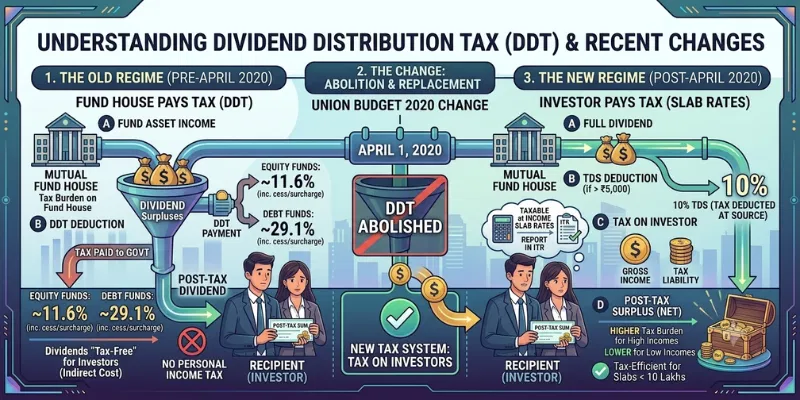
The Finance Act, 2020 removed Dividend Distribution Tax from 1 April 2020. Under the current system, companies and mutual funds do not pay DDT on new dividend distributions. Instead, investors generally add the dividend income to their total taxable income and pay tax according to the applicable rules. Therefore, Dividend distribution tax is now mainly a historical concept, but understanding it helps investors compare the old and current dividend tax systems.
2. What Is Dividend Income?
Dividend income is the money a company or mutual fund pays to its investors from earned profits or available surplus. A company may pay it to shareholders, while a mutual fund may distribute it through an IDCW plan. The payment amount depends on the company’s decision or the fund’s available surplus. Under current tax rules, investors generally add this income to their total taxable income. Unlike Dividend Distribution Tax, the investor now usually pays tax based on the applicable tax rate.
3. How Did Dividend Distribution Tax Work?
Dividend Distribution Tax worked by placing the tax duty on the company or mutual fund that distributed income. First, the company decided how much dividend it wanted to pay to its shareholders. It then calculated and paid Dividend distribution tax to the government before releasing the dividend. After this payment, investors received their share of the distributed profit. A similar system applied to certain payouts under DDT in mutual funds. Investors usually did not pay normal tax again on this dividend under the old system. However, India removed this system from 1 April 2020 and shifted the tax duty to investors.
4. What Was the DDT Rate?
Under the old system, the basic Dividend Distribution Tax rate for domestic companies was 15% on the distributed dividend. However, grossing-up, surcharge, and cess increased the company’s actual tax cost. This made the effective DDT rate higher than the basic 15% figure. The company paid this tax before giving dividends to its shareholders. This rate is now historical because India removed DDT from 1 April 2020.
5. DDT Rate Applicable in Mutual Funds?
Under the old system, Dividend distribution tax in mutual funds depended on the fund type and investor category. Equity-oriented funds faced a 10% basic rate, while liquid and debt funds generally faced 25% for individuals and HUFs. A 30% rate applied to many other investors, such as companies. Surcharge, cess, and grossing-up increased the actual tax cost above these basic rates. These rates are now historical because mutual fund DDT was removed from 1 April 2020.
6. Why Was Dividend Distribution Tax Removed?
Dividend Distribution Tax was removed because it placed the same indirect tax burden on investors with different income levels. Small investors could not fully benefit from their lower tax rates under the old system. Foreign investors also faced problems when claiming tax credit because the company paid Dividend distribution tax. The tax increased the total cost of distributing profits for companies and mutual funds. The government wanted to create a fairer system based on each investor’s taxable income. It therefore shifted the tax duty from the payer to the person receiving the dividend. This change also brought India closer to the common international method of taxing dividends. Since 1 April 2020, investors generally pay tax on dividend income at their applicable rates.
7. How Is Dividend Income Taxed Today?
Today, dividend income is generally taxable in the hands of the investor instead of the company or mutual fund. Resident investors usually add it to their total income under “Income from Other Sources.” The tax rate depends on the investor’s applicable income tax slab. Eligible interest expense used to earn dividends may be deducted, but only up to 20% of the dividend income. The company or fund may also deduct TDS before making the payment. However, TDS is only an advance tax, so the final amount is calculated while filing the income tax return.
8. Tax on Dividends From Shares?
Dividends from shares are generally added to a resident investor’s total income and taxed at the applicable slab rate. The investor usually reports this amount under “Income from Other Sources.” An Indian company may deduct 10% TDS when the yearly dividend paid to an individual crosses ₹10,000. TDS is not the final tax, so the investor may pay extra tax or claim a refund while filing the return. Eligible interest expense may be deducted, but only up to 20% of the total dividend income. Investors should report the full dividend amount and claim the TDS credit shown in Form 26AS.
9. Tax on Mutual Fund Dividends?
Mutual fund dividends, now called IDCW payouts, are generally taxable in the investor’s hands. Resident investors usually add this income to “Income from Other Sources” and pay tax at their applicable slab rate. The mutual fund may deduct 10% TDS when the yearly payment crosses the current ₹10,000 limit. TDS is only an advance payment, so the investor may still pay more tax or claim a refund. Eligible interest expense may be deducted, but the deduction cannot exceed 20% of the dividend income. This current system replaced DDT in mutual funds from 1 April 2020.
10. Can Investors Avoid TDS on Dividend Income?
Yes, eligible resident investors can avoid TDS on dividend income by submitting Form 15G or Form 15H to the payer. Form 15G is generally for eligible resident individuals below 60 years, while Form 15H is for eligible resident senior citizens. The investor’s estimated tax liability for the financial year must be nil. These forms only stop TDS and do not make taxable dividend income tax-free. Investors should submit the correct form before the company or mutual fund pays the dividend. A false declaration may lead to tax problems, so always check the eligibility rules first.
11. How to Calculate Tax on Dividend Income
Step 1: Add All Dividends Received
Add all dividends received from shares and mutual fund IDCW plans during the financial year.
Step 2: Subtract Eligible Interest Expense
Subtract eligible interest expense, but the deduction cannot exceed 20% of the gross dividend income.
Step 3: Add the Remaining Dividend to Other Income
Add the remaining dividend amount to your other taxable income.
Step 4: Apply Your Income Tax Slab Rate
Apply your income tax slab rate and add any applicable cess or surcharge.
Step 5: Subtract the TDS Credit
Subtract the TDS credit shown in Form 26AS to find your final tax payable or refund.
For example, suppose you receive ₹50,000 as dividend income and have ₹6,000 of eligible interest expense. Your taxable dividend becomes ₹44,000 because the expense is within the 20% limit of ₹10,000. This ₹44,000 is added to your total income and taxed at your applicable slab rate.
12. DDT vs TDS on Dividends
Dividend Distribution Tax and TDS are different forms of tax collection on dividend income. Under the old system, the company paid DDT from its own funds before distributing dividends to investors. Dividend distribution tax was removed from 1 April 2020, so companies no longer pay it on current dividend distributions. Today, the company may deduct TDS from the dividend amount before paying the investor. For resident shareholders, dividend TDS is generally deducted at 10% when the applicable yearly limit is crossed. TDS is not the final tax because investors must calculate their actual liability while filing the income tax return.
13. DDT vs Dividend Tax
DDT and dividend tax may sound similar, but they apply to different taxpayers. Under the old system, the company or mutual fund paid DDT before distributing income to investors. Dividend tax under the current system is generally paid by the investor who receives the dividend. The investor adds this income to total taxable income and pays tax at the applicable rate. TDS may also be deducted, but it is only an advance tax payment. So, Dividend distribution tax was a payer-level tax, while dividend tax is mainly an investor-level tax today.
14. How Dividend Income Affects Different Investors
Dividend income affects investors differently because each person may fall under a different tax rate. Small investors with low taxable income may pay little or no tax if their total income stays within the allowed limit. High-income investors may pay more because dividends are generally added to their total taxable income. Senior citizens must also include dividends in their income, though eligible investors may submit Form 15H to avoid TDS when their final tax is nil. Non-resident investors may face special tax rates, while a tax treaty can sometimes offer a lower rate. Therefore, every investor should check income level, residential status, and available TDS credit before calculating dividend tax.
15. Does Dividend Income Affect Advance Tax?
Yes, dividend income can affect your advance tax because it increases your total taxable income. You may need to pay advance tax when your estimated yearly tax liability exceeds the allowed limit after reducing TDS. Since companies may announce dividends during the year, investors cannot always estimate this income early. In such cases, interest for an earlier shortfall may not apply if you pay the required tax in the next available instalment. You should subtract the TDS already deducted before finding the remaining advance tax amount. Check your tax liability after receiving a large dividend to avoid interest charges later.
16. Mistakes Investors Make
- Thinking Dividend Distribution Tax still applies under the current tax system.
- Reporting only the dividend received after TDS instead of the full dividend amount.
- Treating TDS as the final tax and ignoring the actual slab-based liability.
- Forgetting to include IDCW payouts from mutual funds in taxable income.
- Claiming more interest expense than the allowed 20% limit.
17. Tips for Investors
- Keep records of all dividends received from shares and mutual fund IDCW plans.
- Check Form 26AS and AIS before filing your income tax return.
- Report the full dividend amount, even when the payer has deducted TDS.
- Review your advance tax liability after receiving a large dividend payment.
- Choose growth or IDCW options based on your goals, not only regular payouts.
Yes, you can claim a refund by filing your income tax return. The tax department compares your final liability with the TDS already deducted. Any extra amount may be refunded after processing.
You should report the full dividend before TDS. The deducted tax appears separately as a credit in Form 26AS or AIS. Reporting only the net amount can make your income details incorrect.
Eligible interest paid to earn dividend income may be claimed as a deduction. However, the deduction cannot exceed 20% of the gross dividend income. Other expenses usually do not receive the same benefit.
Not always, because IDCW payouts are generally taxable in the investor’s hands. The growth option does not make regular payouts and may suit investors focused on long-term growth. The better choice depends on your income needs, goals, and tax position.
Yes, a large dividend can increase your total tax liability during the year. You should calculate the remaining tax after reducing available TDS credit. Paying the required advance tax on time can help you avoid interest charges.
Compare the AIS entry with your bank statement and dividend records. You can submit feedback through the income tax portal when the information is wrong. Keep supporting documents in case the tax department asks for proof.
Foreign dividends may be taxable in India based on your residential status. Tax may also be deducted in the foreign country, and eligible investors may claim foreign tax credit. Since treaty rules can vary, professional advice may help in complex cases.
Conclusion
So guys, in this article, we’ve covered Dividend Distribution Tax in detail. We discussed its meaning, old tax rates, removal, TDS rules, and current dividend taxation. I personally recommend checking your dividend income, Form 26AS, and AIS before filing your tax return. This simple step can help you avoid reporting mistakes and missed tax credits. Review your dividend records today and plan your taxes with confidence.
The information and calculators on Finance Calculatorz are provided for educational purposes only. Calculator results are estimates and may not always be fully accurate. This content is not financial, investment, tax, or legal advice. Please consult a qualified professional before making any financial decision.



- Be Respectful
- Stay Relevant
- Stay Positive
- True Feedback
- Encourage Discussion
- Avoid Spamming
- No Fake News
- Don't Copy-Paste
- No Personal Attacks
- Be Respectful
- Stay Relevant
- Stay Positive
- True Feedback
- Encourage Discussion
- Avoid Spamming
- No Fake News
- Don't Copy-Paste
- No Personal Attacks
