National Pension Scheme After Death
Published: 25 Sep 2026
The money invested in NPS does not disappear when a subscriber passes away. Under National Pension Scheme After Death rules, the accumulated retirement corpus is paid to the registered nominee or legal heir after completing the required claim process. The exact treatment may depend on the subscriber’s NPS sector, nomination details, and annuity status. Therefore, families should understand the applicable rules, required documents, and claim procedure in advance.
1. What Happens to NPS After Death?
When an NPS subscriber passes away, the money accumulated in the account does not disappear. The available corpus is settled according to the subscriber’s NPS sector, nomination details, and annuity status. Under the National Pension Scheme After Death process, the registered nominee or legal heir must submit a death claim with the required documents.
1. The NPS Account Is Closed
The subscriber’s NPS account is closed after the death claim is approved and settled. No further regular contributions can be made to the deceased person’s PRAN. The final payable amount depends on the value of the accumulated corpus at the time of settlement.
2. The Nominee Can Claim the Corpus
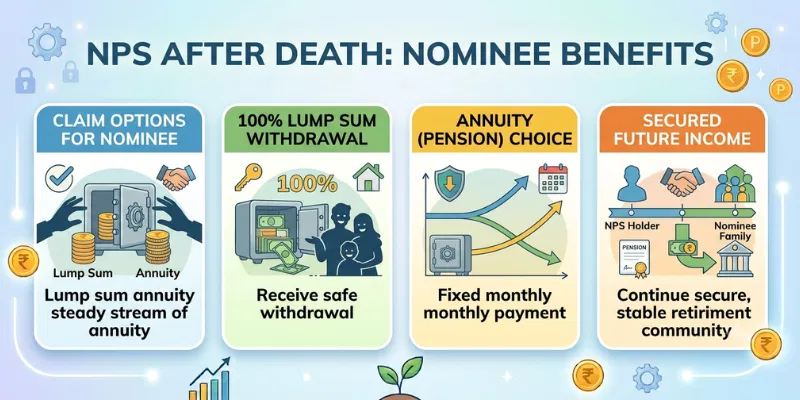
When a valid nominee is registered, that person can apply for the accumulated NPS money. In the All Citizen and Corporate models, the nominee or legal heir can generally withdraw the entire accumulated corpus after the subscriber’s death. An annuity purchase is normally not compulsory in these cases.
3. Legal Heirs Can Claim Without Nomination
When no valid nomination exists, the subscriber’s legal heirs can submit the claim. They may need to provide a legal-heir certificate, succession certificate, or other accepted proof. Claims without nomination can take longer because additional verification is required.
4. Government Sector Rules May Differ
Government employee cases may follow separate service and family pension rules. In some situations, the employer may adjust or transfer part or all of the NPS corpus when pensionary relief is provided to eligible family members. Therefore, the family should contact the subscriber’s nodal office or employer before starting the claim.
5. Annuity Benefits Depend on the Selected Plan
When the subscriber had already purchased an annuity, the NPS corpus had been transferred to an Annuity Service Provider. The benefit after death then depends on the selected annuity plan. For example, a joint-life annuity may continue pension payments to the spouse, while a return-of-purchase-price plan may return the purchase amount to the nominee.
6. A Death Claim Must Be Submitted
The nominee or legal heir must complete the prescribed death withdrawal form and provide documents such as the death certificate, identity proof, bank proof, and PRAN details. The claim is submitted through the applicable Point of Presence, nodal office, employer, or CRA process. After verification, the approved amount is transferred to the claimant’s registered bank account.
You can calculate your nps corpus during the subscriber’s lifetime to understand the possible amount available for retirement or family protection. Overall, the national pension scheme After Death rules aim to transfer the subscriber’s retirement savings to the rightful claimant. Keeping nomination and family details updated can make the settlement process faster and easier.
2. Who Can Claim NPS Money After Death?
Under the National Pension Scheme After Death rules, the accumulated corpus is generally paid to the registered nominee or legal heir. The eligible claimant depends on the nomination record, the subscriber’s NPS sector, and whether the claimant is an adult or a minor.
1. Registered Nominee
A person registered as a nominee in the NPS account can submit the death claim. When there are multiple nominees, the corpus is normally divided according to the percentage recorded for each nominee. The claimant must provide the required identity, bank, and death-related documents.
2. Legal Heir
A legal heir can claim the NPS money when no valid nominee is available. The claimant may need to submit a legal-heir certificate, succession certificate, or other accepted legal proof. This additional verification can make the claim process longer.
3. Multiple Nominees
A subscriber can register more than one nominee and assign a percentage share to each person. Each nominee may need to submit separate KYC and bank details for receiving their share. The total percentage assigned to all nominees should match the account records.
4. Guardian of a Minor Nominee
When the registered nominee is below 18 years of age, the minor cannot complete the claim process independently. The registered or legally appointed guardian can submit the claim on the minor’s behalf. The guardian must provide proof of guardianship along with the other required documents.
5. Family Member Under Government Rules
For Government Sector subscribers, an eligible family member may claim benefits according to the applicable service rules. The claimant usually submits the request through the deceased employee’s nodal office or employer. In some cases, the employer’s existing nomination record may be considered when no valid NPS nomination is available.
6. Surviving Nominee
When one of several nominees dies before the subscriber, the surviving nominee may claim according to the valid nomination record and applicable rules. The treatment of the deceased nominee’s share may require additional documents or legal-heir verification. Therefore, subscribers should update their nomination after the death of any nominee.
The claimant under the National Pension Scheme After Death should first check the subscriber’s PRAN, nomination details, and NPS sector. This helps identify the correct claim form, documents, and submission office.
3. NPS Death Benefits
The benefits available under the National Pension Scheme After Death depend on the subscriber’s NPS sector, nomination details, and annuity status. In most non-government NPS accounts, the nominee or legal heir can receive the full accumulated corpus or use it to purchase an annuity. Government Sector subscribers may follow different rules. An nps calculator can help subscribers estimate their possible retirement corpus, although the final death benefit depends on the actual account value and applicable rules.
1. Full Corpus for All Citizen Subscribers
When an All Citizen Model subscriber dies, the nominee or legal heir can withdraw the entire accumulated pension wealth as a lump sum. They may also choose to use some or all of the money to purchase an annuity. An annuity is optional rather than compulsory in this situation.
2. Full Corpus for Corporate Subscribers
The nominee or legal heir of a deceased Corporate NPS subscriber can generally claim the complete accumulated corpus. The claimant may receive it as a lump sum or voluntarily purchase an annuity. This gives the family flexibility to choose between immediate payment and regular pension income.
3. Government Sector Death Benefits
Government Sector death benefits may follow separate rules. When the corpus exceeds the prescribed limit, a large portion may need to be used to purchase a default annuity for eligible dependent family members, while the remaining amount is paid as a lump sum. The family should contact the deceased subscriber’s employer or nodal office to confirm the applicable service and pension rules.
4. Benefits for Multiple Nominees
When the subscriber has registered multiple nominees, each nominee receives the share recorded in the NPS account. The amount is distributed only after the required documents and bank details are verified. Each nominee may need to complete a separate claim process for their share.
5. Benefits When No Nominee Exists
The accumulated NPS corpus does not disappear when no nominee is registered. The legal heirs can claim the money by providing accepted legal documents, such as a succession certificate or legal-heir certificate where required. However, additional verification may make the settlement process longer.
4. NPS Death Before Retirement
When an NPS subscriber dies before retirement or superannuation, the accumulated money in the account becomes payable under the death-claim rules. The nominee or legal heir must submit the prescribed claim form and supporting documents. The treatment under the National Pension Scheme After Death may vary slightly for non-government and Government Sector subscribers.
1. Full Corpus for Non-Government Subscribers
For All Citizen and Corporate NPS accounts, the entire accumulated pension corpus is generally paid to the registered nominee or legal heir. The claimant is not normally required to purchase an annuity. Therefore, the full eligible amount can usually be received as a lump-sum payment.
2. Retirement Age Does Not Need to Be Reached
The family does not have to wait until the subscriber would have reached age 60. A death claim can be started after obtaining the official death certificate and other required documents. Once the claim is verified, the NPS account is closed and the approved amount is settled.
3. Nominee Receives the Registered Share
When the subscriber has named one nominee, that person can claim the eligible corpus. If multiple nominees are registered, the amount is distributed according to their recorded percentage shares. Each claimant may need to provide separate identity, bank, and KYC documents.
4. Legal Heirs Can Claim Without a Nominee
If no valid nominee exists, the legal heirs can apply for the accumulated NPS money. They may need to submit a legal-heir certificate, succession certificate, or other accepted legal proof. This can make the claim process longer because the claimant’s legal right must be verified.
5. What Happens to NPS Annuity After Death?
Once an NPS subscriber purchases an annuity, the money used for the purchase is transferred to an Annuity Service Provider. After this stage, the death benefit depends mainly on the annuity option selected by the subscriber. The nominee does not automatically receive the original purchase amount under every annuity plan.
1. Annuity for Life
Under a basic life annuity, the subscriber receives regular pension payments throughout life. After the subscriber’s death, the pension payments stop and the annuity policy ends. No further amount is normally paid to the spouse or nominee.
2. Annuity With Return of Purchase Price
This option provides regular pension payments for the subscriber’s lifetime. After the subscriber’s death, the pension stops and the original purchase price is returned to the registered nominee. The annuity policy ends after this payment.
3. Joint-Life Annuity
Under a joint-life annuity, the subscriber receives pension during their lifetime. After the subscriber’s death, the surviving spouse continues receiving the agreed pension, which may be 100% of the original annuity under the selected plan. Payments stop after the spouse’s death when the plan does not include a return-of-purchase-price benefit.
4. Joint-Life Annuity With Return of Purchase Price
This option continues the pension for as long as either the subscriber or spouse remains alive. After the subscriber’s death, the spouse generally receives 100% of the original pension. When the surviving spouse also dies, the purchase price is returned to the nominee.
5. Annuity With a Guaranteed Period
Some plans guarantee pension payments for a fixed period, such as 5, 10, 15, or 20 years. If the subscriber dies during that period, the nominee may continue receiving the pension until the guaranteed period ends. Payments normally stop after the guaranteed period unless the plan contains another continuing benefit.
6. Documents Required for an NPS Death Claim
Under the National Pension Scheme After Death process, the nominee or legal heir must submit the prescribed claim form with supporting documents. The exact requirements may vary based on the subscriber’s NPS sector, CRA, nomination status, and claimant type.
1. NPS Death Claim Form
The claimant must complete the prescribed withdrawal form for the death of an NPS subscriber. All details, including the PRAN, claimant’s name, relationship, and bank information, should be entered correctly. Government and non-government subscribers may have different claim forms.
2. Original Death Certificate
An official death certificate of the subscriber is required for processing the claim. The certificate should be issued by the appropriate local authority. The claimant should also keep additional copies for personal records and other financial claims.
3. PRAN or NPS Account Details
The claimant should provide the subscriber’s Permanent Retirement Account Number. A copy of the PRAN card or NPS statement can help the office identify the account. The associated office may ask for additional account details when the PRAN card is unavailable.
4. Claimant’s Identity and Address Proof
The nominee or legal heir must provide valid identity and address documents. Accepted documents may include Aadhaar, PAN, passport, voter ID, or another officially valid document. The claimant’s name should match the nomination and bank records.
5. Bank Account Proof
A cancelled cheque, recent bank statement, or copy of the bank passbook may be required. The document should clearly show the claimant’s name, account number, bank name, and IFSC code. The approved amount is normally transferred directly to the verified bank account.
7. Step-by-Step NPS Death Claim Process
Under the National Pension Scheme After Death process, the nominee or legal heir must submit a formal death-withdrawal request. The submission channel may differ based on the subscriber’s NPS sector, CRA, employer, and Point of Presence.
1. Identify the Subscriber’s NPS Account
First, find the subscriber’s PRAN, latest NPS statement, and CRA details. Also check whether the account belongs to the All Citizen, Corporate, or Government Sector. This information helps the claimant select the correct form and submission channel.
2. Check the Nomination Details
Confirm whether the claimant is registered as a nominee in the NPS account. When multiple nominees are registered, each nominee may claim the percentage assigned to them. If no valid nominee exists, the legal heirs may need to provide additional legal documents.
3. Collect the Required Documents
Prepare the death certificate, claimant’s identity and address proof, PAN where applicable, bank account proof, PRAN details, and completed death-withdrawal form. A minor nominee also requires age proof and the guardian’s KYC documents. Legal-heir documents may be required when there is no valid nominee.
4. Complete the Death-Withdrawal Form
The nominee, legal heir, or guardian must complete and sign the prescribed claim form. The form asks for details about the deceased subscriber, claimant, PRAN, relationship, nomination, and bank account. Every entry should match the supporting documents.
5. Submit the Claim
The claimant should submit the form and documents through the appropriate Point of Presence, nodal office, employer, or authorized CRA channel. Government Sector claims are generally processed through the associated nodal office. The correct route depends on how the subscriber’s NPS account was maintained.
8. Common Mistakes in an NPS Death Claim
Small errors can delay the National Pension Scheme After Death claim. Claimants should carefully check the form, documents, and submission route before filing the request.
1. Using the Wrong Claim Form
Government, non-government, and other NPS models may have different processing requirements. Using an incorrect or outdated form can delay the request. Always obtain the latest applicable death-withdrawal form from the official CRA or associated office.
2. Entering Incorrect PRAN Details
An incorrect PRAN can prevent the office from identifying the subscriber’s account. The claimant should copy the number from the PRAN card or latest transaction statement. Every digit must be checked before submission.
3. Submitting an Unclear Death Certificate
A blurred, incomplete, or unofficial death certificate may not be accepted. The subscriber’s name and date details should be clearly readable. Submit the original or an attested copy according to the applicable requirements.
4. Providing Mismatched Personal Details
The claimant’s name may differ across the nomination record, PAN, identity proof, and bank account. Even small spelling differences can create verification problems. Supporting documents should be provided when a genuine name change or variation exists.
5. Giving Incorrect Bank Information
An incorrect account number or IFSC code can cause payment failure. The bank account should normally belong to the eligible claimant. The cancelled cheque or bank proof should clearly display the claimant’s name and complete account details.
6. Ignoring Multiple Nominees
One nominee should not assume that they can claim the entire corpus when multiple nominees are registered. Each nominee’s recorded percentage must be considered. The required forms, KYC documents, and bank details should be provided for all relevant claimants.
The registered nominee can usually claim the accumulated NPS corpus. If there is no valid nominee, the legal heirs can submit the claim with supporting documents. Government Sector cases may follow different service and family pension rules.
In the All Citizen and Corporate models, the nominee or legal heir can generally receive the full corpus as a lump sum. Buying an annuity is normally optional in these death cases. Different rules may apply to Government Sector subscribers.
The NPS money does not disappear when there is no nominee. The legal heirs can claim it by providing a legal-heir certificate, succession certificate, or other required proof. The process may take longer because additional verification is needed.
The benefit depends on the annuity plan selected by the subscriber. A joint-life plan may continue pension payments to the spouse, while a return-of-purchase-price plan may pay the purchase amount to the nominee. A basic life-only annuity may stop after the subscriber’s death.
They should submit the correct claim form with complete and clear documents. Names, PRAN details, bank information, and nomination records should match. They should also keep copies of all documents and the claim reference number.
Conclusion
So guys, in this article, we’ve covered National Pension Scheme After Death in detail. We discussed who can claim the NPS money, available death benefits, annuity treatment, required documents, the claim process, and common mistakes. In my opinion, every NPS subscriber should keep nomination details updated and inform trusted family members about the PRAN and account records. This small step can make the claim process easier during a difficult time. Review your NPS nomination today and keep all important documents safely organized.
The information and calculators on Finance Calculatorz are provided for educational purposes only. Calculator results are estimates and may not always be fully accurate. This content is not financial, investment, tax, or legal advice. Please consult a qualified professional before making any financial decision.



- Be Respectful
- Stay Relevant
- Stay Positive
- True Feedback
- Encourage Discussion
- Avoid Spamming
- No Fake News
- Don't Copy-Paste
- No Personal Attacks
- Be Respectful
- Stay Relevant
- Stay Positive
- True Feedback
- Encourage Discussion
- Avoid Spamming
- No Fake News
- Don't Copy-Paste
- No Personal Attacks
