NPS Withdrawal Rules 2026
Published: 23 Sep 2026
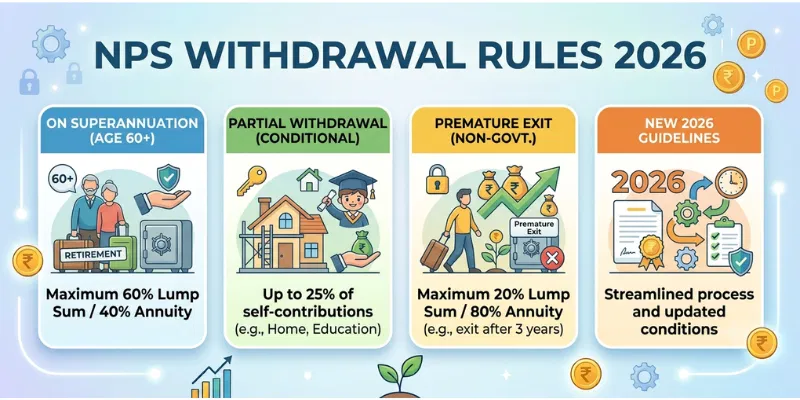
NPS Withdrawal Rules 2026 explain when and how subscribers can withdraw money from their NPS accounts. These rules cover partial withdrawal, normal exit, premature exit, systematic payouts, and death claims. The permitted amount depends on the subscriber category, corpus value, age, and exit type. Government and non-government subscribers may follow different limits. Understanding these rules can help subscribers avoid mistakes and plan withdrawals correctly.
1. What Are NPS Withdrawal Rules 2026?
NPS Withdrawal Rules 2026 are the official conditions that explain when, why, and how subscribers can take money out of their National Pension System accounts. These rules mainly apply to the retirement-focused NPS Tier 1 account.
1. Partial Withdrawal Rules
Partial withdrawal allows subscribers to take out a limited amount without closing their NPS account. It is generally available after completing the required subscription period and only for approved purposes. The maximum amount is calculated using the subscriber’s own contributions rather than the complete account balance.
2. Normal Exit Rules
Normal exit applies when a subscriber reaches the permitted retirement stage or completes the required NPS membership period. For eligible All Citizen subscribers, normal exit may become available after completing 15 years of subscription or reaching age 60, whichever comes earlier. The lump-sum and annuity requirements depend on the subscriber category and accumulated corpus.
3. Premature Exit Rules
Premature exit means closing the NPS account before meeting normal-exit conditions. It usually provides less lump-sum flexibility because a larger portion of the corpus may need to be used for annuity purchase. Special full-withdrawal options may apply when the accumulated corpus falls within the permitted limit.
4. Withdrawal After the Subscriber’s Death
When an NPS subscriber dies, the nominee or legal heir can claim the accumulated pension wealth. The payment method may depend on the subscriber’s sector, nomination details, and applicable family-pension rules. Claimants must submit the required death, identity, and bank documents.
5. Systematic and Deferred Withdrawals
Eligible subscribers may receive their permitted corpus through systematic payouts instead of withdrawing the full amount immediately. They may also postpone the lump-sum withdrawal, annuity purchase, or both under applicable conditions. These options can help subscribers manage retirement income over a longer period.
6. Rules Depend on Subscriber Details
The same withdrawal condition does not apply to everyone. The final amount depends on age, government or non-government category, exit type, personal contributions, corpus value, and length of NPS membership. Therefore, subscribers should review the latest official rules before submitting a request.
The main purpose of NPS Withdrawal Rules 2026 is to provide access to savings while protecting the subscriber’s long-term retirement income.
2. Major Changes in NPS Withdrawal Rules 2026
The updated NPS Withdrawal Rules 2026 provide greater flexibility for subscribers, especially those in the All Citizen and Corporate sectors. The main changes affect normal exit, annuity requirements, small-corpus withdrawals, partial withdrawals, and continuation after retirement.
1. Normal Exit After 15 Years
All Citizen subscribers no longer need to wait only until age 60 for a normal exit. They can generally take a normal exit after completing 15 years of NPS membership or reaching age 60, whichever happens earlier. Corporate subscribers continue to follow the retirement or superannuation age mentioned in their employment terms.
2. Higher Lump-Sum Limit for Non-Government Subscribers
Earlier, eligible All Citizen and Corporate subscribers could generally withdraw up to 60% and had to use at least 40% for an annuity. Under the revised rules, subscribers with corpus above ₹12 lakh can generally withdraw up to 80%, while at least 20% must be used for annuity purchase. Government subscribers continue to follow the 60% lump-sum and 40% annuity structure for corpus above ₹12 lakh.
3. Higher Full-Withdrawal Limit
The full-withdrawal limit at normal exit has increased. Subscribers with accumulated pension wealth of up to ₹8 lakh may generally withdraw the complete amount or choose an approved periodic payout. Earlier, the normal-exit full-withdrawal limit for many subscribers was ₹5 lakh.
4. New Rules for Corpus Between ₹8 Lakh and ₹12 Lakh
Subscribers with corpus above ₹8 lakh but not more than ₹12 lakh now receive additional payout choices. They may generally withdraw up to ₹6 lakh and use the remaining amount for annuity or Systematic Unit Withdrawal for at least six years. They may also choose the applicable percentage-based lump-sum and annuity option.
5. More Partial Withdrawals Allowed
Subscribers can now make up to four partial withdrawals before age 60 or superannuation. Earlier, only three partial withdrawals were generally permitted. Each withdrawal can be up to 25% of the subscriber’s own contributions, with a minimum four-year gap between successive withdrawals.
6. Partial Withdrawals After Age 60
Subscribers who continue their NPS account after age 60 or retirement can also make partial withdrawals. A minimum gap of three years generally applies between two withdrawals after this stage. This provides greater access to savings while the account remains active.
7. Wider Medical Withdrawal Purpose
Earlier rules focused mainly on a specified list of critical illnesses. The updated framework broadly permits partial withdrawal for medical treatment or hospitalisation of the subscriber, spouse, children, or parents. This makes the medical withdrawal facility easier to use in more situations.
8. Financial Assistance Against NPS Contributions
Subscribers may use the partial-withdrawal limit to settle an eligible financial obligation from a regulated financial institution where a lien or charge has been marked on the pension account. The permitted amount remains within 25% of the subscriber’s own contributions. This facility is subject to applicable PFRDA guidelines.
9. Higher Entry and Exit Age
The maximum NPS entry and exit age has increased to 85 years under the revised framework. Subscribers may also continue their NPS account automatically without giving the earlier 15-day advance notice before age 60 or superannuation. This offers more time to contribute and manage retirement savings.
10. More Systematic Payout Options
The revised rules provide greater use of Systematic Lump-Sum Withdrawal and Systematic Unit Withdrawal. These options allow eligible subscribers to receive money in instalments instead of withdrawing the entire permitted corpus at once. They may help retirees create a more organised income flow while the remaining amount stays invested.
Overall, the major changes in NPS Withdrawal Rules 2026 provide more flexibility, higher lump-sum access, wider partial-withdrawal options, and better control over retirement payouts.
3. Types of NPS Withdrawals
Under NPS Withdrawal Rules 2026, subscribers can access their money in different ways. The right withdrawal type depends on age, reason, corpus value, subscriber category, and whether the account will remain active.
1. Partial Withdrawal
Partial withdrawal allows a subscriber to take out a limited amount without closing the nps tier 1 account. It is generally allowed for approved needs such as higher education, marriage, house purchase, medical treatment, or disability-related expenses. The permitted amount is calculated from the subscriber’s own contributions.
2. Normal Exit
Normal exit takes place when a subscriber meets the applicable retirement, age, or membership conditions. The subscriber may withdraw an eligible part of the corpus and use the required amount for annuity purchase. The exact limits can differ for government and non-government subscribers.
3. Premature Exit
Premature exit means closing the NPS account before meeting the normal-exit conditions. It usually requires a larger portion of the corpus to be used for buying an annuity. Smaller corpus amounts may receive more flexible withdrawal options under current rules.
4. Withdrawal After Death
If an NPS subscriber dies, the nominee or legal heir can claim the accumulated pension wealth. The payment process depends on the subscriber category, nomination details, and applicable government or family-pension rules. Claimants must submit the required documents to complete the withdrawal.
5. Systematic Withdrawal
Systematic withdrawal allows eligible subscribers to receive their permitted corpus in regular instalments instead of one large payment. The remaining amount stays invested and may continue to change with market performance. This option can help retirees manage income over a longer period.
6. Deferred Withdrawal
Deferred withdrawal allows a subscriber to postpone the lump-sum payment, annuity purchase, or both. It may suit people who do not need immediate access to their retirement corpus. The deferment must follow the age limits and conditions given under NPS Withdrawal Rules 2026.
4. NPS Normal Exit Rules 2026
A normal exit means closing the NPS Tier 1 account after meeting the required age, retirement, or subscription conditions. Under NPS Withdrawal Rules 2026, the withdrawal and annuity limits depend on the subscriber category and total accumulated pension wealth.
1. Normal Exit for All Citizen Subscribers
An All Citizen subscriber can generally choose normal exit after reaching age 60 or completing 15 years of NPS subscription, whichever happens earlier. Taking an exit at that stage is optional, so the subscriber may continue the account where permitted.
2. Normal Exit for Corporate Subscribers
Corporate subscribers generally become eligible for normal exit after reaching the retirement or superannuation age fixed under their employment conditions. The amount available as lump sum and the amount required for annuity depend on the accumulated corpus. Eligible subscribers may also continue NPS after leaving employment instead of closing the account immediately.
3. Rules for Non-Government Subscribers
For All Citizen and eligible Corporate subscribers, the following corpus-based rules generally apply:
- If the corpus is up to ₹8 lakh, the entire amount may be withdrawn as a lump sum or through permitted periodic payouts.
- If the corpus is above ₹8 lakh and up to ₹12 lakh, up to ₹6 lakh may be withdrawn, while the remaining amount must follow the permitted annuity or systematic payout conditions.
- If the corpus is above ₹12 lakh, at least 20% must generally be used to purchase an annuity. The remaining amount may be taken as a lump sum or through approved periodic withdrawals.
4. Rules for Government Subscribers
Government subscribers follow different normal-exit limits:
- If the corpus is up to ₹8 lakh, the complete amount may generally be withdrawn.
- If the corpus is above ₹8 lakh and up to ₹12 lakh, up to ₹6 lakh may be taken as a lump sum, while the remaining amount follows the applicable annuity or periodic payout rules.
- If the corpus is above ₹12 lakh, at least 40% must generally be used to purchase an annuity. The remaining amount may be paid as a lump sum or through permitted periodic payouts.
5. Normal Exit Example
You can use an nps calculator to estimate your total corpus, lump-sum withdrawal, and annuity amount before applying for normal exit. Suppose a non-government subscriber has an accumulated NPS corpus of ₹20 lakh:
- Minimum amount for annuity: ₹4 lakh
- Remaining eligible amount: ₹16 lakh
For a government subscriber with the same ₹20 lakh corpus:
- Minimum amount for annuity: ₹8 lakh
- Remaining eligible amount: ₹12 lakh
These examples show why subscriber category is important while applying NPS Withdrawal Rules 2026.
6. Important Points Before Normal Exit
Subscribers should check their category, corpus amount, annuity requirement, tax treatment, and available periodic payout options before closing the account. The permitted NPS withdrawal percentage and the tax-exempt percentage may not always be the same. Therefore, subscribers should verify the latest official conditions and compare lump sum, annuity, SLW, and SUR options before submitting the exit request.
5. NPS Tier 1 Withdrawal Rules
NPS Tier 1 is a retirement-focused account, so withdrawals are allowed only under specific conditions. According to NPS Withdrawal Rules 2026, subscribers may access Tier 1 money through partial withdrawal, normal exit, premature exit, or a death claim.
1. Partial Withdrawal From Tier 1
Subscribers can withdraw a limited amount without closing their Tier 1 account. A partial withdrawal is generally available after completing at least three years in NPS and only for approved purposes. The maximum amount for each withdrawal is usually 25% of the subscriber’s own contributions, excluding employer contributions and investment returns.
2. Normal Exit From Tier 1
Normal exit applies after the subscriber meets the required age, retirement, or membership conditions. The amount available as a lump sum and the minimum annuity requirement depend on the subscriber category and accumulated pension wealth. For example, different rules apply to government and non-government subscribers when the corpus exceeds ₹12 lakh.
3. Premature Exit From Tier 1
Premature exit means closing the account before becoming eligible for normal exit. If the accumulated pension wealth is more than ₹5 lakh, at least 80% must generally be used to purchase an annuity, while up to 20% may be withdrawn. A corpus of up to ₹5 lakh may normally qualify for complete withdrawal or another permitted payout option.
4. Withdrawal After the Subscriber’s Death
If the subscriber dies, the nominee or legal heir can claim the Tier 1 corpus. The available payment method depends on the subscriber sector and applicable family-pension rules. Eligible claimants may also receive the amount through permitted systematic payout options in some cases.
5. Systematic Withdrawal Options
Eligible subscribers may receive their permitted Tier 1 corpus through Systematic Lump-Sum Withdrawal or Systematic Unit Redemption instead of taking the full amount at once. The remaining units stay invested and continue to change with market performance. This option may help retirees manage their money over a longer period.
6. NPS Tier 2 Withdrawal Rules
nps tier 2 is a voluntary investment account that offers more flexibility than Tier 1. Under NPS Withdrawal Rules 2026, subscribers can generally withdraw money from a regular Tier 2 account at any time without following retirement-related conditions.
1. Withdrawals Allowed at Any Time
Subscribers can withdraw money from Tier 2 whenever they need it. There is generally no minimum holding period for a regular Tier 2 account. Funds may be withdrawn either fully or partially.
2. No Withdrawal Limit
There is generally no fixed limit on the number of Tier 2 withdrawals. Subscribers may submit multiple withdrawal requests according to their financial needs. This makes Tier 2 more liquid than the retirement-focused Tier 1 account.
3. No Compulsory Annuity Purchase
Money withdrawn from a Tier 2 account does not normally need to be used for purchasing an annuity. The subscriber receives the approved withdrawal amount directly in the registered bank account. Normal and premature exit annuity conditions mainly apply to Tier 1.
4. Partial and Full Withdrawal
Subscribers may withdraw only a part of their Tier 2 balance while keeping the account active. They may also withdraw the entire accumulated amount when needed. However, the account status may depend on whether the linked Tier 1 account remains active.
5. One-Way Transfer to Tier 1
Subscribers may transfer money from Tier 2 to Tier 1 through a one-way switch. Once transferred, the money becomes part of the Tier 1 retirement corpus and follows Tier 1 withdrawal restrictions. Funds generally cannot be transferred back from Tier 1 to Tier 2.
7. Documents Required for NPS Withdrawal
Subscribers must submit the correct documents while applying under NPS Withdrawal Rules 2026. The exact requirements may vary according to the withdrawal type, subscriber category, CRA, and claim situation.
1. NPS Withdrawal Application Form
The subscriber must submit the correct form for partial withdrawal, normal exit, or premature exit. The form includes personal details, PRAN, withdrawal type, bank information, and annuity choice where applicable. Online applicants may complete these details through their CRA account.
2. PRAN and Identity Proof
The Permanent Retirement Account Number helps identify the subscriber’s NPS account. A copy of PAN, Aadhaar, passport, voter ID, or another accepted identity document may also be required. The details should match the information registered in the NPS account.
3. Address and Bank Proof
Subscribers may need to provide valid address proof and bank account evidence. A cancelled cheque, recent bank statement, bank certificate, or passbook copy may be accepted. The account should usually be in the subscriber’s name and linked correctly for payment.
4. Annuity-Related Documents
During normal or premature exit, annuity documents may be required when compulsory annuity purchase applies. Subscribers may need to select an Annuity Service Provider and provide spouse, nominee, KYC, and payment-frequency details. The exact documents depend on the insurer and selected annuity option. PFRDA directs subscribers to the relevant CRA or claim-processing facility for the applicable forms and procedure.
5. Supporting Documents for Partial Withdrawal
A subscriber may need to provide a self-declaration or supporting records explaining the permitted withdrawal purpose. Documents can relate to education, marriage, property purchase, medical treatment, disability, or another eligible reason. Partial withdrawal remains subject to the conditions listed by NPS Trust.
6. Documents for Premature Exit
Premature-exit applicants may need employment or service-related documents in addition to KYC and bank proof. Government or corporate subscribers may be asked for a resignation acceptance letter, relieving order, retirement details, or approval from the nodal office. The applicable documents depend on the reason and subscriber sector.
7. Documents Required for a Death Claim
The nominee or legal heir generally needs to submit the subscriber’s death certificate, claimant’s identity proof, address proof, bank details, and nomination information. A legal-heir or succession document may be required when there is no valid nominee or when the claim is disputed. Government subscribers may also need documents connected with family-pension or service rules.
8. Important Checks Before Submission
Subscribers should ensure that their name, PRAN, date of birth, PAN, nominee details, and bank information match across all documents. Unclear copies, an inactive bank account, an incorrect signature, or incomplete forms may delay the request. The latest forms and process should be confirmed through the relevant CRA or official NPS claim-processing channel before submission.
8. How to Apply for NPS Withdrawal
Subscribers can apply online or through their Point of Presence or nodal office. The process under NPS Withdrawal Rules 2026 depends on whether the request is for partial withdrawal, normal exit, premature exit, or a death claim.
1. Log In to Your CRA Account
Visit the CRA linked to your NPS account and log in using your PRAN and password. NPS Trust provides access links for the available CRAs. After login, open the withdrawal or exit section from your account dashboard.
2. Select the Withdrawal Type
Choose the correct option based on your requirement:
- Partial withdrawal
- Normal exit
- Premature exit
- Death withdrawal claim
For a final exit through Protean CRA, subscribers generally select Manage My Withdrawal, followed by Exit from NPS and Initiate Request.
3. Enter Withdrawal Details
Provide the requested information, such as the withdrawal amount, reason, bank details, and contact information. For normal or premature exit, you may also need to enter the lump-sum percentage, annuity percentage, marital status, spouse details, Annuity Service Provider, and annuity plan.
4. Upload the Required Documents
Upload clear copies of identity proof, address proof, bank proof, and other supporting documents. An annuity application may also be required when part of the corpus must be used to purchase an annuity. Partial withdrawal can be submitted online or offline and may use a self-declaration for the permitted purpose.
5. Complete Online Verification
Confirm the request using OTP, e-signature, or another verification method offered by the CRA. Government and Corporate subscribers may also require verification by their nodal office or employer. The request may be returned when the information or documents are incomplete.
6. Submit the Request Offline
Subscribers who cannot apply online may submit the withdrawal form and supporting documents through their Point of Presence, nodal office, or other authorised channel. The office checks the documents and forwards the request to the CRA for processing.
7. Track the Withdrawal Status
After submission, save the acknowledgement number or claim ID. Subscribers can use the CRA withdrawal utility to check the status with details such as PRAN, date of birth, acknowledgement number, or claim ID.
8. Receive the Withdrawal Amount
Once the request is approved, the permitted lump-sum or partial-withdrawal amount is credited to the registered bank account. Where annuity purchase is required, the selected portion is transferred to the Annuity Service Provider. The insurer then starts pension payments after completing its verification and policy process.
Before applying, subscribers should update their bank account, contact details, nominee information, PAN, and KYC records. Correct information can reduce delays and help complete the process smoothly under NPS Withdrawal Rules 2026.
9. Common Mistakes and Tips for NPS Withdrawal
Understanding NPS Withdrawal Rules 2026 can help subscribers avoid delays, tax issues, and unsuitable retirement decisions.
1. Common Mistakes
- Applying under the wrong withdrawal or exit category.
- Calculating partial withdrawal on the total corpus instead of personal contributions.
- Ignoring compulsory annuity requirements during normal or premature exit.
- Submitting incorrect bank details or incomplete documents.
- Assuming the complete withdrawal amount will always be tax-free.
calculate your nps corpus before applying so you can compare the available lump-sum, annuity, and systematic withdrawal options.
2. Tips
- Check your subscriber category and corpus value before applying.
- Compare partial withdrawal, normal exit, and premature exit carefully.
- Update your KYC, nominee, bank, and contact details in advance.
- Review the tax treatment of lump sum, annuity, and pension income.
- Use the latest official rules instead of relying on old withdrawal limits.
An eligible partial withdrawal can generally be up to 25% of your own NPS contributions. Employer contributions and investment returns are not normally included in this calculation. Your Tier 1 account remains active after the withdrawal.
You generally need to complete at least three years in NPS before making a partial withdrawal. The withdrawal must also be made for an approved reason. You should check the latest conditions before submitting your request.
Full withdrawal may be available when your accumulated corpus falls within the applicable small-corpus limit. At normal exit, the current full-withdrawal threshold is generally ₹8 lakh, subject to subscriber category and conditions. A higher corpus may require annuity purchase or another permitted payout arrangement.
Closing NPS before meeting normal-exit conditions is treated as premature exit. If the corpus exceeds ₹5 lakh, stricter annuity and lump-sum conditions generally apply. Subscribers who joined NPS at age 60 or above follow different exit provisions.
Annuity may be compulsory depending on your subscriber category, exit type, and accumulated corpus. Normal and premature exits can have different minimum annuity requirements. Small-corpus cases may receive full-withdrawal or periodic-payout options.
Conclusion
So guys, in this article, we’ve covered NPS Withdrawal Rules 2026 in detail. We discussed partial withdrawals, normal exit, premature exit, Tier 1 and Tier 2 rules, required documents, application steps, and common mistakes. In my opinion, subscribers should avoid closing their NPS account early unless they genuinely need the money. Always check your subscriber category, corpus amount, annuity requirement, and tax impact before making a withdrawal. Review the latest official rules and choose the withdrawal option that best supports your retirement goals.
The information and calculators on Finance Calculatorz are provided for educational purposes only. Calculator results are estimates and may not always be fully accurate. This content is not financial, investment, tax, or legal advice. Please consult a qualified professional before making any financial decision.



- Be Respectful
- Stay Relevant
- Stay Positive
- True Feedback
- Encourage Discussion
- Avoid Spamming
- No Fake News
- Don't Copy-Paste
- No Personal Attacks
- Be Respectful
- Stay Relevant
- Stay Positive
- True Feedback
- Encourage Discussion
- Avoid Spamming
- No Fake News
- Don't Copy-Paste
- No Personal Attacks
