NPS Eligibility Criteria: Check Age Limit and Citizenship
Published: 31 Aug 2026
NPS Eligibility Criteria define who can open an account under the National Pension System. These conditions mainly depend on age, citizenship, KYC status, bank details, and subscriber category. Salaried employees, self-employed people, eligible NRIs, and OCI applicants may join under applicable rules. Minors can also participate through NPS Vatsalya with the help of a parent or guardian. Understanding these conditions before applying can help avoid delays or rejection.
1. What Are the NPS Eligibility Criteria?
NPS Eligibility Criteria are the basic conditions a person must meet before opening an account under the National Pension System. These conditions mainly include the applicant’s age, citizenship status, KYC details, bank account, and subscriber category. Salaried employees, self-employed people, eligible NRIs, and OCI applicants may join under applicable rules. Government and corporate employees may need to register through their employer or department. Minors can join through NPS Vatsalya with the help of a parent or legal guardian. Meeting all required conditions can help prevent delays, errors, or rejection during registration.
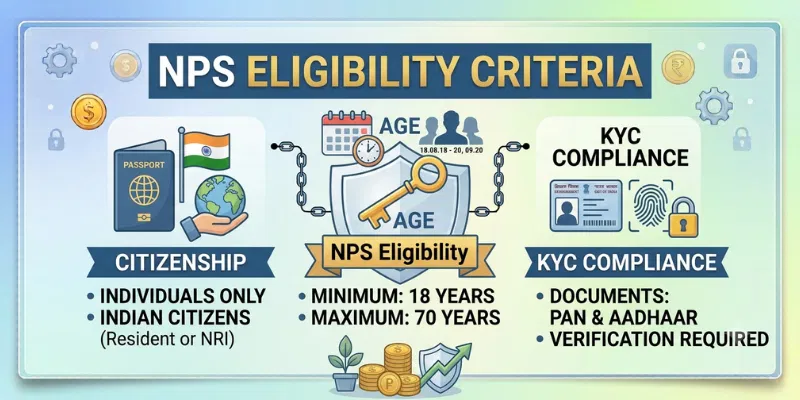
2. NPS Age Limit
The NPS Eligibility Criteria include a specific age requirement for opening an account under the National Pension System. The standard voluntary NPS account is currently available to eligible applicants who are between 18 and 85 years old on the date they submit their application.
1. Minimum Age for NPS
The minimum age for opening a regular NPS account independently is 18 years. A person who has reached this age can apply under the suitable NPS model after completing the required KYC process.
2. Maximum Entry Age
The maximum age for joining the voluntary NPS model is currently 85 years. The applicant must not be older than this limit on the date the online or offline application is submitted.
3. NPS for Applicants Below 18
Children below 18 years cannot independently open a regular adult NPS account. However, eligible minor Indian citizens can join through NPS Vatsalya, which is opened and managed by a parent or legal guardian.
4. What Happens at Age 18?
The guardian manages the NPS Vatsalya account until the child reaches 18 years of age. After becoming an adult, the subscriber can follow the applicable process to continue, shift, or exit from the scheme.
5. Age Limit for Salaried and Self-Employed People
The same standard age range generally applies to salaried employees, freelancers, professionals, business owners, and self-employed applicants joining voluntarily. Their employment type does not normally change the basic age requirement.
6. Age Limit Under Corporate NPS
Employees joining through a registered employer under Corporate NPS must also generally be between 18 and 85 years old. They must complete KYC and register through the employer under the applicable corporate arrangement.
7. Age Limit for NRIs and OCIs
Eligible Non-Resident Indians and Overseas Citizens of India must also fall within the permitted joining age. They may need to meet additional banking, citizenship, residency, and KYC conditions.
3. Citizenship and Residency Requirements
Citizenship and residency are important parts of the NPS Eligibility Criteria. A person must belong to an eligible category and complete the required KYC and banking checks before opening an account.
1. Resident Indian Citizens
An Indian citizen living in India can generally open an NPS account under the All Citizen Model. The applicant must meet the age requirement and provide valid identity, address, PAN, and bank details. Salaried and self-employed people can both apply.
2. Non-Resident Indians
Eligible Non-Resident Indians can also open an nps tier 1 account. They must hold Indian citizenship and follow the current NRI KYC, banking, and foreign-exchange requirements. Contributions may need to come through an eligible NRE or NRO bank account.
3. Overseas Citizens of India
Eligible Overseas Citizens of India may join NPS under the current rules. They need valid OCI documents, identity proof, overseas address proof, PAN, and supported Indian bank details. Additional declarations may also be required during registration.
4. Foreign Citizens
A foreign citizen who is not an Indian citizen or eligible OCI generally cannot open a standard account under the All Citizen Model. Holding an Indian bank account or working in India alone may not provide eligibility.
5. Change in Residency Status
A subscriber should update the account when their residency status changes. For example, a resident Indian who becomes an NRI should update their overseas address, bank account, tax details, and other required information.
6. Change in Citizenship
Account continuation may be affected if an Indian citizen later gives up Indian citizenship. The subscriber should inform the CRA or authorised service provider and follow the applicable continuation or exit process.
7. Tier 2 Restriction for NRIs and OCIs
NRIs and OCI subscribers may open an eligible Tier 1 account, but current PFRDA guidance says they cannot activate a regular Tier 2 account. Therefore, account availability may differ based on residency and citizenship status.
8. NPS Vatsalya for NRI and OCI Minors
Eligible Indian minors living in India or abroad may join NPS Vatsalya. NRI and OCI minors below 18 years can also participate through a parent or legal guardian under the applicable rules.
9. Additional KYC Requirements
NRI and OCI applicants may need to provide extra documents, such as:
- Passport
- OCI card, where applicable
- Overseas address proof
- Indian address proof, if available
- PAN
- NRE or NRO bank proof
- FATCA or tax residency declaration
10. Check Current Rules Before Applying
Cross-border KYC and banking requirements may change over time. NRI and OCI applicants should confirm the latest requirements through PFRDA, NPS Trust, their CRA, or an authorised Point of Presence before submitting the application. PFRDA issued updated onboarding guidance for NRI and OCI applicants in December 2025.
4. Eligibility for Salaried Employees
Salaried employees can join NPS either independently or through their employer. The correct registration method depends on whether the company offers the Corporate NPS facility.
1. Private-Sector Employees
Employees working in private companies can generally open an NPS account voluntarily under the All Citizen Model. Their employer does not need to offer NPS for individual registration. They must still meet the standard age, citizenship, KYC, and banking requirements.
2. Employees Under Corporate NPS
A salaried person can join through the Corporate NPS Model when their employer is registered under this system. The account is then linked to the employer-employee relationship. Both the employee and employer may contribute according to the company’s arrangement.
3. Age and Citizenship Conditions
The employee must fall within the current permitted NPS entry age. Eligible resident Indians, NRIs, and OCIs may join subject to the rules of their subscriber category. They must also complete the required identity and address verification.
4. KYC and Bank Requirements
The employee must provide valid PAN, identity proof, address proof, bank details, mobile number, and email address. All details should match the official records. Incorrect or mismatched information may delay registration.
5. Employer Registration and Approval
When joining through Corporate NPS, the employee may need to submit details through the employer or its authorised service provider. The company helps with employee registration, contribution processing, account updates, and other NPS services.
6. Eligibility After Changing Jobs
The employee’s PRAN remains portable after a job change. They can continue the same account with a new registered employer or shift to the All Citizen Model when applicable. This portability helps salaried people continue retirement savings without opening a completely new account.
5. Eligibility for Self-Employed People
Self-employed people can generally join NPS under the All Citizen Model. They do not need an employer to open the account, but they must meet the standard age, citizenship, KYC, and banking conditions.
1. Eligible Self-Employed Applicants
Freelancers, shop owners, consultants, doctors, lawyers, traders, and other professionals can open an NPS account. Their income does not need to come from a fixed monthly salary. They can join as individual subscribers.
2. Age Requirement
The applicant must fall within the permitted NPS entry age. They should check the latest age limit before applying. Age is verified through official identity documents.
3. Citizenship and Residency Status
Resident Indian citizens can generally apply under the All Citizen Model. Eligible NRIs and OCIs may also join subject to current rules. Additional documents may be required for applicants living outside India.
4. KYC Requirements
The applicant must complete the Know Your Customer process. This usually requires PAN, identity proof, address proof, photograph, mobile number, and email address. All details should match across the submitted documents.
5. Bank Account Requirement
A valid bank account in the applicant’s name is required for contributions and withdrawals. The bank details should match the KYC information. Incorrect account details may delay registration or future payments.
6. No Employer Registration Needed
Self-employed people do not need company approval or employer registration. They can open the account online through eNPS or offline through an authorised Point of Presence. This makes NPS accessible even to people with irregular or seasonal income.
6. Eligibility for Government Employees
Government employees may be covered under NPS according to their joining date, department, service rules, and the pension system adopted by the relevant government. Registration is normally completed through the employee’s department or authorised nodal office.
1. Central Government Employees
Central Government employees who joined service on or after January 1, 2004 are generally covered under NPS, except personnel of the armed forces. The account is opened under the Government Sector model rather than through normal individual registration.
2. State Government Employees
State Government employee eligibility depends on whether the concerned state has adopted NPS and which employee groups are covered. The joining date and contribution rules may differ according to the state’s official notification and service conditions.
3. Employees of Autonomous Bodies
Employees working in eligible Central or State Autonomous Bodies may also be covered under NPS. Their eligibility depends on whether the organisation has adopted the scheme and included the employee under its service rules.
4. Registration Through the Department
Government employees generally register through their Drawing and Disbursing Office, Pay and Accounts Office, treasury, or another designated nodal office. The department verifies the employee’s service, salary, identity, and appointment details before creating the account.
5. KYC and Service Requirements
The employee must provide correct PAN, identity proof, address details, bank information, date of birth, and employment records. All details should match the department’s official service records to avoid delays or errors.
6. Existing Pension Coverage
Eligibility may depend on whether the employee is already covered under an older pension scheme, NPS, or another government pension arrangement. Central Government employees covered under NPS may also need to check whether they qualify for the Unified Pension Scheme under current rules.
7. Employee and Government Contributions
Both the eligible employee and the government contribute to the Tier 1 account under the applicable rules. Contribution percentages may differ between Central Government, State Government, and autonomous-body employees.
7. NPS Tier 1 Eligibility
NPS Tier 1 can generally be opened by eligible Indian citizens between 18 and 85 years of age. Salaried employees, self-employed people, government employees, eligible NRIs, and OCIs may join under the applicable NPS model. The applicant must complete KYC and provide valid identity, address, PAN, bank, mobile, and email details. A new subscriber can open Tier 1 directly without first holding another NPS account. The applicant must also make the required initial contribution during registration.
8. NPS Tier 2 Eligibility
nps tier 2 can generally be opened only by eligible subscribers who already have an active Tier 1 account. The same PRAN is used for both accounts, so a separate PRAN is not required. The subscriber must have valid KYC, bank, mobile, and email details. Availability may depend on citizenship, residency status, and subscriber category. Tier 2 is optional and does not need to be opened by every NPS subscriber.
9. KYC Requirements for NPS
Completing KYC is an important part of the NPS Eligibility Criteria. It helps verify the applicant’s identity, address, bank details, and other personal information before the account is opened.
1. PAN Details
The applicant generally needs a valid PAN for identity and tax verification. The name and date of birth entered in the NPS form should match the PAN records.
2. Proof of Identity
An accepted identity document must be submitted during registration. Depending on the available KYC method, this may include Aadhaar, passport, voter ID, driving licence, or another officially accepted document.
3. Proof of Address
The applicant must provide a valid residential address document. The address entered in the application should match the submitted proof to avoid verification delays.
4. Bank Account Details
A valid bank account in the applicant’s name is normally required. The subscriber may need to provide the account number, IFSC code, bank proof, or a cancelled cheque for verification.
5. Photograph and Signature
A recent photograph and signature may be required during online or offline registration. The uploaded files should be clear and follow the size and format rules shown by the registration platform.
6. Mobile Number and Email
An active mobile number and email address are needed for OTP verification, account alerts, statements, and login-related services. Subscribers should keep these contact details updated.
7. Available KYC Methods
Applicants may complete KYC through Aadhaar-based verification, PAN and bank-based KYC, DigiLocker, video verification, or an authorised Point of Presence, depending on the platform and subscriber category.
8. NRI and OCI Requirements
NRI and OCI applicants may need additional documents, such as a valid passport, OCI card, overseas address proof, NRE or NRO bank proof, and tax-residency declarations. Their name in the application must match the accepted identity and address documents.
10. Conditions That May Make an Applicant Ineligible
An applicant may fail to meet the NPS Eligibility Criteria because of age, citizenship, KYC, banking, or registration-related issues. The following conditions can make a person ineligible or cause the application to be rejected.
1. Age Outside the Permitted Limit
A person may be ineligible for a regular NPS account if they are below the minimum age or above the maximum joining age. Minors must apply through NPS Vatsalya instead of a standard adult account.
2. Invalid Citizenship Status
A foreign citizen who is neither an eligible Indian citizen nor an eligible OCI may not qualify under the standard NPS rules. Citizenship status must match the permitted subscriber category.
3. Incomplete KYC
Missing identity proof, address proof, PAN, photograph, signature, or contact details can stop the registration process. The application may remain pending until all required documents are submitted.
4. Mismatched Personal Details
Differences in name, date of birth, address, PAN, Aadhaar, or bank records may cause rejection. Applicants should use the same information across all official documents.
5. Invalid Bank Account
A closed, inactive, unsupported, or incorrectly entered bank account can create eligibility and payment problems. The account should normally be active and held in the applicant’s name.
6. Duplicate PRAN
A person who already has a PRAN should not apply for another regular NPS account. They should use or update the existing account instead of creating a duplicate registration.
7. Wrong Subscriber Category
Selecting the wrong category, such as Government, Corporate, All Citizen, NRI, or OCI, can delay approval. Applicants should choose the model that matches their employment and residency status.
8. Missing Employer or Department Approval
Government and Corporate NPS applicants may need registration through their employer, department, or nodal office. Applying through the wrong route may make the request invalid.
9. Unsupported NRI or OCI Documents
NRI and OCI applicants may face rejection if they do not provide valid passport, overseas address, bank, tax residency, or OCI documents. Their banking and KYC details must meet current cross-border requirements.
10. Failed Verification
An application may fail because of an expired OTP, unclear document scan, invalid signature, incomplete e-sign, or unsuccessful video verification. Applicants should complete all verification steps within the allowed time.
11. Common Reasons for NPS Application Rejection
These common issues can prevent an applicant from meeting the NPS Eligibility Criteria.
- Incorrect or mismatched PAN, Aadhaar, name, or date of birth details.
- Incomplete KYC documents, unclear scans, or missing signatures.
- Invalid, inactive, or incorrectly entered bank account information.
- Selecting the wrong subscriber category during registration.
- Applying for a new PRAN when an active PRAN already exists.
12. How to Apply After Meeting the Eligibility Criteria
Once you meet the NPS Eligibility Criteria, you can apply online or through an authorised Point of Presence. The process is simple if your KYC, bank, and personal details are ready.
1. Choose Online or Offline Registration
You can apply online through an authorised eNPS or CRA platform. You may also visit a registered Point of Presence for offline registration.
2. Select the Correct Subscriber Category
Choose the category that matches your situation, such as All Citizen, Corporate, Government, NRI, OCI, or NPS Vatsalya. Selecting the correct category helps avoid delays.
3. Enter Personal Details
Provide your name, date of birth, address, PAN, mobile number, and email address. Make sure these details match your official documents.
4. Complete the KYC Process
Verify your identity and address through the available method. This may include Aadhaar, PAN and bank-based KYC, DigiLocker, video verification, or physical documents.
5. Add Bank and Nominee Details
Enter an active bank account for contributions and withdrawals. You should also add a nominee to protect the account benefits for your family.
6. Choose Investment Options
Select a pension fund manager and investment choice where permitted. You may choose Active Choice for more control or Auto Choice for age-based allocation.
7. Make the Initial Contribution
Pay the required opening contribution through an available payment method. The amount will be invested according to your selected option.
8. Complete Authentication
Confirm the application through OTP, e-sign, or another supported verification method. Review all details carefully before final submission.
9. Receive Your PRAN
After successful registration, you will receive a Permanent Retirement Account Number. Keep your PRAN, login details, acknowledgement, and payment receipt safe for future use.
Yes, a retired person may open an account if they fall within the permitted entry age. The current voluntary NPS joining age is generally between 18 and 85 years. Other citizenship, KYC, and banking conditions must also be met.
Yes, self-employed people, freelancers, business owners, and professionals can join under the All Citizen Model. A fixed monthly salary is not required. The applicant must meet the standard age, citizenship, KYC, and bank requirements.
Eligible NRIs and OCIs may open a Tier 1 account under current rules. They may need additional passport, overseas address, bank, and tax-residency documents. Their eligibility also depends on completing the required KYC process.
A minor cannot independently open a regular adult NPS account. However, an eligible child below 18 years can join through NPS Vatsalya. A parent or legal guardian opens and manages the account for the child.
You should normally continue using your existing PRAN instead of applying for a duplicate account. The PRAN remains portable across employment and subscriber models. Update or shift the existing account through an authorised NPS service channel.
Conclusion
So guys, in this article, we’ve covered NPS Eligibility Criteria in detail. We discussed the age limit, citizenship rules, salaried and self-employed eligibility, government employee conditions, KYC needs, and common rejection reasons. In my opinion, the best approach is to check every personal, bank, and document detail before applying. This simple step can prevent delays and make registration easier. Review your eligibility today and start your NPS application with the correct information.
The information and calculators on Finance Calculatorz are provided for educational purposes only. Calculator results are estimates and may not always be fully accurate. This content is not financial, investment, tax, or legal advice. Please consult a qualified professional before making any financial decision.


- Be Respectful
- Stay Relevant
- Stay Positive
- True Feedback
- Encourage Discussion
- Avoid Spamming
- No Fake News
- Don't Copy-Paste
- No Personal Attacks
- Be Respectful
- Stay Relevant
- Stay Positive
- True Feedback
- Encourage Discussion
- Avoid Spamming
- No Fake News
- Don't Copy-Paste
- No Personal Attacks
