Mutual Fund vs FD: Which is Better Investment Option
Published: 27 Jul 2026
Mutual Fund vs FD is a common comparison for people who want to grow or protect their savings. Mutual funds offer market-linked returns, while fixed deposits provide a fixed interest rate. Both options have different levels of risk, return, tax, and liquidity. Mutual funds may suit long-term goals, while FDs may work better for short-term safety. The right choice depends on your income, goal, and risk comfort. Understanding Mutual Fund vs FD can help you invest your money more wisely.
1. What is Mutual Fund?
A mutual fund collects money from many investors and invests it in shares, bonds, gold, or other assets. A professional fund manager handles this money based on the scheme’s goal. Investors receive units according to the amount they invest. The value of these units may rise or fall with market performance. In the Mutual Fund vs FD comparison, mutual funds offer market-linked growth instead of fixed returns.
2. What is Fixed Deposits?
A fixed deposit is a bank investment where you keep a lump-sum amount for a fixed period. The bank pays interest at a set rate chosen at the time of deposit. You can receive the interest monthly, yearly, or at maturity, depending on the option. FDs usually offer stable returns and lower risk than market-linked investments. In the Mutual Fund vs FD comparison, FDs suit investors who prefer safety and predictable income.
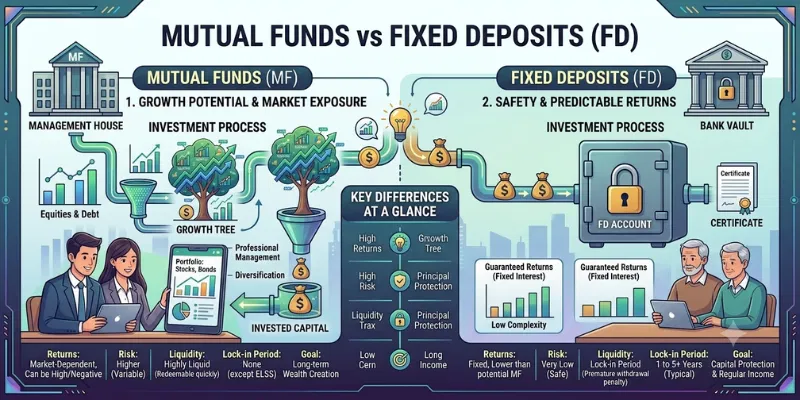
3. Comparison Between Mutual Fund vs FD
The Mutual Fund vs FD comparison depends on returns, risk, safety, tax, and investment goals. Mutual funds offer market-linked returns, while fixed deposits provide fixed and predictable interest. The right option depends on how much risk you can take and when you need the money.
| Comparison Point | Mutual Fund | Fixed Deposit |
| Return | Market-linked and not fixed | Fixed at the time of investment |
| Risk | Low to high, based on fund type | Usually low |
| Capital Safety | Not guaranteed | Generally more stable |
| Investment Method | SIP or lump sum | Mainly lump sum |
| Liquidity | Most open-ended funds allow withdrawal | Early withdrawal may attract a penalty |
| Tax | Depends on fund type and holding period | Interest is generally taxed as income |
| Inflation Protection | Better growth potential over the long term | Returns may struggle to beat inflation |
| Professional Management | Managed by a fund manager | No fund manager is needed |
| Suitable For | Long-term growth and different goals | Safety and predictable returns |
| Return Guarantee | No guaranteed return | Contracted interest rate is known |
In the Mutual Funds vs Fixed Deposit comparison, mutual funds may suit investors seeking long-term growth. Fixed deposits may suit people who value stability and predictable income.
4. Difference Between Mutual Funds and Fixed Deposits
The difference between Mutual Funds vs FD are following:
1. Type of Investment
Mutual funds invest money in shares, bonds, gold, or other market assets. Fixed deposits keep your money with a bank for a set period. This makes their working methods very different.
2. Return
Mutual fund returns change with market performance. Fixed deposits offer a set interest rate at the time of investment. In the Mutual Fund vs FD comparison, FDs give more predictable returns.
3. Risk
Mutual funds can carry low, medium, or high risk based on the scheme. Fixed deposits usually have lower market risk. However, both options still need careful selection.
4. Investment Method
You can invest in mutual funds through SIPs or a lump-sum payment. Fixed deposits usually need a lump-sum amount. SIPs can make regular investing easier for beginners.
5. Liquidity
Most open-ended mutual funds allow investors to redeem units when needed. Fixed deposits may charge a penalty for early withdrawal. Some products may also have a lock-in period.
6. Tax Treatment
mutual fund tax depends on the fund category and holding period. FD interest is usually added to taxable income and taxed at the applicable rate. Tax can reduce the final return from both options.
7. Inflation Protection
Mutual funds may offer better long-term growth potential against inflation. FD returns may lose value after tax and rising prices. This point is important in the Mutual Funds vs Fixed Deposit decision.
8. Suitable Investors
Mutual funds may suit investors who want growth and can accept market changes. Fixed deposits may suit people who prefer stable and predictable returns. The right choice depends on your goal, time period, and risk comfort.
5. Mutual Fund vs FD Returns
Mutual fund returns depend on market performance, fund type, and investment period. They may offer higher growth over the long term, but returns are not guaranteed. Fixed deposits provide a set interest rate for a chosen period, so the maturity amount is easier to estimate. However, FD returns may remain lower after tax and inflation. In the Mutual Fund vs FD comparison, mutual funds offer higher growth potential, while FDs offer more stability. Investors should choose based on their goal, time period, and risk comfort.
6. Mutual Fund vs FD Risk
Mutual fund risk depends on the scheme type and the assets in which it invests. Equity funds may face higher market changes, while debt funds may carry interest-rate and credit risks. Fixed deposits usually have lower market risk because the interest rate stays fixed for the chosen term. However, early withdrawal can reduce interest, and bank safety should still be checked. In the Mutual Fund vs FD comparison, mutual funds carry more uncertainty but may offer better growth. FDs suit investors who prefer stable returns and lower risk.
7. Mutual Fund vs FD Liquidity
In the Mutual Fund vs FD comparison, mutual funds usually offer better liquidity because most open-ended schemes allow redemption when needed. However, some funds may charge an exit load, and elss funds have a three-year lock-in. Fixed deposits may also allow early withdrawal, but banks can reduce the interest rate or charge a penalty. Tax-saving FDs usually have a five-year lock-in and do not allow normal premature withdrawal. Mutual funds may suit investors who want easier access to money. FDs may work better when the investor can keep the money invested until maturity.
8. Mutual Fund vs FD Taxation
Mutual fund tax depends on the fund category, purchase date, holding period, and type of return. Equity fund gains may receive special short-term or long-term tax rates, while many debt fund gains may be taxed at the investor’s normal rate. FD interest is added to total taxable income and taxed according to the applicable income tax slab. Banks may deduct TDS on FD interest, but TDS is not always the final tax amount. In the Mutual Fund vs FD comparison, mutual funds may offer better tax treatment in some cases, while FDs follow simpler income-tax rules. Investors should compare post-tax returns instead of looking only at the advertised return.
9. Mutual Fund vs FD for Inflation
Inflation reduces the buying power of your money over time, so your investment should grow faster than rising prices. Mutual funds, especially equity funds, may offer better long-term growth and can help beat inflation. Fixed deposits provide stable returns, but their post-tax return may remain close to or below the inflation rate. This means your money may grow in numbers but still buy less in the future. In the Mutual Fund vs FD comparison, mutual funds may suit long-term goals, while FDs may suit short-term safety. Investors should always compare real returns after tax and inflation.
10. SIP vs FD
An sip allows you to invest a fixed amount in a mutual fund every month, while an FD usually needs one lump-sum investment. SIP returns depend on market performance, so they may rise or fall over time. Fixed deposits offer a set interest rate, which makes returns easier to predict. SIPs may suit long-term goals and investors who can accept market risk. FDs may suit people who want stable returns and lower risk. The right choice depends on your income, goal, time period, and comfort with risk.
11. Lump Sum vs FD
A lump-sum mutual fund investment puts a large amount into the market at one time, while an FD keeps that money at a fixed interest rate. Lump-sum returns can be higher over the long term, but they can also fall when markets perform poorly. An FD offers more stable and predictable growth for the chosen period. Lump-sum investing may suit people with long-term goals and higher risk tolerance. FDs may suit investors who want capital safety and a known maturity value. The better option depends on your goal, time period, and need for easy access to money.
12. Advantages of Mutual Funds
- Mutual funds can offer better long-term growth than many traditional saving options.
- You can invest through a small monthly sip or a larger lump-sum amount.
- A professional fund manager handles the investment decisions for you.
- Mutual funds spread money across different assets, which helps reduce risk.
- You can choose from equity, debt, hybrid, gold, and other fund types based on your goal.
13. Advantages of Fixed Deposits
- FDs offer fixed and predictable returns for the chosen period.
- They usually carry lower market risk than mutual funds.
- You can choose different tenures based on your financial goal.
- Many banks offer regular interest payments for monthly or quarterly income.
- Eligible bank deposits receive DICGC insurance of up to ₹5 lakh per depositor per bank.
14. Disadvantages of Mutual Funds
- Mutual fund returns are not guaranteed and may fall during weak market periods.
- Some funds can carry high risk, especially equity and sector-based schemes.
- Expense ratios and other charges can reduce your final returns.
- Choosing the right fund may feel confusing for new investors.
- Exit loads and tax rules may apply when you redeem units early.
15. Disadvantages of Fixed Deposits
- FD returns may remain lower than inflation over the long term.
- Interest income is generally taxable at the investor’s slab rate.
- Early withdrawal may reduce interest and attract a penalty.
- Tax-saving FDs usually lock your money for five years.
- Deposit insurance covers only up to ₹5 lakh per depositor per bank.
Yes, mutual fund value can fall because it depends on market performance. An FD usually gives the agreed interest if you keep it until maturity. However, bank safety and deposit insurance limits should still be checked.
An FD can suit short-term goals when you want stable and predictable returns. However, early withdrawal may reduce interest or attract a penalty. You should match the FD tenure with the date when you need the money.
Yes, many investors use both options for different needs. FDs can support safety and short-term goals, while mutual funds can support long-term growth. The right mix depends on your age, goals, income, and risk comfort.
No, debt mutual funds still carry interest-rate, credit, and liquidity risks. Their returns are not fixed like FD interest. Investors should check the fund quality and investment period before choosing one.
The answer depends on your tax rate, investment period, and actual return. FD interest may look stable, but tax and inflation can reduce its real value. In the Mutual Fund vs FD comparison, always compare post-tax returns instead of only looking at the advertised rate.
Conclusion
So guys, in this article, we’ve covered Mutual Fund vs FD in detail. We compared returns, risk, safety, liquidity, tax, inflation, and investment methods. I personally recommend choosing mutual funds for long-term growth and FDs for short-term safety. You can also use both options to create a balanced investment plan. Review your goals today and choose the option that fits your needs.
The content on Finance Calculatorz is intended for educational and informational purposes. It provides general guidance on financial topics and tools. Readers are encouraged to use the information to make informed decisions about their finances.



- Be Respectful
- Stay Relevant
- Stay Positive
- True Feedback
- Encourage Discussion
- Avoid Spamming
- No Fake News
- Don't Copy-Paste
- No Personal Attacks
- Be Respectful
- Stay Relevant
- Stay Positive
- True Feedback
- Encourage Discussion
- Avoid Spamming
- No Fake News
- Don't Copy-Paste
- No Personal Attacks
