What is Exit Load in Mutual Funds? Working and Types
Published: 22 May 2026
Many mutual funds charge a small fee when investors withdraw money early. This fee is called exit load in mutual funds. It may look small, but it can reduce your returns if you are not careful. Many beginners ignore this and lose money without knowing why. So, should you always check this before investing?
1. What is Exit Load in Mutual Funds?
Exit load in mutual fund means a small fee that you pay when you withdraw your money before a fixed time. This fee applies only if you exit early. If you stay invested for the required period, you usually do not pay anything. People also call it exit load, early withdrawal charge, or redemption fee. Not every fund has this charge, but many use it to manage investor behavior.
In easy words, it is a cost for leaving the fund too soon. For example, a fund may set a holding period of one year. If you withdraw your money before that time, the fund may charge around 1% as a fee. So, if you take out $1,000, you may lose $10 as an exit charge. This amount gets deducted from your total value. It may look small, but it can affect your returns.
You may also see this in exit load in SIP investments. Each installment in SIP is treated separately. This means the holding period starts from the date of each investment. If you withdraw early, some parts of your money may face a charge, while others may not. So, before you invest, ask yourself. Do you know the holding period and the charges if you exit early?
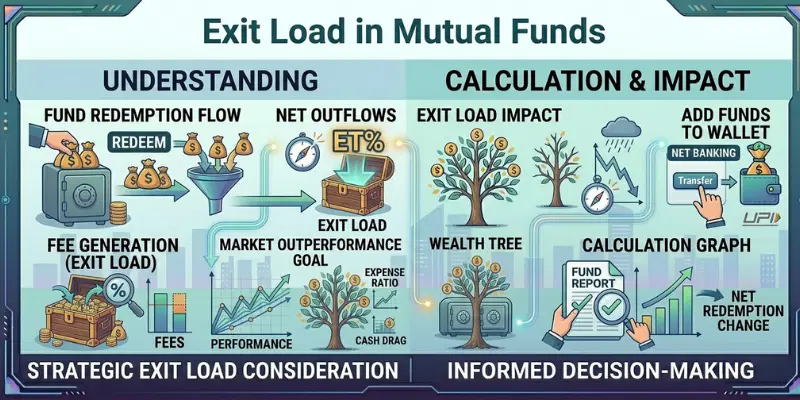
2. Why Do Mutual Funds Charge Exit Load?
The main reason is to discourage early withdrawals. Mutual funds work better when investors stay for a longer time. If many people withdraw money quickly, it can disturb the fund’s strategy. This can affect other investors too. So, the exit load helps control sudden exits and keeps the fund stable.
Another reason is to protect long-term investors. Imagine many people invest and leave within a short time. The fund manager may have to sell assets quickly to pay them. This can create losses or reduce returns for others. By adding an early withdrawal charge, the fund encourages investors to stay committed.
Let’s take a simple example. Suppose many investors put money into a fund and then withdraw it within a few months. The fund may struggle to manage cash flow. But if there is an exit fee, fewer people will leave early. This helps the fund run smoothly and protects everyone’s investment.
So, ask yourself. Are you planning to invest for the short term or long term? If you stay longer, you can avoid this charge and get better results.
3. How Exit Load Works
The exit load depends on how long you stay invested in a fund. Each mutual fund sets a specific time period, often called the holding period. If you withdraw your money before this time ends, the fund charges a small fee. If you stay invested for the full period, you usually do not pay anything.
For example, a fund may have a rule like this. If you exit within 12 months, you pay a 1% fee. If you withdraw after 12 months, there is no charge. So, if you invest $1,000 and withdraw early, the fund may deduct $10 as a fee. The rest of the money comes back to you. This is how the exit charge works in a simple way.
You should also understand how this applies to exit load in sip. In SIP, each installment has its own holding period. This means if you withdraw early, some installments may face a fee while others may not. So, the timing of your investment matters a lot.
4. Types of Exit Load Structures
Different mutual funds follow different rules for exit charges. Let’s understand each type in a simple way.
a. Fixed Exit Load
In this type, the fee stays the same for a fixed period set by the fund. For example, a fund may charge 1% if you withdraw your money within one year. It does not matter if you exit in one month or eleven months. The charge remains the same during that time.
This structure is simple and easy to understand. You just need to remember the time limit. If you exit before that period ends, the fee will apply.
b. Declining Exit Load
In this type, the fee reduces as time passes. The longer you stay invested, the lower the charge becomes. For example, the fund may charge 1% if you exit within six months, and 0.5% if you exit before one year.
After the full period ends, there may be no charge at all. This type encourages investors to stay longer and avoid early withdrawal.
c. No Exit Load
Some funds do not charge any exit fee at all. This means you can withdraw your money at any time without paying a charge. These funds are often chosen by people who want flexibility.
But you should not decide based on this alone. Always check returns, risk, and other costs before you invest.
5. How Exit Load is Calculated
The exit load is calculated on the amount you withdraw, not on your full investment. The fund charges a small percentage based on its rules. This percentage applies only if you withdraw your money before the required holding period. The amount is directly deducted from your total value, so you receive a slightly lower amount.
Let’s take a simple example. Suppose you withdraw $1,000 from a fund that charges a 1% exit fee. The fund will deduct $10 as the charge, and you will receive $990. This may look small, but it can reduce your overall returns if you exit early. The same idea applies to exit load in SIP, where each installment has its own holding period. So, some parts of your investment may be charged, while others may not.
Before you withdraw your money, take a moment to check the fee. Ask yourself a simple question. How much will I actually receive after the deduction? This small step can help you plan better and avoid unexpected loss.
6. When Do You Have to Pay Exit Load?
You pay an exit load when you withdraw your money before the required holding period ends. Each mutual fund sets its own time limit. If you exit before that time, the fund charges a small fee. If you stay invested for the full period, you usually do not pay anything.
This charge also applies in some other situations. For example, if you switch your money from one fund to another within the same company, it may be treated like a withdrawal. In that case, the exit fee can apply. Many investors do not notice this and end up paying charges without planning.
Now think about exit load in SIP. Each SIP installment has its own time period. If you withdraw early, only the recent investments may face the fee. Older investments that have completed the required time may not be charged. So, before you withdraw or switch funds, always check the timing. This simple step can help you avoid extra costs.
7. When You Don’t Pay Exit Load
You do not pay an exit load when you stay invested for the required holding period. Each fund sets a time limit, such as 6 months or 1 year. If you withdraw your money after this period, there is usually no charge. This is why long-term investors often avoid this fee completely.
Some mutual funds also come with no exit load. These funds allow you to withdraw your money at any time without any charge. This gives you more flexibility. But you should not choose a fund only because it has no fee. Always check returns, risk, and other charges as well.
In the case of exit load in SIP, each installment has its own holding period. If older investments complete the required time, you can withdraw them without any fee. Only the newer installments may be charged if withdrawn early. So, before you withdraw money, ask yourself. Have I completed the required time? This simple check can help you save money.
8. How Exit Load Affects Your Returns
The exit load can reduce your final returns if you withdraw your money early. Even a small percentage can make a difference. This is because the fee is deducted directly from your investment value. So, the amount you receive becomes lower than expected.
Let’s understand this with a simple example. Suppose you earn a profit of $100 on your investment. If the fund charges a 1% exit fee on your withdrawal amount, you may lose $10. Now your actual profit becomes $90. This shows how an early withdrawal charge can reduce your gains.
This impact becomes more important for short-term investors. If you enter and exit quickly, these charges can add up over time. In the case of exit load in SIP, early withdrawals from recent installments can also reduce your returns. So, before you exit, ask yourself. Is it the right time, or can I wait a little longer?
9. Tips to Avoid Exit Load
Avoiding an exit load is not hard if you plan your investment well. The first step is to invest with a clear time goal. Before you put money into a fund, check the holding period. If the fund has a one-year rule, try to stay invested for that time. This simple step can help you avoid unnecessary charges.
Another important tip is to read the fund details carefully. Many investors skip this part and face charges later. Always check the exit rules before you invest. If you are using SIP, remember that each installment has its own time period. So, avoid withdrawing early unless it is really needed.
You should also avoid frequent switching between funds. Every switch can act like a withdrawal and may trigger a fee. Plan your moves carefully and think long term. Before you withdraw, ask yourself a simple question. Can I wait a little longer and save this cost? This mindset can help you protect your returns.
10. Common Mistakes Beginners Make
Many beginners ignore exit load when they invest. They focus only on returns and miss small charges. Later, when they withdraw money, they feel surprised. This can reduce their profit without warning.
Another common mistake is withdrawing too early. Some investors panic when the market moves and exit quickly. This triggers an early withdrawal charge and reduces their returns. In exit load in SIP, many people also forget that each installment has a different time period. So, they withdraw without planning and end up paying fees.
Some investors also do not read fund details before investing. They follow others or choose popular funds without checking rules. This leads to poor decisions. So, ask yourself a simple question. Do you fully understand the charges before you invest? Taking a few minutes to check can save you money.
11. Real-Life Example
Ali invests $2,000 in a mutual fund. The fund has a 1% exit load if he withdraws money within one year. After six months, he decides to take out his money. At that time, his investment grows to $2,100. But since he exits early, the fund charges 1% on the withdrawal amount. This means he pays $21 as a fee and receives $2,079.
Now compare this with Sara. She invests the same amount in the same fund. But she waits for more than one year before withdrawing. Her investment also grows, and when she exits, she pays no exit fee. She receives the full amount without any deduction.
This example shows a clear difference. One investor loses money due to early withdrawal, while the other avoids the charge by waiting. So, before you withdraw, ask yourself. Can you stay invested a little longer and save this cost?
Yes, you can still lose a small part of your profit. The exit load is charged on the withdrawal amount, not on profit only. So, even if you earn, the fee will reduce your final amount.
Yes, in most cases you can avoid it by completing the holding period. Each fund sets a time limit for this. Once you cross that time, you usually do not pay any fee.
Some funds want to give more flexibility to investors. They allow easy entry and exit without any charge. But you should still check returns and risk before investing.
No, you pay it only if you withdraw before the set time. If you stay invested long enough, there is no charge. Always check the fund rules to be sure.
Yes, it can apply in many cases. Switching funds is often treated like a withdrawal. So, the fee may be charged if you switch early.
Short-term investors exit quickly and face this charge more often. This reduces their overall returns. Long-term investors usually avoid this cost.
You can find it in the fund details or fact sheet. It is clearly mentioned with the holding period. Always read this before you invest your money.
Conclusion
So guys, in this article, we’ve covered Exit load in mutual funds in detail. Now you understand how this small fee can affect your returns if you withdraw early. My personal recommendation is simple. Always check the holding period before you invest and try to stay for the required time. Want to avoid unnecessary charges? Start reviewing fund details before your next investment.
The content on Finance Calculatorz is intended for educational and informational purposes. It provides general guidance on financial topics and tools. Readers are encouraged to use the information to make informed decisions about their finances.



- Be Respectful
- Stay Relevant
- Stay Positive
- True Feedback
- Encourage Discussion
- Avoid Spamming
- No Fake News
- Don't Copy-Paste
- No Personal Attacks
- Be Respectful
- Stay Relevant
- Stay Positive
- True Feedback
- Encourage Discussion
- Avoid Spamming
- No Fake News
- Don't Copy-Paste
- No Personal Attacks
