What is Asset under management (AUM) ?
Published: 17 May 2026
Many investment firms manage millions or even billions of dollars every day. This total amount is called asset under management (AUM). It shows how much money a company handles for its clients. Investors often check this number before they trust a fund. But what does it really tell you?
1. What is Asset Under Management (AUM)?
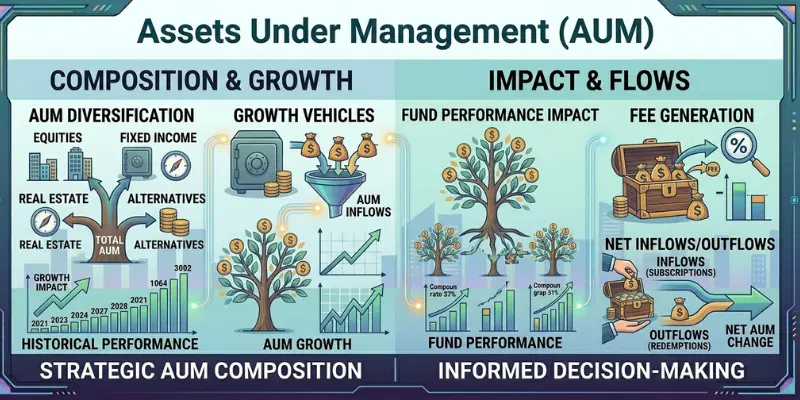
Asset under management (AUM) means the total money an investment company manages for its clients. This money belongs to investors, not the company itself. The company only handles and invests it on their behalf. In simple words, it is the total value of all investments a firm controls at a given time. These investments can include stocks, bonds, cash, and other assets. People often use the short term AUM, and you may also hear names like fund size or total assets managed.
Many financial companies use this term, such as mutual funds, banks, and wealth managers. For example, if three people invest $1,000, $2,000, and $3,000, the total becomes $6,000, which is the firm’s AUM. This number helps you understand how big a company is and how much trust investors place in it. But here is an important point. A bigger fund size does not always mean better results. So, before you invest, ask yourself. Are you only looking at size, or also checking performance and risk?
2. AUM in Mutual Funds
When you explore mutual funds, you will often see the term AUM. In simple words, AUM in mutual funds shows the total money that all investors have put into that fund. It tells you how large the fund is at a given time. A fund with many investors usually has a higher fund size, while a new or less popular fund may have a smaller one. This number keeps changing as people invest more money or withdraw their funds.
Let’s take a simple example. Imagine a mutual fund where 100 people invest small amounts, and the total reaches $500,000. That total becomes the fund’s AUM. If more people join, the value grows. If some investors take their money out, it drops. This helps you see how popular a fund is, but remember one thing. A larger fund is not always the best choice. Always check returns, risk, and fees along with fund size before making a decision.
3. Why AUM Matters for Investors?
When you plan to invest, you want to feel safe and confident. This is where asset under management helps. It gives you a quick idea about how big an investment company or fund is. A higher value often shows that many people trust that firm with their money. It also shows that the company has experience in handling large amounts of investments. For beginners, this can be a helpful starting point when comparing different options.
But you should not rely on this number alone. A large fund size does not always mean better returns or lower risk. Sometimes smaller funds grow faster and offer better opportunities. So, what should you do? Always check performance, fees, and risk along with AUM. Ask yourself a simple question. Am I choosing this fund because it is big, or because it is right for my goals?
4. How Total Managed Assets Are Calculated?
To find asset under management, a company adds the total value of all investments it manages. This includes stocks, bonds, cash, and other assets. The value depends on current market prices. When prices go up, the total managed assets increase. When prices fall, the value also drops. So, this number is not fixed. It keeps changing with the market.
Let’s understand with a simple example. Imagine a fund holds stocks worth $4,000, bonds worth $3,000, and cash of $1,000. When you add everything, the total becomes $8,000. This is the fund’s AUM. If stock prices rise, the total will grow. If investors withdraw money, the total will reduce. So, always remember, this value changes over time and reflects both market movement and investor activity.
5. What Changes AUM Over Time
The total value a fund manages does not stay the same. It keeps changing based on a few simple factors. One major factor is the market. When stock prices go up, the total assets managed also increase. When the market falls, the value goes down. This happens even if no new money comes in or goes out. So, market movement plays a big role in how this number changes.
Another important factor is investor activity. When new people invest money, the fund size grows. When existing investors withdraw their money, it reduces. For example, if many people join a mutual fund, its AUM will increase quickly. But if investors start taking money out, the value will drop. This is why you should not judge a fund based on this number alone. Always look at performance and consistency along with it.
6. High AUM vs Low AUM
When you compare funds, you will notice that some have a large fund size while others are smaller. A fund with high asset under management usually shows strong trust from investors. Many people have already invested in it. These funds often feel more stable and less risky. They can handle market changes better because they have more resources.
On the other hand, funds with lower AUM are smaller in size. They may not be as popular yet, but they can be more flexible. This means they can move money quickly and take new opportunities faster. In some cases, smaller funds grow faster than larger ones. So, what should you choose? A big fund for stability or a small one for growth? The right choice depends on your goals, not just the size.
7. How Investors Use AUM
Investors often look at asset under management to compare different funds. It helps them understand how big a fund is and how many people trust it. A larger fund size can give a sense of stability, while a smaller one may feel less crowded. This makes it easier to shortlist options before making a decision. Many beginners use this number as a quick filter when they explore mutual funds.
But smart investors do not stop there. They also check returns, fees, and risk along with AUM. For example, a fund may be large but give low returns, while a smaller fund may perform better. So, what should you do? Use AUM as a starting point, not the final decision. Always look at the full picture before you invest your money.
8. Common Mistakes Beginners Make
Many beginners look at asset under management and think a bigger number means better results. This is a common mistake. A large fund size only shows how much money people have invested, not how well the fund performs. Some big funds grow slowly, while smaller ones may give better returns. So, if you only focus on size, you may miss better options.
Another mistake is ignoring important factors like fees, past performance, and risk. Some investors also follow the crowd without understanding the fund. For example, if everyone invests in a popular fund, they join without checking details. This can lead to poor decisions. So, always ask yourself. Do you understand where your money is going? Take time to compare funds and make a smart choice.
9. Real-Life Example
Let’s understand this with a simple real-life example.
Imagine you have two mutual funds in front of you. Fund A has a large asset under management of $500 million. Fund B is smaller, with total managed assets of $50 million. At first, Fund A may look safer because many people trust it. It feels stable and well-established. But when you check returns, you see that Fund A gives steady but lower growth.
Now look at Fund B. It has fewer investors and a smaller fund size. But it is more flexible and invests in new opportunities. Over time, it gives higher returns, but with slightly more risk. So, what should you do here? If you want stability, Fund A may suit you. If you want growth and can take some risk, Fund B might be a better choice. This example shows why you should not depend on size alone when making investment decisions.
Not always. A larger fund may feel stable because many people invest in it. But safety depends on where the money is invested, not just the size.
Yes, it can. Smaller funds can move money quickly and take new opportunities. This can help them grow faster in some cases.
This happens because of market movement. When stock prices go up or down, the total value also changes. So, the fund size keeps moving with the market.
No, that is not a smart approach. Popular funds may not always give the best returns. Always check performance, risk, and fees before you decide.
No, it does not guarantee better returns. A large fund may grow slowly over time. Returns depend on strategy and market conditions.
Use it as a starting point, not the final decision. Compare different funds and then check other details. This will help you make a balanced choice.
Yes, it gives useful signals. If AUM is rising, more people are investing. If it is falling, investors may be withdrawing money.
Conclusion
So guys, in this article, we’ve covered asset under management in detail. You now understand how this number shows the size of a fund and investor trust. My personal advice is simple. Do not choose a fund based on size alone. Always check returns, risk, and fees before you invest. Want to make smarter investment choices? Start comparing funds today and take control of your financial future.
The content on Finance Calculatorz is intended for educational and informational purposes. It provides general guidance on financial topics and tools. Readers are encouraged to use the information to make informed decisions about their finances.



- Be Respectful
- Stay Relevant
- Stay Positive
- True Feedback
- Encourage Discussion
- Avoid Spamming
- No Fake News
- Don't Copy-Paste
- No Personal Attacks
- Be Respectful
- Stay Relevant
- Stay Positive
- True Feedback
- Encourage Discussion
- Avoid Spamming
- No Fake News
- Don't Copy-Paste
- No Personal Attacks
