What are ELSS Funds? A Complete Beginner Guide
Published: 24 Mar 2026
Every year, thousands of salaried investors choose ELSS funds to save tax under Section 80C. These funds invest mainly in equities and come with a three-year lock-in period. Among tax-saving options, they have the shortest lock-in time. That is why many young investors prefer them for both tax savings and long-term growth.
1. What are ELSS Funds?
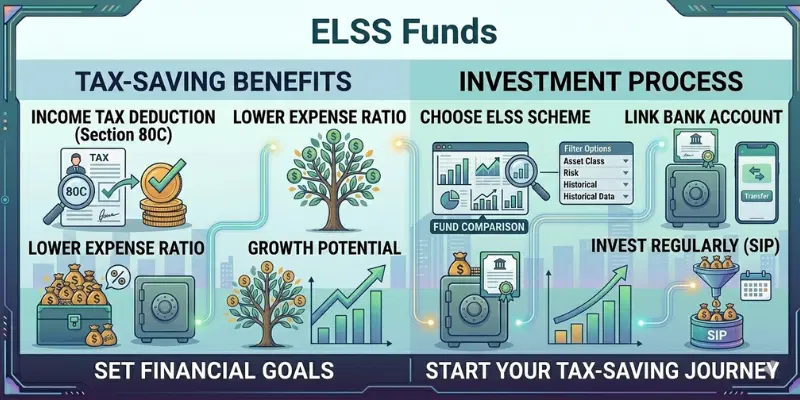
Equity Linked Savings Scheme funds are tax-saving mutual funds that invest mainly in the stock market. They help you claim deduction under Section 80C and also aim to grow your money over time. These equity linked savings schemes come with a three-year lock-in period, which is the shortest among most tax-saving options. In an Equity Linked Savings Scheme pooled structure, a fund manager invests money collected from many investors into different companies. Returns depend on market performance, so values can go up or down. They are suitable for investors who want tax savings along with long-term growth.
2. How Do ELSS Funds Work?
Equity Linked Savings Scheme funds collect money from many investors and invest it mainly in shares of different companies. A professional fund manager manages this money and decides where to invest. You do not need to pick stocks yourself. The fund manager spreads the investment across different sectors to reduce risk.
You can invest in equity linked savings schemes either through a lump sum or a monthly sip. If you choose SIP, you invest a fixed amount every month. Each investment stays locked for three years from its own date. This means you cannot withdraw the money before completing the lock-in period.
In an Equity Linked Savings Scheme pooled system, your money joins funds from other investors. The combined amount gets invested in various companies to create growth opportunities. Returns depend on stock market performance, so the value may rise or fall in the short term.
For example, if you invest ₹5,000 every month, each month’s amount will complete its three-year period separately. After three years, you can withdraw the amount that has completed its lock-in. To get better results, you should stay invested for a longer time instead of exiting immediately.
3. Key Features of ELSS Funds
- Tax-Saving Benefit: Equity Linked Savings Scheme funds qualify for deduction under Section 80C. You can claim up to ₹1.5 lakh in a financial year.
- Three-Year Lock-in: These equity linked savings schemes come with a lock-in period of three years. This is the shortest lock-in among most tax-saving options.
- Equity Investment: Equity Linked Savings Scheme funds invest mainly in shares of companies. Returns depend on stock market performance.
- Market-Linked Returns: The value can go up or down in the short term. In the long run, equities have the potential to generate higher returns.
- SIP and Lump Sum Option: You can invest in an Equity Linked Savings Scheme pooled structure either through a one-time investment or monthly sip. This makes it flexible for different income levels.
- Professional Management: A fund manager handles the investment decisions. You do not need to select or track stocks yourself.
4. Benefits of ELSS Funds
- Save Tax and Build Wealth Together: Equity Linked Savings Scheme funds help you reduce taxable income under Section 80C. At the same time, they invest in equities for long-term growth. This gives you two benefits in one investment.
- Shortest Lock-in Period: These equity linked savings schemes have a lock-in of only three years. Other options like PPF or tax-saving FDs keep your money locked for much longer. This gives you better liquidity compared to many tax-saving tools.
- Higher Return Potential: Since ELSS pooled investments focus on shares, they offer better growth potential than traditional fixed-income options. Returns are not fixed, but long-term equity investment can create strong wealth.
- Start with Small Amount: You can invest through SIP with a small monthly amount. This makes it easy for beginners to start investing without financial pressure.
- Professional Fund Management: A trained fund manager handles stock selection and portfolio decisions. This helps investors who do not have market knowledge or time to track stocks.
5. Risks of ELSS Funds
Before investing in Equity Linked Savings Scheme funds, you should understand the risks involved. These funds offer growth potential, but they are linked to the stock market. That means returns can fluctuate. Let’s look at the main risks in simple words.
1. Market Risk
Equity Linked Savings Scheme funds invest mainly in shares. Stock prices can rise and fall based on market conditions. If the market goes down, your investment value can also decrease. Returns are not fixed or guaranteed.
2. Short-Term Volatility
Equity linked savings schemes can show frequent ups and downs. The value may change daily due to news, economic changes, or global events. New investors may feel nervous during this period. You need patience to handle these fluctuations.
3. Three-Year Lock-in Risk
Your money stays locked for three years from the date of investment. You cannot withdraw it before that period ends. If you face an emergency, this money will not be available. So invest only what you can keep aside.
4. Return Uncertainty
In an ELSS pooled structure, performance depends on market trends and fund management decisions. Some years may give high returns, while others may give low or negative returns. Long-term investment reduces risk, but it does not remove it completely.
6. Who Should Invest in ELSS Funds?
Not everyone has the same financial goals. Equity Linked Savings Scheme funds are suitable for people who want both tax savings and long-term growth. Let’s understand who can benefit the most.
1. Salaried Employees
If you pay tax and want to reduce your taxable income, equity linked savings schemes can help. You can claim deduction under Section 80C. At the same time, your money gets invested for growth. This makes it a smart option for salaried individuals.
2. Young Investors
Young investors can take more risk because they have time on their side. ELSS pooled investments focus on equities, which can grow well in the long run. If you start early, you can rbnC1#4AE@n@tcompounding.
3. First-Time Mutual Fund Investors
If you want to enter the stock market but feel confused, Equity Linked Savings Scheme can be a simple starting point. A professional fund manager handles the stock selection. You just need to stay invested and patient.
4. Investors in Higher Tax Slabs
If you fall in the 20% or 30% tax slab, tax savings become more important. Investing in ELSS funds can reduce your tax burden significantly. The higher your slab, the higher your tax saving.
7. Best ELSS Funds in India 2026
If you are thinking of saving tax and building wealth in 2026, some Equity Linked Savings Scheme funds have shown strong performance and steady growth. These equity linked savings schemes are popular among many investors for both tax benefit and long-term wealth creation.
Here are some of the best ELSS funds in India for 2026 (based on recent performance and growth history):
- SBI ELSS Tax Saver Fund: A top choice with steady returns over the years and strong assets under management.
- HDFC ELSS Tax Saver Fund: Known for consistent performance and a disciplined strategy.
- DSP ELSS Tax Saver Fund: Good long-term return track record with professional management.
- Mirae Asset ELSS Tax Saver Fund: Large fund with an impressive performance in recent years.
- Motilal Oswal ELSS Tax Saver Fund: Offers strong returns and has a focused investment strategy.
- Nippon India ELSS Tax Saver Fund: A well-balanced fund with a good blend of growth and stability.
- ICICI Pru ELSS Tax Saver Fund: A solid performer with reasonable costs and long-term returns.
These funds vary in risk and performance, so it’s best to check recent returns, expense ratios, and portfolio style before investing. Many start with even small amounts like ₹500 through SIPs to build wealth slowly while saving tax.
Equity Linked Savings Scheme funds invest in the stock market, so they carry market risk. Their value can go up or down in the short term. They are suitable for long-term investors who can handle market fluctuations.
No, you cannot withdraw your money before completing three years. Each investment has its own lock-in period. You can withdraw only after the lock-in ends.
You can claim a deduction of up to ₹1.5 lakh under Section 80C. The actual tax saving depends on your tax slab. Higher tax slab means higher tax saving.
Equity Linked Savings Scheme funds offer higher return potential because they invest in equities. PPF gives stable but fixed returns. ELSS has market risk, while PPF is safer.
Yes, beginners can invest in equity linked savings schemes. A professional fund manager handles the stock selection. You just need to invest and stay patient.
Both options are available in Equity Linked Savings Scheme pooled investments. SIP helps you invest small amounts regularly. Lump sum is suitable if you have surplus money.
After three years, you can withdraw your investment. You may also choose to stay invested for longer growth. Long-term investing can improve wealth creation potential.
Conclusion
So guys, in this article, we’ve covered ELSS funds in detail. You now understand how these equity linked savings schemes help you save tax and build wealth at the same time. In my opinion, ELSS is a smart option for salaried and young investors who can stay invested for at least three years. If you want tax benefits with growth potential, this can be a strong choice. Start small, stay consistent, and take your first step toward smarter investing today.
The content on Finance Calculatorz is intended for educational and informational purposes. It provides general guidance on financial topics and tools. Readers are encouraged to use the information to make informed decisions about their finances.




- Be Respectful
- Stay Relevant
- Stay Positive
- True Feedback
- Encourage Discussion
- Avoid Spamming
- No Fake News
- Don't Copy-Paste
- No Personal Attacks
- Be Respectful
- Stay Relevant
- Stay Positive
- True Feedback
- Encourage Discussion
- Avoid Spamming
- No Fake News
- Don't Copy-Paste
- No Personal Attacks
