Different Types of Mutual Funds
Published: 1 Mar 2026
Mutual fund have become one of the most popular and beginner-friendly ways to grow wealth. But many investors feel confused because there are different Types of Mutual Funds and each serves a different purpose. Some fund help you build long-term wealth, while others focus on stability or regular income. Choosing the wrong fund can slow your progress, but choosing the right one can bring you closer to your financial goals. That’s why understanding the different Types of Mutual Fund is essential before investing. In this article, you will learn the main categories, how they work, and which one may suit your needs best.
1. Types of Mutual Funds
There are different Types of Mutual Fund designed for different financial goals. Some focus on growth, while others focus on safety or regular income. Choosing the right fund category can directly impact your returns and risk level. That is why understanding the Types of Mutual Fund available in the market is important before you invest.
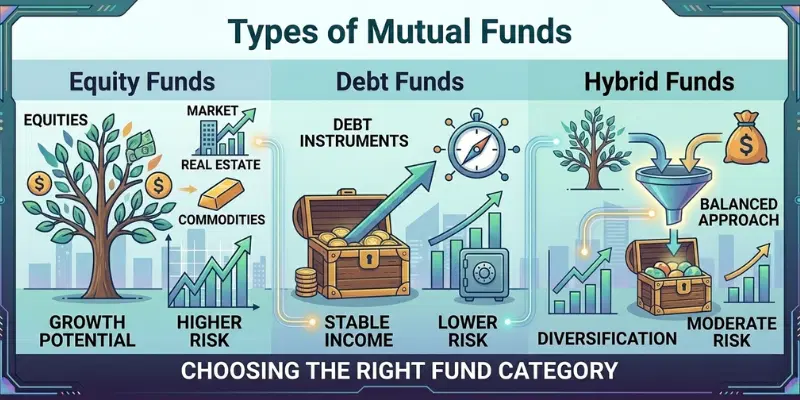
1. Equity Mutual Funds
Equity mutual pool invest mainly in company shares. Their primary goal is to grow your money over time. When companies perform well, their stock prices increase, and your investment value also rises. This makes equity pool one of the best options for long-term wealth creation.
However, stock prices can move up and down in the short term. This means equity fund carry higher risk compared to other fund categories. But over longer periods, they have the potential to deliver higher returns than most other investment options.
These funds are best suited for investors who want to build wealth and can stay invested for many years.
Key points to remember:
- Best for long-term goals like retirement
- Higher return potential
- Short-term market fluctuations are normal
Example:
A 25-year-old investing for retirement can benefit greatly from equity-based funds because time reduces risk and increases growth potential.
2. Debt Mutual Funds
Debt mutual funds invest in fixed-income instruments such as government bonds, treasury bills, and corporate bonds. Their main goal is to provide stable and predictable returns while protecting your capital.
These fund are less affected by stock market volatility. That is why they are considered safer compared to equity-based investments. However, their returns are usually lower than equity funds.
Debt pool are ideal for short-term and medium-term financial goals. They are also useful for investors who prefer stability over high returns.
Key points to remember:
- Lower risk compared to equity funds
- Stable and predictable returns
- Suitable for short-term goals
Example:
If you are saving money to buy a car in two years, debt funds can help protect your money while earning moderate returns.
3. Hybrid Mutual Funds
Hybrid mutual funds invest in both stocks and fixed-income securities. This combination helps balance risk and return. The equity portion provides growth, while the debt portion provides stability.
These fund are suitable for investors who want growth but do not want to take full equity risk. Hybrid pools reduce overall volatility and create a more balanced investment experience.
They are often recommended for beginners because they offer diversification in a single fund.
Key points to remember:
- Combination of equity and debt
- Balanced risk and return
- Suitable for beginners
Example:
A beginner who feels unsure about investing fully in stocks can start with hybrid funds for safer exposure.
4. Index Funds
Index funds are a passive investment option. They follow a market index like Nifty 50 or S&P 500. Instead of selecting stocks actively, they copy the index structure.
Because there is no active management, these fund have lower costs. Over time, they can provide returns similar to overall market performance.
Index pools are becoming very popular among long-term investors due to their simplicity and low fees.
Key points to remember:
- Low cost investment option
- No active management
- Provides market-level returns
Example:
Instead of choosing individual stocks, you can invest in an index fund that tracks the entire market.
5. ELSS
ELSS funds are equity-based funds that also provide tax benefits. These funds come with a lock-in period of three years, which means you cannot withdraw money during that time.
They help investors save taxes while also building long-term wealth. ELSS is considered one of the most efficient tax-saving investment options.
These funds are suitable for salaried individuals and long-term investors.
Key points to remember:
- Provides tax benefits
- Three-year lock-in period
- High long-term growth potential
Example:
A salaried person can invest in ELSS to reduce tax and grow wealth at the same time.
6. Money Market Mutual Funds
Money market funds invest in short-term financial instruments. Their main goal is capital safety and liquidity. These funds are considered very low risk.
Returns are usually lower, but your money remains safe and easily accessible. These pools are useful for temporary investments or emergency savings.
They are ideal for investors who want safety and quick access to funds.
Key points to remember:
- Very low risk
- High liquidity
- Suitable for short-term needs
Example:
If you plan to use money within six months, money market funds can be a good option.
7. Sectoral and Thematic Mutual Funds
These funds invest in specific sectors such as banking, technology, or healthcare. Because they focus on one sector, their returns depend on that sector’s performance.
They can provide high returns if the sector performs well. But they also carry higher risk because there is less diversification.
These funds are more suitable for experienced investors.
Key points to remember:
- Invests in specific sectors
- Higher risk and higher return potential
- Requires market understanding
Example:
If the technology sector grows rapidly, technology-focused funds can deliver strong returns.
8. Solution-Oriented Mutual Funds
These funds are designed for specific life goals such as retirement or child education. They encourage long-term investing and disciplined savings.
They usually come with a lock-in period to help investors stay committed to their goals.
These funds are helpful for goal-based financial planning.
Key points to remember:
- Designed for specific goals
- Encourages long-term investing
- Helps with financial planning
Example:
Parents can use these funds to build savings for their child’s education.
3. How to Choose the Right Type of Mutual Fund
Choosing the right fund is important because every investor has different goals and comfort levels. The best choice depends on your purpose, time period, and ability to handle risk. If you select a fund that does not match your needs, you may face stress or poor returns. Understanding the available Types of Mutual Funds helps you make smarter and more confident decisions.
1. Identify Your Financial Goal
First, understand why you want to invest. Your goal decides which fund category is suitable. Long-term goals usually need growth-focused fund, while short-term goals need safer options. For example, retirement planning works well with equity fund, while saving for a car in two years may be better with debt fund.
2. Understand Your Risk Tolerance
Risk tolerance means how comfortable you are with market ups and downs. Some investors can handle fluctuations, while others prefer stability. Equity-oriented pools offer higher growth but also higher volatility. Debt-oriented funds offer more stability but lower returns. You should always choose a fund that matches your comfort level.
3. Consider Your Investment Time Period
Your investment duration plays a major role in fund selection. Longer time periods allow you to take more risk because markets recover over time. Short-term investments should focus on capital protection. Long-term investments can focus on growth. This is why equity funds are suitable for long-term investors, while debt funds suit short-term needs.
4. Check Fund Performance Consistency
Looking at past performance helps you understand how the fund behaved in different situations. Consistent performance over many years is a positive sign. Avoid funds that show unstable results. Always focus on long-term performance instead of short-term gains.
5. Balance Between Risk and Return
Every investment fund offers a balance between risk and return. Higher return potential usually comes with higher risk. Lower risk usually means lower returns. Choosing from the right Types of MF based on your goal helps you maintain this balance and grow your money safely.
Real-Life Example
Suppose Mike is 25 years old and investing for retirement. He can choose equity funds because he has a long time horizon. On the other hand, Jhon wants to use his money in one year. He chooses debt funds to protect his capital. Both investors selected the right fund based on their goals and needs.
4. Types of Mutual Funds Based on Structure
Mutual funds are also classified based on their structure. Structure means how investors can enter or exit the fund. Some funds allow investment anytime, while others have fixed rules. Understanding this classification helps you choose the right option based on your flexibility and investment plan.
There are three main Types of Mutual Fund based on structure: open-ended funds, close-ended funds, and interval funds.
1. Open-Ended Mutual Funds
Open-ended funds are the most common and beginner-friendly option. These allow investors to buy or sell units at any time. There is no fixed maturity date, so you can stay invested as long as you want.
This flexibility makes open-ended funds very convenient. Investors can enter when they have money and exit when they need funds. Most equity, debt, and hybrid funds follow this structure.
Key features include:
- No fixed maturity period
- Investors can buy and sell anytime
- High liquidity and flexibility
Example: If you start investing monthly through SIP, you are most likely investing in an open-ended fund.
2. Close-Ended Mutual Funds
Close-ended funds have a fixed maturity period. Investors can invest only during the initial launch period, known as the New Fund Offer (NFO). After that, new investments are not allowed.
Your money stays invested until the maturity date. This helps investors stay disciplined and avoid early withdrawals. However, it reduces flexibility compared to open-ended funds.
Key features include:
- Fixed investment period
- Limited entry opportunity
- Less liquidity compared to open-ended funds
| Benefits of Mutual Funds |
|---|
|
5. Common Mistakes to Avoid in Mutual Fund Investing
Many investors enter mutual funds with excitement but without proper planning. Small mistakes at the beginning can reduce returns and create stress later. If you understand these common errors, you can avoid losses and invest more confidently.
1. Investing Without a Clear Goal
Many people invest just because others are investing. They do not define whether the goal is short-term, long-term, or tax-saving. Without a clear goal, choosing the right Types of Mutual Fund becomes difficult and confusing.
2. Ignoring Risk Tolerance
Some investors choose high-return fund without understanding the risk involved. When the market falls, they panic and withdraw money. This emotional decision often leads to losses.
3. Focusing Only on High Returns
Past high returns attract many beginners. But choosing a fund only because it gave high returns last year is risky. Always check long-term consistency instead of short-term performance.
4. Not Diversifying Properly
Investing all money in one fund category increases risk. A balanced mix of equity, debt, or hybrid funds can reduce overall volatility.
5. Stopping SIP During Market Fall
When markets decline, many investors stop their sip. This is a mistake because market dips actually allow you to buy units at lower prices. Staying consistent helps in long-term growth.
6. Ignoring Expense Ratio
Every fund charges a management fee. If the expense ratio is high, it can reduce your overall returns. Always compare costs before investing.
7. Withdrawing Too Early
Mutual funds, especially equity funds, need time to grow. Many investors withdraw money too early due to fear or impatience. Long-term investing usually provides better results.
Index and hybrid pools are often suitable for beginners. They offer diversification and lower risk compared to pure equity funds. These funds also require less market knowledge.
Equity mutual funds usually offer the highest return potential over the long term. However, they also carry higher risk due to market fluctuations. Long-term investors benefit the most from these funds.
Debt mutual fund are considered safer than equity-based funds. They invest in bonds and fixed-income securities. These funds offer stable but moderate returns.
Yes, you can invest in multiple fund categories. This helps diversify your portfolio and reduce risk. Many investors use a mix of equity, debt, and hybrid funds.
You should choose based on your goal, risk tolerance, and time horizon. Long-term goals may suit equity pools, while short-term goals may suit debt funds. Always match the fund with your financial objective.
Yes, mutual funds are very effective for long-term wealth creation. Equity-oriented funds perform well over longer periods. Consistent investing helps achieve major financial goals.
Conclusion
So guys, in this article, we’ve covered Types of mutual funds in detail. You learned that each fund category serves a different goal, risk level, and investment period. In my personal opinion, beginners should start with index and hybrid funds because they are simple and balanced. Once you gain confidence, you can explore other options based on your goals. Take the first step today and choose the right fund to start building your financial future.
The content on Finance Calculatorz is intended for educational and informational purposes. It provides general guidance on financial topics and tools. Readers are encouraged to use the information to make informed decisions about their finances.






- Be Respectful
- Stay Relevant
- Stay Positive
- True Feedback
- Encourage Discussion
- Avoid Spamming
- No Fake News
- Don't Copy-Paste
- No Personal Attacks
- Be Respectful
- Stay Relevant
- Stay Positive
- True Feedback
- Encourage Discussion
- Avoid Spamming
- No Fake News
- Don't Copy-Paste
- No Personal Attacks
