What is ROI? How it Works
Published: 11 Nov 2026
Are you confused about whether your investment has actually generated a good return? Looking only at the final amount may not clearly show how much profit you earned compared with the original cost. Return on Investment solves this problem by converting the gain or loss into a simple percentage. It allows investors to compare different opportunities more easily. However, the investment period, risk, fees, and other expenses should also be considered.
1. What Is ROI?
ROI stands for Return on Investment and measures the profit or loss earned from an investment compared with its total cost. It is usually expressed as a percentage, making the result easy to understand and compare. A positive Rate on Investment means the investment generated a profit, while a negative result shows a loss. The calculation uses the net profit and the original investment amount. Investors and businesses use ROI to evaluate projects, marketing campaigns, property, stocks, and other financial decisions. However, it does not usually consider investment duration, risk, or the time value of money. Therefore, ROI should be reviewed with other financial factors before making a final decision.
2. Working of ROI
Return on Investment works by comparing the net profit or loss from an investment with its total cost. First, calculate the final value or total income received from the investment. Then subtract the original investment amount and all related expenses to find the net profit. Divide this profit by the total investment cost and multiply the result by 100. A positive percentage shows that the investment earned a profit, while a negative percentage shows a loss. Rate on Investment makes it easier to compare different opportunities, but it does not usually consider time, risk, or compounding. Therefore, investors should review these factors separately before making a final decision.
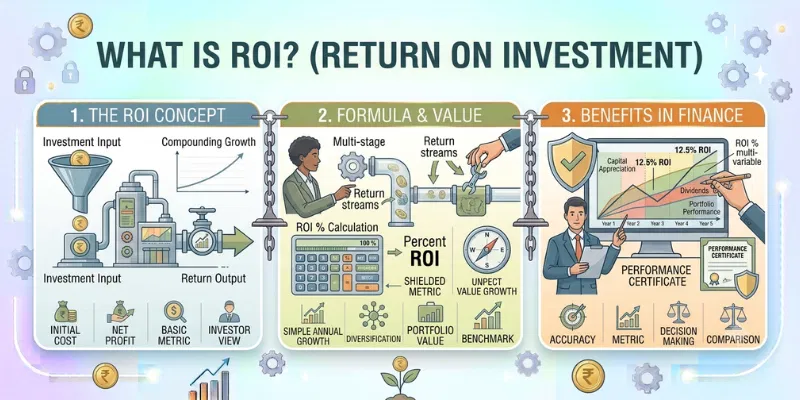
3. Formula of ROI
The Rate on Investment formula measures the profit or loss generated from an investment compared with its total cost.
ROI = (Net Profit ÷ Investment Cost) × 100
You can also calculate it using the final investment value:
ROI = [(Final Value − Investment Cost) ÷ Investment Cost] × 100
Here:
- Net Profit is the total return minus the complete investment cost.
- Final Value is the current value or total amount received.
- Investment Cost includes the original amount and related expenses.
- ROI is the final result expressed as a percentage.
For example, if you invest ₹1,00,000 and the final value becomes ₹1,25,000, your net profit is ₹25,000.
ROI = (₹25,000 ÷ ₹1,00,000) × 100 = 25%
This means the investment generated a total return of 25%.
4. How to Calculate ROI?
To calculate Rate on Investment, you need the total investment cost and the final value or income received from it. The calculation shows whether the investment generated a profit or loss compared with the amount spent.
1. Step 1: Find the Total Investment Cost
Add the original investment amount and all related expenses. These may include transaction fees, maintenance costs, marketing expenses, renovation charges, or other costs.
Step 2: Find the Final Value
2. Step 2: Find the Final Value
Check the current value, sale amount, or total income received from the investment. Make sure you include all financial returns.
Step 3: Calculate the Net Profit
3. Step 3: Calculate the Net Profit
Subtract the total investment cost from the final value.
Net Profit = Final Value − Investment Cost
4. Step 4: Divide the Net Profit by the Investment Cost
Divide the calculated profit or loss by the total amount invested.
Net Profit ÷ Investment Cost
5. Step 5: Multiply the Result by 100
Convert the result into a percentage by multiplying it by 100.
ROI = (Net Profit ÷ Investment Cost) × 100
6. Example
Suppose you invest ₹2,00,000 and the final value becomes ₹2,50,000.
Net Profit = ₹2,50,000 − ₹2,00,000 = ₹50,000
ROI = (₹50,000 ÷ ₹2,00,000) × 100
ROI = 25%
This means the investment generated a total profit of 25%. You can calculate your roi using the same steps, but remember to include all related costs for a more accurate result.
5. Negative ROI With Example
Negative Rate on Investment means an investment has lost money instead of generating a profit. It happens when the final value is lower than the total investment cost.
Suppose you invest ₹1,00,000, but the final value falls to ₹80,000.
Net Loss = ₹80,000 − ₹1,00,000 = −₹20,000
ROI = (−₹20,000 ÷ ₹1,00,000) × 100
ROI = −20%
This means the investment produced a 20% loss. A negative Rate on Investment shows that the money received was not enough to recover the original investment cost.
6. Main Components of ROI
Rate on Investment depends on several basic components that help measure the profit or loss generated from an investment. Using complete and accurate values makes the final result more reliable.
1. Investment Cost
Investment cost is the total amount spent on an investment, project, or asset. It may include the purchase price, setup charges, transaction fees, and other related expenses.
2. Final Investment Value
The final value is the current market value, selling price, or total amount received from the investment. It is compared with the original cost to calculate the gain or loss.
3. Net Profit
Net profit is the amount left after subtracting the total investment cost from the final value. A positive result shows profit, while a negative result shows loss.
4. Additional Income
Additional income may include dividends, rental income, interest, commissions, or other earnings received during the investment period. These returns should be included for a more accurate calculation.
5. Additional Expenses
Additional expenses include maintenance costs, taxes, brokerage fees, advertising charges, or repair costs. Ignoring these expenses may make the ROI appear higher than the actual return.
6. Return Percentage
The return percentage is the final result after dividing net profit by the total investment cost and multiplying by 100. It makes Rate on Investment easier to understand and compare across different opportunities.
7. Importance of ROI
Rate on Investment is important because it helps investors and businesses understand whether an investment has generated a profit or loss. It converts financial performance into a simple percentage, making different opportunities easier to compare.
- Measures profitability: It shows how much profit or loss was generated compared with the total investment cost.
- Supports investment comparison: Investors can compare different projects, assets, or campaigns using one percentage.
- Improves decision-making: It helps determine whether an investment is worth continuing, changing, or stopping.
- Tracks business performance: Companies can evaluate marketing campaigns, equipment purchases, technology, and expansion projects.
- Encourages cost control: Including all expenses helps businesses identify unnecessary spending.
- Makes results easy to understand: The percentage format is simple for beginners, managers, and investors.
- Helps with budgeting: Businesses can direct more funds toward activities that generate stronger returns.
8. Features of ROI
ROI is a simple financial method used to measure the profit or loss generated from an investment. It compares the net return with the total amount invested and presents the result as a percentage. This makes different projects, assets, and business activities easier to evaluate. However, Rate on Investment usually does not consider duration, risk, compounding, or cash-flow timing.
- Simple calculation: It requires only the investment cost and net profit or loss.
- Percentage-based result: The final percentage makes performance easy to understand and compare.
- Wide application: It can be used for business projects, marketing, property, stocks, and technology.
- Positive or negative outcome: A positive result shows profit, while a negative result indicates a loss.
| Advantages of ROI |
|---|
|
| Disadvantages of ROI |
|---|
|
9. Annualized ROI
Annualized ROI shows the average return an investment generates each year after considering the total holding period. Basic Rate on Investment only shows the overall profit or loss, so it may give an unfair comparison between investments held for different durations. For example, a 30% return earned in two years is better than the same return earned in five years. Annualizing the result makes long-term investment comparisons more meaningful.
Annualized ROI Formula:
Annualized ROI = [(Final Value ÷ Initial Value)^(1 ÷ Number of Years) − 1] × 100
For example, suppose an investment of ₹1,00,000 grows to ₹1,30,000 in three years:
Annualized ROI = [(₹1,30,000 ÷ ₹1,00,000)^(1 ÷ 3) − 1] × 100
Annualized ROI = 9.14% approximately
This means the investment generated an average annual compounded return of around 9.14%. Investors can use an roi calculator to calculate the result quickly, but they should also consider risk, expenses, inflation, and cash-flow timing.
10. ROI in Business
ROI in business helps companies measure whether a project, department, or investment has generated enough profit compared with its total cost. It can be used to evaluate equipment purchases, business expansion, employee training, software, and new product launches. A positive result suggests that the investment created financial value, while a negative result may show weak performance or excessive costs. However, businesses should also consider project duration, risk, cash-flow timing, and long-term benefits.
- Include setup, operating, labour, and maintenance costs.
- Use net profit instead of total sales revenue.
- Compare projects with similar goals and durations.
- Review non-financial benefits such as efficiency and customer satisfaction.
11. ROI in Real Estate
Rate on Investment in real estate measures the profit or loss earned from buying, renting, improving, or selling a property. The calculation may include the purchase price, renovation costs, maintenance expenses, rental income, and final sale value. A positive Rate on Investment indicates that the property generated more value than its total cost. Investors should also consider financing charges, taxes, vacancies, and the holding period before making a decision.
- Include the purchase price and transaction charges.
- Add rental income and final sale proceeds.
- Deduct repairs, maintenance, taxes, and management costs.
- Review market risk, location, and property appreciation separately.
12. ROI in Education
ROI in education compares the cost of a degree, course, or professional certification with the financial and career benefits gained afterward. Costs may include tuition fees, books, travel, technology, and income lost during the study period. Benefits may include a higher salary, better job opportunities, promotions, or improved professional skills. Some educational benefits are difficult to measure, so the final percentage may not show the complete value of learning.
- Include tuition fees and other learning expenses.
- Consider salary growth and career opportunities.
- Account for the time spent completing the education.
- Review personal development and job satisfaction separately.
13. ROI in Marketing
ROI in marketing measures how much profit a campaign generates compared with the amount spent on it. Businesses may calculate it for social media advertising, email marketing, SEO, paid search, or promotional events. The calculation should use the profit linked to the campaign rather than total revenue alone. Accurate tracking is important because customers may interact with several channels before making a purchase.
- Include advertising, design, software, and agency costs.
- Measure revenue or profit directly linked to the campaign.
- Compare campaigns using similar time periods and goals.
- Consider leads, brand awareness, and customer retention separately.
14. ROI vs Profit
ROI and profit both measure financial performance, but they explain results differently. Profit shows the actual amount of money earned after subtracting total costs from total revenue. Rate on Investment shows how efficiently an investment generated that profit by comparing the net gain with the original investment cost. In simple words, profit tells you how much money you earned, while ROI tells you how well your invested money performed.
For example, suppose one project earns a profit of ₹50,000 from an investment of ₹1,00,000, while another project earns the same profit from an investment of ₹5,00,000. Both projects have equal profit, but the first project has a much higher return percentage. Therefore, Rate on Investment is more useful when comparing investments of different sizes, while profit is better for understanding the actual money earned.
| Basis | ROI | Profit |
|---|---|---|
| Meaning | Return earned compared with investment cost | Money remaining after subtracting costs |
| Result | Expressed as a percentage | Expressed as a monetary amount |
| Main purpose | Measures investment efficiency | Measures actual earnings |
| Investment size | Considers the amount invested | Does not show efficiency by itself |
| Best use | Comparing different investments | Checking total financial gain |
| Limitation | May ignore time and risk | May be misleading without investment cost |
Yes, Rate on Investment becomes negative when the final value is lower than the total investment cost. A negative percentage shows that the investment generated a loss. Investors should review the reasons behind the loss before making another decision.
No, a higher ROI does not automatically make an investment better. It may involve greater risk, hidden costs, or a longer holding period. Investors should also review duration, stability, and total profit.
Yes, ROI can exceed 100% when the net profit is greater than the original investment cost. For example, earning ₹1,50,000 profit from a ₹1,00,000 investment gives a 150% return. However, all related costs must be included for accuracy.
Basic Rate on Investment does not usually consider how long the investment was held. The same return earned in one year and five years may appear equal. Annualized returns are more useful when comparing different holding periods.
Yes, taxes, brokerage, maintenance, and other related expenses should be included. Ignoring these costs can make the return appear higher than it actually is. Complete cost information provides a more reliable result.
No, ROI mainly measures historical or estimated financial performance. Future results may change because of market conditions, costs, and investment decisions. Past performance should never be treated as a guaranteed return.
Conclusion
So guys, in this article, we’ve covered Return on Investment in detail. It is a simple method for measuring the profit or loss generated compared with the total investment cost. However, it does not always consider duration, risk, compounding, or multiple cash flows. I personally recommend including every direct and indirect expense to get a more accurate result. Review your investment costs and returns today to understand whether your money has been used effectively.
The information and calculators on Finance Calculatorz are provided for educational purposes only. Calculator results are estimates and may not always be fully accurate. This content is not financial, investment, tax, or legal advice. Please consult a qualified professional before making any financial decision.

- Be Respectful
- Stay Relevant
- Stay Positive
- True Feedback
- Encourage Discussion
- Avoid Spamming
- No Fake News
- Don't Copy-Paste
- No Personal Attacks
- Be Respectful
- Stay Relevant
- Stay Positive
- True Feedback
- Encourage Discussion
- Avoid Spamming
- No Fake News
- Don't Copy-Paste
- No Personal Attacks
