Active vs Passive Funds: Which One is Right for Your Money?
Published: 22 Mar 2026
Imagine you are planning a road trip. You have two choices. You can hire a tour guide who knows all the shortcuts, the best restaurants, and the scenic routes. You pay them for their expertise, and they handle everything. Or, you can just get on the highway and follow the same road everyone else uses. It is simple, cheap, and gets you where you need to go.
Picking an investment fund is a lot like this. If you are new to investing, you have probably heard the terms “Active vs Passive Funds” But what do they actually mean? And more importantly, which one is better for your money? Let us break it down in simple terms.
1. What is an Active Fund?
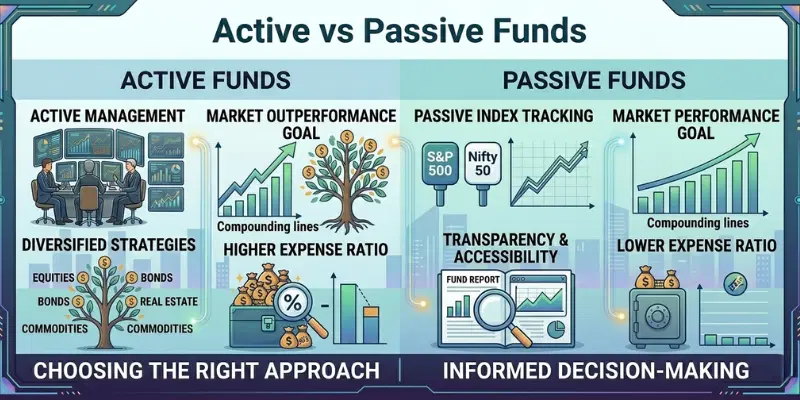
An active fund is a type of investment where a professional manager or a team of experts makes the decisions. Their job is to pick specific stocks or bonds they believe will go up in value. When you put money into an active fund, you are trusting this manager to study companies, read reports, and watch the news to find the “winners” before everyone else does.
The main goal here is to beat the market. For example, if the overall stock market goes up 10 percent in a year, the active manager wants to go up 15 percent. They want to perform better than average.
Think of a fantasy sports league. You do not just pick every player. You study the stats and pick the ones you think will score the most points. An active fund manager does the same thing with companies. They build a portfolio they believe will win.
However, this expertise comes at a cost. Because you have experts working for you, you have to pay them. This fee is called the expense ratio. Active funds have higher fees because you pay for the research, the trading, and the staff. These costs matter because they can eat into your profits over time. If a fund earns 8 percent but charges 2 percent in fees, you only keep 6 percent.
2. What is a Passive Fund?
A passive fund takes a completely different approach. Instead of trying to win, it tries to keep up with the market. These funds, often called index funds or ETFs, track a specific list of companies known as an “index.” For example, the S&P 500 is a list of the 500 biggest companies in the United States.
If you buy a passive fund that tracks the S&P 500, you are buying a tiny piece of all 500 companies. You do not pick which ones are best. You simply buy them all and hold on. The goal here is to match the market. If the index goes up 7 percent, your fund goes up roughly 7 percent. If it goes down 5 percent, your fund goes down 5 percent. You are basically riding along with the entire market.
Here is a simple way to look at it. Imagine you go to a grocery store and buy one of every fruit they have. You get apples, oranges, bananas, and grapes. You do not have to guess which fruit will taste the best tomorrow. You just own everything. A passive fund does the same with stocks.
Because no one is picking stocks or doing heavy research, passive funds are much cheaper. They have very low fees. There is also less buying and selling, which keeps trading costs down. Low fees mean more of your money stays invested and works for you over the long run.
3. Active vs. Passive: A Simple Comparison
Let us look at the two side by side to see how they differ. Active funds have human experts making decisions. Passive funds use a computer or follow an index. Active funds try to beat the market. Passive funds try to be the market. Active funds come with higher fees. Passive funds offer lower costs.
Active funds require constant research and monitoring. Passive funds are more of a “set it and forget it” approach. With active funds, the risk is that the manager might pick the wrong stocks. With passive funds, the risk is that the whole market might drop.
| Feature | Active Funds | Passive Funds |
| Goal | Beat the market | Match the market |
| Management | Human experts pick stocks | Computer follows an index |
| Cost | Higher expense ratios | Lower expense ratios |
| Trading | Buy and sell often | Rarely buy and sell |
| Risk Type | Manager might pick wrong stocks | Whole market might drop |
| Manager Role | Active decision maker | No decisions, just tracks |
| Best For | Specialized areas, small markets | Long-term, set-and-forget investors |
| Example | Fund manager picking 50 top stocks | S&P 500 Index Fund |
4. Which One Should You Pick?
So, which is better? The answer depends entirely on you and your goals.
You might prefer active funds if you want a professional to handle the tough decisions. They can be useful if you are interested in a specific area where a good manager might find hidden value, such as small companies or specific foreign markets. This option works best if you trust the manager’s skill and track record.
On the other hand, passive funds are often better if you are a beginner and want a simple start. They are ideal if you want to pay lower fees and believe that, over time, the market tends to go up. Many people choose passive funds because they do not want to watch their investments every single day.
Here is the honest truth that most financial experts share. For most people, most of the time, passive funds are the smarter choice. Why? Because it is very hard for active managers to beat the market year after year. And the high fees they charge make it even harder to come out ahead.
A good strategy is to put most of your money in a low-cost passive fund that tracks the whole market. Then, if you want to explore, you can put a small portion in an active fund. This gives you the best of both worlds.
You can buy both types through a brokerage account, a retirement account like a 401k, or an investing app on your phone. Apps like Vanguard, Fidelity, or even Robinhood make it easy to search for the fund name and buy shares with just a few clicks. Just make sure you understand any trading fees before you hit the buy button.
Yes, you can move your money whenever you want. This is called “switching funds” or “rebalancing your portfolio.” Just be aware that selling one fund to buy another might create a tax bill if the fund grew in value, so it is smart to do this inside a retirement account like a 401k or IRA to avoid taxes.
A popular passive fund might be called the “Vanguard 500 Index Fund” or the “Fidelity Total Market Index Fund.” These names usually include words like “Index,” “Market,” or “ETF” to show they are passive. If you see a fund named after a famous investor or using words like “Growth” or “Opportunity,” it is likely an active fund.
A popular passive fund might be called the “Vanguard 500 Index Fund” or the “Fidelity Total Market Index Fund.” These names usually include words like “Index,” “Market,” or “ETF” to show they are passive. If you see a fund named after a famous investor or using words like “Growth” or “Opportunity,” it is likely an active fund.
A popular passive fund might be called the “Vanguard 500 Index Fund” or the “Fidelity Total Market Index Fund.” These names usually include words like “Index,” “Market,” or “ETF” to show they are passive. If you see a fund named after a famous investor or using words like “Growth” or “Opportunity,” it is likely an active fund.
You can start with very little money these days. Many funds let you buy fractional shares, so you can invest as little as one dollar or five dollars. Some funds have minimums, but you can find plenty of options that welcome small starter amounts.
Your money is still safe. Fund companies are required by law to keep your investments separate from their own money. Even if the company closes, you still own the stocks or bonds inside the fund, and they will be transferred to another company or sold and returned to you.
Conclusion
So guys, in this article, we’ve covered Active vs Passive Funds in detail. Investing does not have to be complicated. Think back to the road trip example. Do you want a tour guide who makes all the decisions? Or do you prefer the simple highway that everyone uses?
Active investing is like hiring a guide. You might get there faster, but it costs more and success depends on the guide’s skill. Passive investing is like taking the highway. It is simple, cheap, and reliable. For long-term goals like retirement, the simple path is often the best.
So, what about you? Do you like the idea of having an expert pick stocks for you, or do you prefer to just buy the whole market and relax? Let us know in the comments below.
The content on Finance Calculatorz is intended for educational and informational purposes. It provides general guidance on financial topics and tools. Readers are encouraged to use the information to make informed decisions about their finances.

- Be Respectful
- Stay Relevant
- Stay Positive
- True Feedback
- Encourage Discussion
- Avoid Spamming
- No Fake News
- Don't Copy-Paste
- No Personal Attacks
- Be Respectful
- Stay Relevant
- Stay Positive
- True Feedback
- Encourage Discussion
- Avoid Spamming
- No Fake News
- Don't Copy-Paste
- No Personal Attacks
