Large Cap Mutual Funds: Features, Benefits and Risk
Published: 26 Apr 2026
Large companies make up a big part of the stock market and are known for their stable performance. This is why many investors prefer large cap mutual funds for steady returns. These funds invest in well-established companies with strong market presence. They may not grow very fast, but they often provide more stability compared to other options.
1. What Are Large Cap Companies?
Large cap companies are big and well-established businesses with a strong market presence. These companies are usually leaders in their industry and are trusted by many investors. In simple words, they are companies that have already grown and are now stable. This is why they play an important role in large cap mutual funds.
In the stock market, companies are divided into three main types: large cap, mid cap, and small cap. Large cap companies are the biggest among them. They have strong financial performance and a stable track record. For example, think of a company that is known across the country and has been operating successfully for many years. Many investors prefer the best large cap mutual funds because they invest in such reliable businesses and offer steady growth with lower risk.
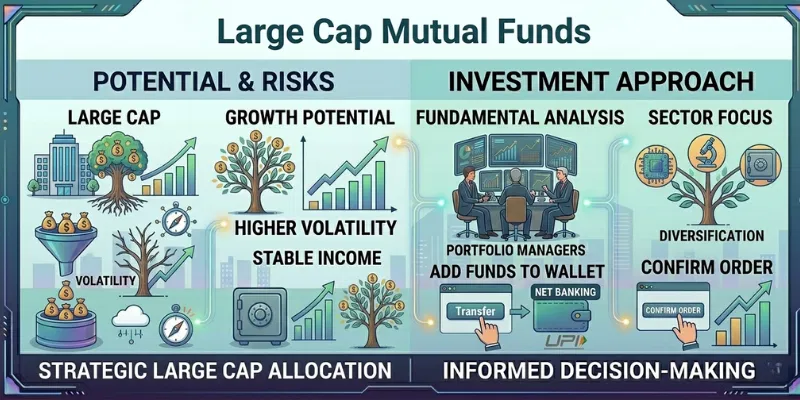
2. How Large Cap Mutual Funds Work
Large cap mutual funds invest mainly in big and well-established companies. Instead of choosing individual stocks, you invest your money in a fund that is managed by experts. The fund manager studies different companies and selects strong businesses with a stable track record. This helps reduce the risk of making wrong investment choices.
When you invest in these funds, your money is spread across multiple companies. This is called diversification, and it helps balance your investment. For example, if one company does not perform well, others may support the overall return. You can invest through a lump sum or start with a SIP, where you invest a fixed amount every month. Many beginners prefer this method because it is simple and easy to manage. Over time, large cap funds aim to provide steady and consistent returns.
3. Key Features of Large Cap Mutual Funds
Before you invest, it is important to understand the key features of large cap mutual funds. These features help you know why many investors prefer them for stable and steady returns.
1. Focus on Stable Companies
Large cap mutual funds invest in big and well-established companies. These companies already have a strong market presence and stable business models. This reduces the risk compared to smaller companies. Many investors choose the best large cap mutual funds because they trust these companies for consistent performance.
2. Professional Fund Management
These funds are managed by experienced fund managers who study market trends and company performance. They select companies based on stability, growth, and long-term potential. This makes it easier for investors who do not have time or knowledge to research on their own.
3. Diversification of Investment
Your money is invested across multiple large companies instead of one. This helps reduce the impact if one company performs poorly. Diversification makes the investment more balanced and stable over time.
4. Lower Risk Compared to Other Equity Funds
Large cap funds are considered less risky compared to mid and small cap options. This is because they invest in companies that are already established. While returns may be lower, the stability is higher.
5. Suitable for Long-Term Stability
These funds are best for investors who want steady growth over time. They may not give very high returns quickly, but they focus on consistent performance. This makes them suitable for long-term financial planning.
4. Why Do People Invest in Large Cap Mutual Funds?
Many investors choose large cap mutual funds because they want stability and steady returns. These funds invest in well-known companies that have a strong market position. This makes them less risky compared to other equity options. People who do not want sudden market shocks often prefer large cap funds for peace of mind.
For example, think of a company that has been running successfully for many years and continues to grow slowly. Investing in such companies can provide consistent returns over time. This is why many beginners explore the best large cap mutual funds when they want a safer start in the stock market.
Here are some common reasons why people invest in large cap funds:
- Stable returns compared to mid and small cap investments
- Lower risk due to strong and established companies
- Suitable for long-term financial planning
- Helps build a balanced and secure portfolio
- Managed by experienced professionals
- Easy to start through SIP for regular investing
- Ideal for investors who prefer safety over high risk
5. Benefits of Large Cap Mutual Funds
- Provide stable and consistent returns over time
- Lower risk compared to mid and small cap investments
- Invest in strong and well-established companies
- Managed by experienced fund managers
- Help build a balanced and secure investment portfolio
- Suitable for long-term financial goals
- Easy to invest through SIP for regular investing
6. Risks of Large Cap Mutual Funds
- Lower growth potential compared to mid and small cap funds
- Returns may be slower over time
- Affected by overall market conditions
- Limited opportunity for very high returns
- May not suit investors looking for aggressive growth
- Can show slow performance during certain market phases
- Requires patience for steady long-term results
7. Who Should Invest in Large Cap Mutual Funds?
Large cap mutual funds are suitable for investors who want stability and lower risk. These funds focus on big and trusted companies, which makes them a good choice for people who do not want high market volatility. If you are someone who prefers steady returns instead of sudden ups and downs, this category can fit your investment style. Many beginners start with the best large cap mutual funds because they are easier to understand and manage.
For example, if you are saving for long-term goals like retirement or building a secure future, these funds can help you stay consistent. They do not aim for very high returns, but they focus on reliability and steady growth. This makes them useful for investors who want peace of mind.
Here are the types of investors who can consider large cap mutual funds:
- Investors who prefer low to moderate risk
- Beginners who want a simple and safe investment option
- People looking for steady and consistent returns
- Individuals with long-term financial goals
- Investors who want to balance their portfolio
- Those who prefer regular investing through SIP
- People who want stability over high growth
8. Large Cap vs Mid Cap vs Small Cap
Large cap, mid cap, and small cap investments differ in size, risk, and growth. Large companies are stable and well-established, so they offer steady returns. Small companies can grow faster, but they carry higher risk. Mid-sized companies sit in the middle and offer a mix of both. This is why many investors compare these options before choosing large cap mutual funds or other categories.
For example, a large company may grow slowly but gives more stable returns. A small company may grow quickly but can also fall fast. A mid-sized company often shows steady growth with some risk. Your choice depends on how much risk you can handle and how long you want to stay invested.
Key Differences
- Large cap companies are stable, mid cap companies focus on growth, and small cap companies offer high growth with higher risk
- Large cap mutual funds have lower risk, while mid cap funds have moderate risk and small cap funds have higher risk
- Growth potential is highest in small cap, balanced in mid cap, and steady in large cap
- Market changes affect small cap more, mid cap moderately, and large cap less
- Large cap funds are suitable for long-term stability, while mid and small cap focus more on growth
- Small cap needs high patience, mid cap needs moderate patience, and large cap needs steady long-term patience
- Many investors choose large cap funds for safety and stability
9. How to Invest in Large Cap Mutual Funds
Investing in large cap mutual funds is simple and suitable for beginners. You do not need deep market knowledge to start. First, choose a trusted investment platform or app where you can explore different options. Then, compare a few funds based on their past performance, fund manager experience, and stability. Many investors look at the best large cap mutual funds that have shown consistent returns over time.
You can invest in two main ways. One is a lump sum, where you invest a fixed amount at once. The other is through a SIP, where you invest a small amount every month. SIP is a good option because it spreads your investment over time and reduces the impact of market changes. Once you invest, stay consistent and allow your money to grow steadily.
Simple Steps to Start
- Choose a reliable investment platform or app
- Select a fund based on performance and stability
- Decide between lump sum or SIP investment
- Start with an amount you are comfortable with
- Track your investment from time to time
- Stay invested for the long term
- Avoid making quick decisions during market ups and downs
10. Tips Before Investing
Before you invest in large cap funds, it is important to follow some simple tips. These can help you make better decisions and avoid common mistakes.
- Do not invest all your money in one type of fund
- Always check the fund’s past performance
- Start with a small amount if you are new
- Be patient and focus on long-term growth
- Avoid panic selling during market drops
- Prefer SIP for steady investing
- Match your investment with your financial goals
11. Best large cap mutual funds in India 2026
- Nippon India Large Cap Fund
- ICICI Prudential Large Cap Fund
- HDFC Large Cap Fund
- SBI Large Cap Fund
- Kotak Large Cap Fund
- Invesco India Largecap Fund
- DSP Large Cap Fund
- Aditya Birla Sun Life Large Cap Fund
12. Best large cap mutual funds in US 2026
- Vanguard 500 Index Fund (VFIAX)
- Fidelity 500 Index Fund (FXAIX)
- Schwab S&P 500 Index Fund (SWPPX)
- Fidelity ZERO Large Cap Index Fund (FNILX)
- Fidelity Blue Chip Growth Fund (FBGRX)
- Fidelity Large Cap Stock Fund (FLCSX)
- Vanguard Growth and Income Fund (VQNPX)
- BlackRock Advantage Large Cap Growth Fund (BMCAX)
You should first look at your risk level and financial goals. If you prefer stable returns and want to avoid high risk, these funds can be a good fit. Many beginners start with the best large cap mutual funds for this reason.
You can begin with a small amount and avoid putting all your money at once. Starting a SIP helps you invest regularly and stay consistent. This method is simple and works well for most new investors.
These funds invest in big and established companies that grow slowly. Their focus is on stability rather than fast growth. This is why returns are more consistent but not very high.
Large cap investments work best over a longer period. Most investors stay invested for at least 3 to 5 years or more. This helps you benefit from steady growth over time.
Avoid expecting quick profits or reacting to short-term market changes. Do not invest without understanding your goals. Stay patient and focus on long-term results.
You should check past performance, fund manager experience, and consistency. Compare a few options before making a decision. This helps you select from the best large cap mutual funds more confidently.
For most people, regular investing is easier and safer. It spreads your investment and reduces the effect of market ups and downs. A SIP also helps you stay disciplined and consistent.
Conclusion
So guys, in this article, we’ve covered large cap mutual funds in detail. These funds are a good choice if you want stable and steady growth with lower risk. In my opinion, beginners should start with a small amount and use sip to stay consistent. This approach helps you manage market changes easily. Now take the next step, review your options, and start investing today.
The information and calculators on Finance Calculatorz are provided for educational purposes only. Calculator results are estimates and may not always be fully accurate. This content is not financial, investment, tax, or legal advice. Please consult a qualified professional before making any financial decision.



- Be Respectful
- Stay Relevant
- Stay Positive
- True Feedback
- Encourage Discussion
- Avoid Spamming
- No Fake News
- Don't Copy-Paste
- No Personal Attacks
- Be Respectful
- Stay Relevant
- Stay Positive
- True Feedback
- Encourage Discussion
- Avoid Spamming
- No Fake News
- Don't Copy-Paste
- No Personal Attacks
