What are Hybrid Funds? Working and Types
Published: 17 Mar 2026
Do you want to grow your money but feel confused about where to put it? Stocks offer high returns but come with risk. Debt fund are safer but grow slowly. You want both. You want balance. Many investors feel this way. They want the best of both worlds. They want some growth and some safety.
This is where hybrid funds come in. They do the balancing for you. One fund holds both stocks and debt. It is like a complete meal in one bowl.
In this guide, you will learn:
- What a hybrid fund really is.
- How these funds make money.
- The different types available.
- How to pick the right one for you.
Let us break it down simply.
1. What is a Hybrid Fund?
Imagine you want a healthy meal. You need protein, vegetables, and some carbs. You could cook three different dishes. That takes time and effort. Or you could buy a ready-made meal that has everything mixed together in the right amounts.
Hybrid fund work the same way.
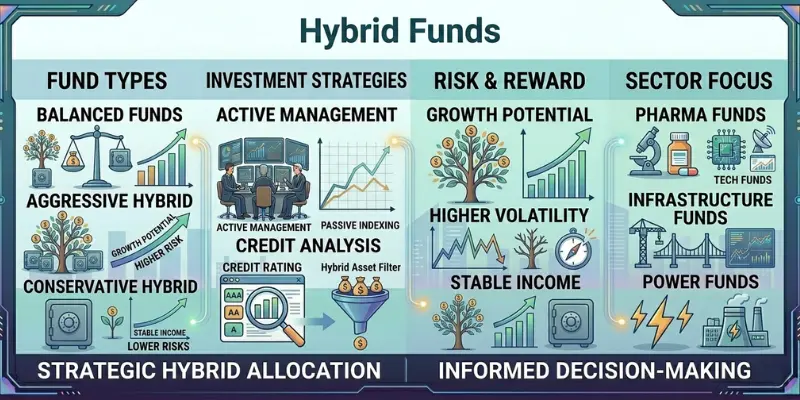
A hybrid fund is a single fund that invests in both stocks and debt. Stocks give you growth. Debt gives you stability. The fund manager decides how much of each to hold.
So, when you buy one hybrid mutual fund, you get a balanced portfolio instantly. You do not need to buy two or three different funds. It is all in one place.
2. How Do Hybrid Funds Make You Money?
Because hybrid fund hold two different things, they make money in two ways.
1. Growth from the Stock Part
The stock portion of the fund works just like equity funds. You own small pieces of companies. When those companies do well, their stock prices go up. The value of your fund goes up too.
Over many years, this is what helps your money grow faster than inflation.
2. Income from the Debt Part
The debt portion of the fund works just like lending money. The fund lends to governments and companies. These borrowers pay interest. That interest flows back to you as regular income.
Some hybrid pooled fund pay this income out to you every month. Others reinvest it to buy more shares.
3. The Balance Effect
Here is the key point. When stocks have a bad year, the debt part helps cushion the fall. You do not lose as much as someone who owns only stocks. When stocks have a good year, you still share in the gains.
It is a smoother ride.
3. Types of Hybrid Funds
Not all hybrid fund are the same. They mix stocks and debt in different amounts. The mix depends on the fund’s goal.
1. Aggressive Hybrid Funds
These funds put more money in stocks and less in debt. Usually, they hold about 65% to 80% in stocks. The rest goes into debt.
These are for people who want growth but also want some safety. They are willing to take some risk for higher returns. The stock part drives growth. The debt part provides a cushion.
2. Conservative Hybrid Funds
These funds do the opposite. They put more money in debt and less in stocks. Usually, they hold about 75% to 90% in debt. The rest goes into stocks.
These are for people who want safety first. They want regular income from the debt part. They also want a little taste of stock growth, but not too much risk.
3. Balanced Hybrid Funds
These funds sit right in the middle. They try to keep an equal mix, often 50% stocks and 50% debt. The fund manager adjusts the mix based on market conditions.
These are for people who want a true balance between growth and safety.
4. Multi-Asset Funds
These fund go even wider. They invest in stocks, debt, and also other things like gold or real estate. This gives you even more diversification.
These are for people who want everything in one fund.
4. Pros of Hybrid Funds
Why do millions of investors choose hybrid mutual funds? There are several good reasons.
1. One Fund Does It All
You do not need to be an expert. You do not need to buy three different fund. You buy one fund, and you are done. The fund manager handles the rest.
This is perfect for beginners. It is also great for busy people who do not have time to manage their investments.
2. Automatic Rebalancing
Here is a smart feature. When stocks go up a lot, the stock part of your fund becomes bigger. This makes your fund riskier than you planned. The fund manager automatically sells some stocks and buys more debt to bring the mix back to normal.
This is called rebalancing. It happens without you doing anything. It keeps your risk level steady.
3. Lower Volatility
Volatility is a fancy word for “ups and downs.” Hybrid funds have smaller ups and downs than pure stock funds. The debt part acts like a shock absorber.
If the stock market drops 10%, a hybrid pooled fund with 50% stocks might only drop 5%. That feels much better when you check your account.
4. Good for All Goals
Different hybrid funds work for different goals.
- Saving for retirement in 20 years? An aggressive hybrid fund works well.
- Already retired and need income? A conservative hybrid fund is better.
- Not sure what you want? A balanced fund is a safe choice.
5. Cons of Hybrid Funds
Hybrid fund are balanced, but they are not risk-free. You need to know the risks.
1. Stock Market Risk
The stock part of the fund will go up and down. If the stock market has a bad year, your fund will lose value. It will lose less than a pure stock fund, but it will still lose.
You must be okay with some ups and downs.
2. Interest Rate Risk
The debt part of the fund is affected by interest rates. When rates go up, bond prices go down. This can pull the fund value down a little.
For conservative hybrid funds with lots of debt, this matters more.
3. Fund Manager Risk
The manager decides how to mix stocks and debt. If they make a bad choice, your returns could suffer. Some funds let the manager change the mix a lot. Others follow a fixed formula.
Always check how much freedom the manager has.
4. Not the Best for Pure Goals
If you want maximum growth, pure stock fund are better. If you want maximum safety, pure debt funds are better. Hybrid fund trade some growth and some safety for balance.
You get good growth and good safety, but not the best of either.
6. Who Should Use Hybrid Funds?
Hybrid fund are perfect for certain types of investors.
- If you are a beginner. You do not know much about investing. You want something simple. Buy one hybrid fund and you are set.
- If you want a set-it-and-forget-it approach. You do not want to check your account every day. You want a fund that handles everything. Hybrid funds do that.
- If you are saving for a medium-term goal. A goal that is five to ten years away. Like a down payment on a house or your child’s college fund.
- If you want balance in your life. Some people do not like big swings in their money. They prefer a smoother ride. Hybrid fund give them that.
7. How to Choose the Right Hybrid Fund
Picking the right hybrid mutual fund is not hard. Follow these steps.
Step 1: Know Your Goal
Ask yourself: Why am I investing?
- For growth over many years? Choose aggressive hybrid.
- For income and some growth? Choose conservative hybrid.
- For a true balance? Choose balanced hybrid.
Step 2: Check the Mix
Look at how much the fund puts in stocks versus debt. Make sure it matches your comfort level. If 80% stocks feels too scary, pick a fund with less.
Step 3: Look at Past Performance
Do not chase the hottest fund. But do check how the fund performed in both good and bad years. Did it hold up well when the market dropped? That shows good management.
Step 4: Keep Costs Low
Every fund charges fees. These are called expense ratios. Lower fees mean more money stays in your pocket. Compare fees between similar fund and pick the cheaper one.
Step 5: Start Small
You do not need a lot of money. Many funds let you start with $100 or less. You can always add more later.
8. Tips for Success
Here are a few tips to help you get the most from hybrid funds.
- Stay invested. Do not sell when the market drops. Hybrid fund are built to handle ups and downs. Give them time to work.
- Reinvest your income. If you do not need the cash now, reinvest it. This buys more shares and helps your money grow faster.
- Use tax-smart accounts. If possible, hold hybrid fund in a retirement account like an IRA. This helps you delay or avoid taxes on the gains.
- Review once a year. Look at your fund once a year. Make sure it still matches your goal. If your life changes, you may need a different fund.
Yes, they are perfect for beginners. You get a balanced portfolio in one fund. You do not need to learn how to mix stocks and debt yourself. The fund manager does all the work for you. Just pick one fund and start investing.
Yes, you can lose money, especially if the stock market drops. But you will lose less than someone who owns only stocks. The debt part helps cushion the fall. Over long periods, hybrid funds have a good history of recovering from losses.
It depends on the fund. Some hybrid pooled funds pay income every month. Others pay once a year. Some reinvest all income automatically. Check the fund details before you buy. If you want monthly cash, look for a fund that offers it.
Aggressive hybrid funds put more money in stocks, usually 65% to 80%. They aim for higher growth. Conservative hybrid funds put more money in debt, usually 75% to 90%. They aim for safety and regular income. Choose based on your risk comfort.
No, one good hybrid mutual fund is enough. Buying multiple hybrid funds just gives you more of the same mix. It does not add much benefit. Pick one fund that matches your goal and put your money there.
It depends on where you live and what type of account you use. In a regular account, the stock part may have tax advantages. The debt part is taxed like regular income. For best tax results, hold hybrid funds in a retirement account.
Very little. Many fund companies let you start with $100 or even less. Some have no minimum at all. You can start small and add more over time. The important thing is to start, not how much you start with.
Conclusion
Hybrid funds offer a simple way to balance growth and safety. They hold both stocks and debt in one fund. The stocks give you growth. The debt gives you stability. The fund manager handles the rest.
Remember the key points:
- One fund gives you a complete portfolio.
- Different mixes suit different goals.
- They offer a smoother ride than pure stock funds.
- They are perfect for beginners and busy people.
If you want a simple, balanced way to invest, hybrid mutual funds are a great choice. Pick one that matches your goal, start small, and let time do its work.
The information and calculators on Finance Calculatorz are provided for educational purposes only. Calculator results are estimates and may not always be fully accurate. This content is not financial, investment, tax, or legal advice. Please consult a qualified professional before making any financial decision.



- Be Respectful
- Stay Relevant
- Stay Positive
- True Feedback
- Encourage Discussion
- Avoid Spamming
- No Fake News
- Don't Copy-Paste
- No Personal Attacks
- Be Respectful
- Stay Relevant
- Stay Positive
- True Feedback
- Encourage Discussion
- Avoid Spamming
- No Fake News
- Don't Copy-Paste
- No Personal Attacks
