What is Equity Funds? Types, Pros and Cons
Published: 13 Mar 2026
Have you ever wanted to own a piece of a big company like Apple or Coca-Cola? Maybe you thought about buying stock, but it felt too expensive or too risky.
You are not alone. Many people want to invest, but they do not know where to start. Buying stock in just one company can feel like a gamble. What if that company has a bad year?
This is where Equity funds come in. They offer a simpler way to own stocks.
In this guide, you will learn:
- What an equity fund really is.
- How these funds make money.
- The good parts and the risks.
- Simple steps to buy your first fund.
Let us break it down so it is easy to understand.
1. What is an Equity Fund?
Imagine you go to a farmer’s market. You want to buy fruit, but you cannot decide. Apples look good, but what if they are sour? Oranges are nice, but peeling them is hard.
Now, imagine you and nine friends pool your money together. With that combined money, you buy a big basket of mixed fruit. The basket has apples, oranges, bananas, and grapes. You all share the basket. You own a little piece of every fruit.
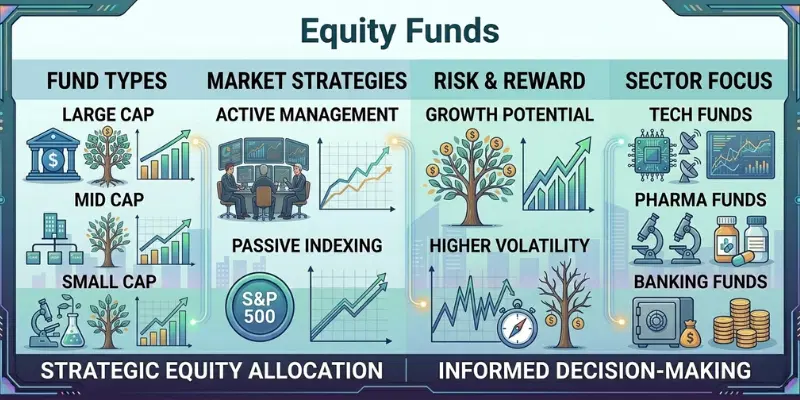
An equity fund works the same way:
Instead of fruit, the basket holds stocks. Stocks are small pieces of companies. When you put your money into an equity fund, you join many other people. Together, you all own a big basket of different companies.
You do not pick the companies yourself. A professional does that for you.
2. How Do Equity Funds Make You Money?
This is the fun part. How does a basket of stocks put money in your pocket?
There are two main ways.
1. The Value of Your Shares Goes Up
This is called “capital appreciation.” It is a fancy term for “the price increases.”
Think about the fruit basket. If bananas become very popular and the price of bananas goes up, your whole fruit basket becomes more valuable. The same happens with stocks.
If the companies in your fund do well, their stock prices tend to rise. When that happens, the value of your fund shares goes up too.
You can then sell your shares later for more than you paid.
2. Companies Pay You Cash
Some companies share their profits with the people who own their stock. These payments are called “dividends.”
Let us use a real-life example.
Example: The Soda Company
Imagine an equity fund that owns stock in a big soda company.
- The soda company has a great summer. They sell millions of cans of soda.
- They make a lot of profit.
- To say thank you to their owners (the stockholders), they send out a cash payment. This is a dividend.
- The equity pooled fund receives cash from the soda company, plus cash from all the other companies in the basket.
- The fund then adds up all that cash and sends you a small piece of it.
You get paid just for owning the fund. It is like the companies are saying “thank you” for being a part-owner.
3. Pros of Equity Funds
Why do millions of people use equity mutual funds instead of buying stocks themselves? There are some very good reasons.
1. You Are Not Alone
Picking stocks is hard work. You have to read news, study companies, and understand the market. Most people do not have time for that.
When you use an equity fund, a professional fund manager does the hard work. This person spends all day studying companies. They decide which stocks to buy and which to sell.
You get an expert working for you, even if you only have a small amount of money.
2. Don’t Put All Your Eggs in One Basket
You have probably heard this saying before. It is the most important rule of investing.
If you buy stock in just one airline company, and people stop flying, you could lose a lot of money. All your eggs are in one basket.
Equity funds fix this problem. Because the fund owns many companies, you are protected if one does poorly.
For example, a fund might own:
- 10% in a tech company like Microsoft.
- 10% in a retail company like Walmart.
- 10% in a healthcare company like Pfizer.
- And 70% in many other different companies.
If the tech company has a bad year, but the retail and healthcare companies do well, your fund will probably still be okay. The good companies balance out the bad one.
This is called “diversification.” It is a fancy word for not putting all your eggs in one basket.
3. You Can Start Small
This is one of the best parts about equity pooled funds.
Buying stock in a single company can cost a lot. One share of a popular company might cost hundreds or even thousands of dollars. To build a diversified basket of ten different companies, you would need a lot of cash.
With an equity mutual fund, you can start with a small amount. Many funds let you start with $50 or $100.
With that small amount, you instantly own a tiny piece of every company in the fund. You get diversification without needing a lot of money.
4. It is Easy to Reinvest
When your fund pays you dividends (that cash payment we talked about), you have a choice. You can take the cash and spend it.
Or, you can tell the fund to use that cash to buy more shares automatically. This is called “reinvesting.”
Reinvesting is powerful. It is like planting seeds from your fruit to grow more fruit. Over time, this helps your money grow faster.
4. Cons of Equity Funds
Nothing in investing is perfect. Equity funds have risks too. You need to know these before you start.
1. The Market Goes Up and Down
This is the number one thing to remember. The stock market does not go up in a straight line. Some years it goes up a lot. Some years it goes down.
When the market goes down, the value of your equity funds will go down too. This is normal. It happens to everyone.
If you look at your account on a down day, do not panic. Think of it like your house. The value of your house goes up and down over time based on the market. But you still live in it. You do not sell it just because prices drop one month.
2. You Can Lose Money
This is the hard truth. If you sell your fund shares when the market is down, you will lose money.
For example, let us say you buy a fund for $100 per share. The market has a bad year, and the share price drops to $70. If you sell right then, you lose $30 for every share you owned.
But if you wait, the market might recover. The price might go back up to $120. You only lose money if you sell at the wrong time.
3. It is Not for Short-Term Goals
Because the market goes up and down, equity mutual funds are best for long-term goals.
What is long-term? Usually, it means five years or more. Ideally, you should plan to keep your money in the fund for ten years or longer.
If you need money next year for a car or a house down payment, an equity fund is probably not the right choice. If the market drops right when you need the cash, you could be in trouble.
These funds are great for goals like retirement, which is many years away.
5. Types of Equity Funds
Not all equity funds are the same. They come in different flavors. The main difference is the size of the companies they buy.
1. Large-Cap Funds
These funds buy stocks in very big, well-known companies. Think of names like Apple, Microsoft, or McDonald’s. These are the giants of the business world.
Large companies tend to be more stable. They do not grow as fast as small companies, but they also do not fall as hard.
2. Mid-Cap Funds
These funds buy stocks in medium-sized companies. You might not know their names yet, but they are growing.
Mid-sized companies offer a balance. They have more room to grow than the big giants, but they are more established than the tiny startups.
3. Small-Cap Funds
These funds buy stocks in smaller, younger companies. These companies have the potential to grow very fast.
However, they are also riskier. Small companies can go out of business more easily than large ones. These funds are for people who are comfortable with higher risk for the chance of higher reward.
4. International Funds
These funds buy stocks in companies outside your home country. You can own companies in Europe, Asia, or South America.
This gives you even more diversification. Different countries’ markets go up and down at different times.
6. How to Buy Your First Equity Fund
Are you ready to start? The process is simpler than you might think. Here are the steps.
Step 1: Open an Account
You cannot just walk into a store and buy an equity fund. You need a special account.
Most people use a “brokerage account.” This is like a bank account for investments. You can open one online with companies like Vanguard, Fidelity, or Charles Schwab.
If you are saving for retirement, you might use a 401(k) through your job or an IRA account. These accounts have tax benefits.
Step 2: Pick a Fund
This is where people get stuck. There are thousands of funds to choose from. Do not let this scare you.
For a beginner, a great choice is an “index fund.” This type of fund does not try to pick winning stocks. It simply buys a little bit of every company in a major market index, like the S&P 500.
The S&P 500 is a list of the 500 largest companies in the United States. When you buy an S&P 500 index fund, you instantly own a tiny piece of all 500 companies.
It is simple, cheap, and it works well over time.
Step 3: Decide How Much to Invest
You do not need a lot of money. Decide on an amount that feels comfortable.
Many experts suggest starting with a small, automatic investment. You can set it up so your account takes $50 from your bank account every month and buys more shares of the fund.
This is called “dollar-cost averaging.” You buy a little bit at a time, no matter what the price is. Over time, this smooths out the ups and downs of the market.
Step 4: Be Patient
This is the hardest step for most people. Once you buy, the best thing to do is often nothing.
Do not check the price every day. Do not panic when the news says the market is crashing. Crashes happen. They always have. And every time, the market has recovered and gone on to reach new highs.
Give your money time to grow. The real magic of equity mutual funds happens over many years and decades.
7. Tips for Success
Here are a few final pieces of advice to help you on your journey.
- Start now. The best time to plant a tree was 20 years ago. The second best time is today. The same is true for investing. The sooner you start, the more time your money has to grow.
- Keep costs low. Every fund charges fees for managing your money. These are called “expense ratios.” Look for funds with low fees. More money in fees means less money growing for you.
- Do not try to time the market. This means do not try to guess when the market will go up or down. Even the experts get it wrong. Just buy regularly and hold on.
- Ignore the noise. The news will always have scary stories about the market. Ignore them. Stick to your plan.
No investment is 100% safe. Equity funds are safer than buying one single stock because you own many companies. But the value will still go up and down with the market. If you need your money next month, a savings account is safer. For long-term goals, these funds are a good choice.
Yes, usually. When your fund pays you dividends, you may owe taxes on that cash. If you sell your shares for a profit, you may owe taxes on that gain as well. The rules depend on where you live and what type of account you use. A retirement account like a 401(k) can help you delay or avoid some taxes.
Yes, you can sell your shares and get your cash anytime the market is open. This is called “liquidity.” It usually takes a day or two for the money to show up in your bank account. Just remember that if you sell when the market is down, you will get back less than you put in.
They are very similar. Both hold a basket of stocks. The main difference is how you buy them. You buy an equity mutual fund directly from the fund company at a set price once a day. You buy an ETF (exchange-traded fund) like a stock, through a brokerage, and the price changes throughout the day. For a beginner, either one is a fine choice.
An expense ratio is the fee the fund charges you for managing your money. Think of it like a small monthly membership fee. It is shown as a percentage. If a fund has a 0.10% expense ratio, you pay $1 per year for every $1,000 you have invested. Always look for funds with low expense ratios so more of your money stays invested.
Start by asking two questions. First, how long do you plan to invest? If it is more than five years, equity funds are a good fit. Second, how do you feel about risk? If big drops in the market will keep you up at night, you might want a more balanced fund that also owns bonds. If you are unsure, a simple S&P 500 index fund is a great place to begin.
Conclusion
Equity funds are one of the best tools for regular people to build wealth over time. They let you own a piece of many companies without needing to be a stock market expert.
Remember the key points:
- An equity fund is a basket of many different stocks.
- You make money when the stocks go up in value or when they pay dividends.
- The main benefits are professional management, diversification, and low cost to start.
- The main risk is that the value goes up and down. You only lose if you sell at the wrong time.
Investing is a journey, not a race. Start small, think long-term, and stay patient.
The information and calculators on Finance Calculatorz are provided for educational purposes only. Calculator results are estimates and may not always be fully accurate. This content is not financial, investment, tax, or legal advice. Please consult a qualified professional before making any financial decision.


- Be Respectful
- Stay Relevant
- Stay Positive
- True Feedback
- Encourage Discussion
- Avoid Spamming
- No Fake News
- Don't Copy-Paste
- No Personal Attacks
- Be Respectful
- Stay Relevant
- Stay Positive
- True Feedback
- Encourage Discussion
- Avoid Spamming
- No Fake News
- Don't Copy-Paste
- No Personal Attacks
